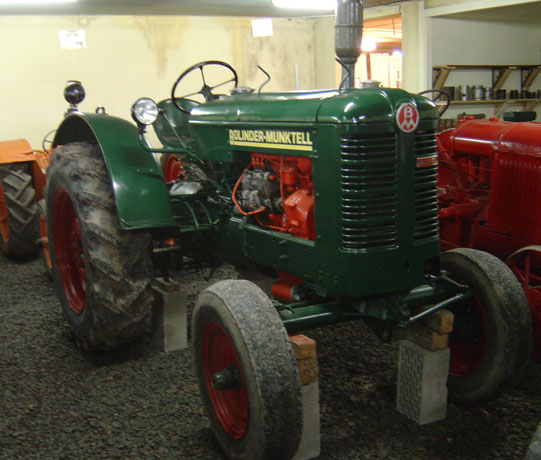
Bolinder-Munktell farm tractors are a cornerstone of Swedish agricultural machinery history, combining the innovation of Munktell and the engine expertise of Bolinder. The two firms merged in 1932 to form Bolinder-Munktell (BM), setting the stage for decades of precision-built tractors. Initially independent, the company attracted interest from Volvo in the 1940s, leading to a full acquisition by 1950. The BM name held strong until the 1970s, when Volvo transitioned to branding their tractors as Volvo BM. Eventually, the tractor division was sold to Valmet, but the Bolinder-Munktell influence remains significant.
The tractors produced during the BM years became known for their robust construction, reliability in Nordic climates, and mechanical simplicity. Whether in the form of the compact BM-10 or the more powerful BM-20 and BM-21, these machines found favor among farmers across Sweden and beyond.
Notable Bolinder-Munktell Tractor Models
| Model | Horsepower | Years Produced |
|---|---|---|
| 25 | 32 hp | 1934–1938 |
| 30-40 | 40 hp | 1913–1915 |
| 36 | 41 hp | 1953–1954 |
| 55 | 46 hp | 1953–1959 |
| 230 | 29 hp | 1955–1961 |
| BM-10 | 20 hp | 1947–1952 |
| BM-20 | 41 hp | 1944–1950 |
| BM-21 | 43 hp | 1951–1952 |
These tractors showcased forward-thinking designs and dependable diesel engines that powered Scandinavian agriculture through post-war reconstruction and industrial growth.
Why Bolinder-Munktell Tractors Are Still Admired
- Mechanical simplicity and ease of repair
- Reliable diesel engines built for cold climates
- Solid metal construction, minimal electronics
- Legacy models still in use and collected today
- Historical link to Volvo and Valmet tractor development
Collectors and vintage tractor enthusiasts value Bolinder-Munktell models for their engineering heritage and their role in advancing European farming mechanization.
Final Thoughts
Bolinder-Munktell farm tractors represent a proud era of Swedish engineering in agriculture. As the forerunners of Volvo BM and Valmet, these tractors helped define quality standards in farming machinery across Scandinavia and Europe. Today, they continue to inspire admiration among restorers, collectors, and anyone interested in agricultural history.