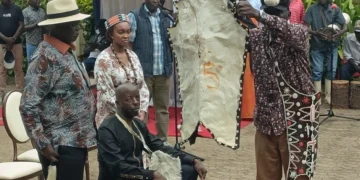
The Banyala community, a sub-group of the Luhya found along the shores of Lake Victoria and the mouth of River Nzoia in Budalangi, western Kenya, maintains a distinct cultural identity shaped by geography, language exchange, and long-standing oral traditions. The community borders the Samia and the Luo of Alego, creating a unique cultural zone where interaction between groups remains strong.
In border areas between Busia and Siaya counties, linguistic exchange is common. Many Banyala residents speak both Lunyala and Dholuo, while their Luo neighbours also demonstrate similar bilingual fluency. This interaction has created a setting where distinguishing between the two communities can be difficult in everyday social spaces such as markets and trading centres.
Banyala Community and Cross-Border Identity
The Banyala community is widely distributed across Budalangi, with settlements concentrated near Lake Victoria and River Nzoia. However, another group identified as Abanyala is also found in Kakamega, often referred to as Abanyala ba Ndombi. The historical movement that led to this separation remains unclear in available accounts.
Along the Busia-Siaya border, places such as Nyadorera and Rwambwa serve as interaction points where Banyala and Luo communities engage in trade and social exchange. In these areas, residents often switch between languages with ease.
The Luo refer to the Banyala as Manyala, while the Banyala refer to the Luo as Abanyolo, reflecting mutual recognition and coexistence.
Banyala Community and Sumba Island Traditions
A key element of Banyala cultural heritage is the belief in Sumba Island, a small granite island rising from Lake Victoria a few miles from the Bunyala shoreline. The island holds spiritual significance within the Banyala community.
According to oral traditions, the island is associated with supernatural beings known as “Sumba,” described as dwarfish and invisible entities that could reveal themselves at will. These beings were believed to possess influence over natural and social events.
Narratives recount encounters with these beings. In one account, a visitor who invoked the Sumba shared a meal with them but was warned not to disclose the experience. After breaking this oath, he was reportedly found dead the following day.
Banyala Community Rituals and Offerings
The Banyala community regarded the Sumba with reverence and caution. As a result, the island became a site for rituals and offerings aimed at appeasing these entities.
When faced with challenges such as poor harvests, lack of rainfall, or repeated misfortune, community leaders organized offerings. These included cattle, goats, beer, cooking pots, and tobacco pipes, which were left on the island.
In cases of family misfortune, such as the loss of children, individuals were required to take at least two goats. One was sacrificed on arrival, while the other was left as an offering.
Role of Sumba Priests
Historical accounts indicate that a group of about fifteen individuals, described as priests of Sumba, resided on the island. They were responsible for managing offerings and maintaining knowledge of the rituals associated with the island.
Due to the island’s limited space, some of the cattle offered were transferred to the mainland. These animals were integrated into local herds but remained distinct and were not to be sold or slaughtered.
Even during conflicts with neighbouring communities, these cattle were considered sacred and were not taken as war spoils.
Cultural Significance and Social Impact
The Sumba Island traditions illustrate how spiritual beliefs influenced social organization within the Banyala community. These practices shaped responses to uncertainty, including environmental challenges and personal misfortune.
At the same time, the bilingual nature of the Banyala community highlights the role of geography in shaping identity. Living at the intersection of Luhya and Luo cultural zones has fostered adaptability and shared cultural practices.
Outlook on Banyala Heritage
The Banyala community continues to reflect a blend of linguistic interaction and traditional belief systems. While modernization has influenced daily life, elements of oral tradition and identity remain part of the community’s historical narrative.
Researchers and historians continue to examine such traditions to better understand cultural continuity and regional dynamics in western Kenya.