Apple acquisitions show how one of the world’s most valuable technology companies built many of its most important products and features. Apple is famous for designing hardware, software, chips, services, and consumer devices in-house, but the company has also bought many businesses to strengthen its ecosystem.
Unlike some technology giants, Apple rarely buys large consumer brands and keeps them operating independently. Instead, Apple often buys smaller technology companies, absorbs their teams, and integrates their ideas into products such as iPhone, Mac, Apple Watch, AirPods, Apple Music, Apple Pay, Face ID, Touch ID, Siri, Vision Pro, and Apple Silicon.
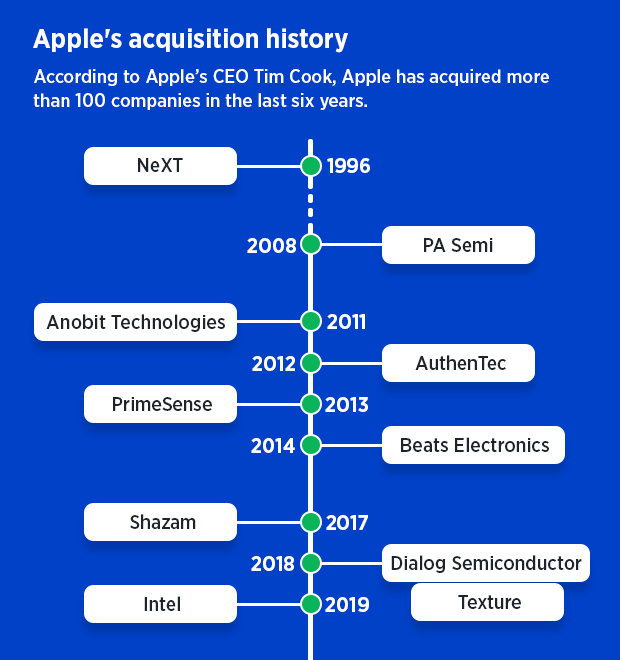
Apple’s biggest acquisition remains Beats Electronics, the $3 billion deal that helped Apple expand in headphones and music streaming. Other acquisitions were smaller but arguably just as important. NeXT brought Steve Jobs back to Apple and helped shape the operating system foundation behind macOS, iOS, iPadOS, watchOS, and tvOS. PA Semi strengthened Apple’s chip design ambitions. AuthenTec helped create Touch ID. PrimeSense contributed to 3D sensing and Face ID. Shazam improved music discovery. Intel’s smartphone modem business supported Apple’s long-term wireless chip strategy.
This guide explains Apple acquisitions, what Apple owns, the company’s biggest deals, and how these purchases helped shape Apple’s modern business.
What Are Apple Acquisitions?
Apple acquisitions are companies, technologies, patents, teams, or assets that Apple has bought to support its products and long-term strategy.
An acquisition happens when one company buys another company. Apple may buy a business because it wants:
- Engineering talent
- Software technology
- Hardware expertise
- Chip design capability
- Artificial intelligence tools
- Music technology
- Biometric security
- Camera technology
- Display technology
- Health technology
- Mapping tools
- Payment technology
- Augmented reality expertise
Apple usually keeps its acquisition strategy quiet. Many deals are small and undisclosed. Apple often confirms acquisitions with a short statement, but it may not explain how the technology will be used.
How Apple Became One of the World’s Largest Companies
Apple was founded in 1976 by Steve Jobs, Steve Wozniak, and Ronald Wayne. The company became famous for early personal computers such as the Apple I and Apple II.
Apple later struggled during parts of the 1990s. One of the most important turning points came when Apple acquired NeXT in 1996. NeXT brought Steve Jobs back to Apple and gave the company software technology that helped rebuild its operating system strategy.
Apple later launched products that transformed the company, including:
- iMac
- iPod
- iTunes
- iPhone
- App Store
- iPad
- Apple Watch
- AirPods
- Apple Silicon Macs
- Apple Music
- Apple TV+
- Vision Pro
Acquisitions supported many of these shifts. Apple’s growth came from internal innovation, but strategic acquisitions helped fill gaps, add talent, and speed up product development.
What Does Apple Own?
Apple owns many acquired technologies and brands, although most are integrated into Apple’s products rather than run as separate public brands.
Major Apple-owned or Apple-acquired businesses include:
| Company or Asset | Main Area |
|---|---|
| Beats Electronics | Headphones and audio |
| Beats Music | Music streaming foundation |
| Intel smartphone modem business | Wireless modem technology |
| Shazam | Music recognition |
| NeXT | Operating system foundation |
| PrimeSense | 3D sensing |
| AuthenTec | Fingerprint security |
| PA Semi | Chip design |
| Anobit | Flash storage technology |
| Texture | Digital magazine service |
| Dialog Semiconductor assets | Power management technology |
| Siri | Voice assistant technology |
| Mobeewave | Mobile payments |
| Dark Sky | Weather forecasting |
| Pixelmator | Image editing software |
| Beddit | Sleep tracking |
| NextVR | Virtual reality video |
| Xnor.ai | Edge artificial intelligence |
Many of these names no longer operate as separate consumer brands. Their technology became part of Apple’s ecosystem.
Why Apple Buys Companies
Apple buys companies for several strategic reasons.
To Improve Products
Apple often buys companies to improve iPhone, Mac, iPad, Apple Watch, AirPods, Vision Pro, and services.
For example, AuthenTec helped Apple build Touch ID, while PrimeSense contributed to 3D sensing technology.
To Acquire Talent
Apple often acquires engineering teams with deep technical knowledge.
This is common in areas such as chips, artificial intelligence, camera systems, audio, health, and augmented reality.
To Control Core Technology
Apple prefers to control key technologies that make its products different.
This is why acquisitions such as PA Semi, Anobit, Intel’s modem business, and Dialog Semiconductor assets matter. They support Apple’s long-term strategy of owning more of its hardware stack.
To Expand Services
Apple’s services business includes Apple Music, Apple TV+, Apple Arcade, Apple News+, iCloud, AppleCare, App Store services, and payment services.
Acquisitions such as Beats, Shazam, and Texture supported this services expansion.
To Strengthen Privacy and Security
Apple often markets privacy and security as core values. Acquisitions in biometrics, device security, and on-device intelligence support that positioning.
Apple’s Biggest Acquisitions
Apple’s biggest acquisitions are not as large as the biggest deals by companies such as Microsoft, Google, or Amazon. Apple usually prefers smaller, focused deals.
Still, several Apple acquisitions stand out.
| Rank | Company or Asset | Year | Deal Value | Main Sector |
| 1 | Beats Electronics and Beats Music | 2014 | $3 billion | Audio and music streaming |
| 2 | Intel smartphone modem business | 2019 | $1 billion | Wireless hardware |
| 3 | Dialog Semiconductor assets | 2018 | $600 million | Power management chips |
| 4 | Anobit Technologies | 2011 | About $500 million | Flash storage |
| 5 | Texture | 2018 | Around $485 million | Digital magazines |
| 6 | Shazam | 2018 completed | Reported around $400 million | Music recognition |
| 7 | NeXT | 1996 | About $429 million | Software and operating systems |
| 8 | PrimeSense | 2013 | Reported around $360 million | 3D sensing |
| 9 | AuthenTec | 2012 | $356 million | Fingerprint sensors |
| 10 | PA Semi | 2008 | $278 million | Chip design |
Deal values can vary by source because Apple does not always disclose full terms.
1. Beats Electronics
Beats Electronics is Apple’s largest acquisition.
Apple announced the $3 billion acquisition of Beats Electronics and Beats Music in 2014. The deal included the Beats headphone business, the Beats Music streaming service, and the involvement of co-founders Dr. Dre and Jimmy Iovine.
Why Beats Mattered
Beats gave Apple three important things:
- A popular premium headphone brand
- A music streaming service
- Music industry relationships
- Audio product expertise
- Cultural relevance
- A foundation for Apple Music
At the time, Apple’s iTunes download model was facing pressure from streaming. Spotify and other services were changing how people listened to music. Beats helped Apple move faster into subscription music.
How Beats Changed Apple
Beats helped Apple launch Apple Music, which became one of the company’s most important services.
Beats also remained a visible audio brand. Apple later expanded its own audio products through AirPods, AirPods Pro, AirPods Max, HomePod, and spatial audio features.
2. Intel Smartphone Modem Business
Apple announced in 2019 that it would acquire most of Intel’s smartphone modem business for $1 billion.
The deal included around 2,200 Intel employees, intellectual property, equipment, and leases.
Why the Intel Modem Deal Mattered
Modems are essential for wireless connectivity. They allow iPhones and other devices to connect to cellular networks.
Apple has long worked to control more of its hardware technology. The Intel modem deal supported Apple’s effort to develop its own modem capabilities and reduce long-term dependence on outside suppliers.
Why Modem Technology Is Important
A modem affects:
- Cellular speed
- Battery efficiency
- Signal performance
- 5G connectivity
- Device integration
- Hardware control
- Product differentiation
The deal was part of Apple’s broader strategy to own more key silicon technologies.
3. Dialog Semiconductor Assets
Apple bought part of Dialog Semiconductor’s power management business in a $600 million deal.
Dialog had supplied power management chips used in Apple products.
Why Dialog Mattered
Power management matters because battery life is one of the most important parts of mobile device performance.
The acquisition helped Apple bring more power management expertise in-house.
This supported Apple’s broader silicon strategy, which includes custom chips for iPhone, iPad, Mac, Apple Watch, and other devices.
4. Anobit Technologies
Apple acquired Anobit Technologies, an Israeli flash storage company, for a reported amount of around $500 million.
Anobit worked on flash memory technology and storage controllers.
Why Anobit Mattered
Flash storage is essential for iPhones, iPads, Macs, and other Apple products.
Anobit helped Apple improve storage performance, reliability, and efficiency.
The deal showed Apple’s interest in controlling more of the hardware technologies that affect user experience.
5. Texture
Apple acquired Texture, a digital magazine subscription service, in 2018.
Texture offered access to many magazines through a subscription model.
Why Texture Mattered
Texture became an important foundation for Apple News+.
Apple News+ offers magazine and news content through Apple’s services ecosystem.
The deal helped Apple expand from hardware into recurring services revenue.
6. Shazam
Apple completed its acquisition of Shazam in 2018.
Shazam is a music recognition app that can identify songs from short audio samples.
Why Shazam Mattered
Shazam strengthened Apple’s music ecosystem.
It helped Apple improve:
- Music discovery
- Apple Music integration
- Siri music recognition
- User engagement
- Artist discovery
- Music data and recommendations
Apple later made Shazam ad-free and integrated its features more deeply into iOS and Apple Music.
7. NeXT
NeXT is one of the most important Apple acquisitions in history.
Apple acquired NeXT in 1996. The deal brought Steve Jobs back to Apple and gave Apple the NeXTSTEP operating system technology that later influenced macOS and Apple’s modern software platforms.
Why NeXT Mattered
NeXT helped Apple rebuild its software foundation.
The acquisition contributed to:
- Steve Jobs returning to Apple
- macOS development
- iOS foundations
- Developer tools
- Modern Apple software architecture
- Apple’s long-term recovery
Many people consider NeXT the most important acquisition Apple ever made, even though it was not the largest by price.
8. PrimeSense
Apple acquired PrimeSense in 2013.
PrimeSense was an Israeli company known for 3D sensing technology. Its technology had been linked to motion sensing and depth detection.
Why PrimeSense Mattered
PrimeSense helped Apple strengthen its 3D sensing capabilities.
This technology became relevant to:
- Face ID
- Depth sensing
- Camera systems
- Augmented reality
- Spatial computing
- Gesture recognition
PrimeSense is often discussed as one of the acquisitions that helped Apple build advanced sensing features for iPhone.
9. AuthenTec
Apple acquired AuthenTec in 2012 for $356 million.
AuthenTec specialised in fingerprint sensor and security technology.
Why AuthenTec Mattered
AuthenTec helped Apple create Touch ID.
Touch ID first appeared on the iPhone 5s and later expanded to iPads, Macs, and other Apple devices.
Touch ID improved:
- Device security
- App authentication
- Apple Pay security
- User convenience
- Biometric login
This acquisition became one of Apple’s most visible product-feature deals.
10. PA Semi
Apple acquired PA Semi in 2008 for $278 million.
PA Semi was a semiconductor company with expertise in low-power chip design.
Why PA Semi Mattered
PA Semi helped Apple build its internal chip design capability.
This deal supported Apple’s long-term move toward custom silicon.
Apple later developed chips such as:
- A-series chips for iPhone and iPad
- M-series chips for Mac and iPad
- S-series chips for Apple Watch
- W-series and H-series chips for wireless audio
- R-series chips for spatial computing
PA Semi was one of the foundation stones in Apple’s chip strategy.
Other Important Apple Acquisitions
Apple has acquired many smaller companies that played important roles.
Siri
Apple acquired Siri in 2010.
Siri became Apple’s voice assistant and later appeared across iPhone, iPad, Mac, Apple Watch, Apple TV, HomePod, CarPlay, and other products.
Mobeewave
Apple acquired Mobeewave, a payments technology company.
Mobeewave worked on technology that allowed smartphones to accept payments using NFC.
This supported Apple’s payments strategy and helped expand tap-to-pay features.
Dark Sky
Apple acquired Dark Sky, a weather app known for hyperlocal forecasts.
Dark Sky technology later influenced Apple’s Weather app.
Beddit
Apple acquired Beddit, a sleep tracking company.
This supported Apple’s health and wellness strategy, especially around sleep monitoring.
NextVR
Apple acquired NextVR, a virtual reality video company.
This acquisition became relevant as Apple moved deeper into spatial computing and immersive media.
Xnor.ai
Apple acquired Xnor.ai, an edge artificial intelligence company.
Edge AI means running AI models on devices rather than relying only on cloud servers. This supports Apple’s privacy-focused approach because more processing can happen directly on the device.
Pixelmator
Apple completed its acquisition of Pixelmator, the maker of Pixelmator Pro, Pixelmator for iOS, and Photomator.
Pixelmator strengthens Apple’s creative software ecosystem and could support photo editing, image tools, and machine-learning-powered creative workflows.
DarwinAI
Apple acquired DarwinAI, a Canadian artificial intelligence start-up.
DarwinAI focused on making AI systems smaller and more efficient. That fits Apple’s interest in on-device AI, where privacy, speed, and battery efficiency matter.
Apple Acquisition History by Business Area
Apple’s acquisitions can be grouped by strategic purpose.
| Business Area | Example Acquisitions |
| Music and audio | Beats, Shazam |
| Operating systems | NeXT |
| Voice assistants | Siri |
| Biometrics | AuthenTec |
| 3D sensing | PrimeSense |
| Chip design | PA Semi, Intel modem business, Dialog assets |
| Storage technology | Anobit |
| News and services | Texture |
| Payments | Mobeewave |
| Health | Beddit |
| Weather | Dark Sky |
| AR and VR | NextVR, PrimeSense |
| Creative software | Pixelmator |
| Artificial intelligence | Xnor.ai, DarwinAI |
This shows Apple’s acquisition strategy clearly. The company buys technology that can disappear into its products and make the Apple ecosystem stronger.
How Apple Uses Acquired Companies
Apple usually does not keep acquired companies as separate brands for long.
Instead, it often:
- Hires the team
- Absorbs the technology
- Integrates features into Apple products
- Removes competing apps from other platforms
- Rebuilds the product inside Apple’s ecosystem
- Uses patents and expertise for future devices
This is why many people do not realise how many Apple features started with acquisitions.
Apple’s Most Important Acquisitions
Apple’s most important acquisitions are not always the most expensive.
NeXT
NeXT may be Apple’s most important acquisition because it brought Steve Jobs back and helped rebuild Apple’s operating system foundation.
PA Semi
PA Semi helped Apple become a custom chip powerhouse.
AuthenTec
AuthenTec enabled Touch ID and strengthened Apple’s security reputation.
PrimeSense
PrimeSense contributed to depth sensing and Face ID-related technology.
Beats
Beats helped Apple launch Apple Music and compete in premium audio.
Siri
Siri gave Apple a voice assistant platform before voice computing became mainstream.
Apple’s Biggest Acquisition: Beats
Beats remains Apple’s largest disclosed acquisition.
The $3 billion deal was unusual because Apple does not often spend that much on acquisitions. It also involved a visible consumer brand, famous founders, hardware products, and a streaming service.
Beats gave Apple immediate cultural relevance in audio and helped Apple move beyond iTunes downloads into subscription streaming.
Apple’s Acquisition Strategy Compared With Other Tech Giants
Apple’s acquisition strategy is different from Microsoft, Google, Amazon, and Meta.
| Company | Acquisition Style |
| Apple | Smaller technology deals integrated into products |
| Search, ads, video, cloud, AI, cybersecurity | |
| Amazon | Retail, logistics, media, healthcare, smart homes |
| Microsoft | Software, gaming, cloud, AI, enterprise platforms |
| Meta | Social platforms, VR, messaging, AI |
Apple usually avoids huge headline deals. It prefers focused acquisitions that improve its products.
This makes Apple’s acquisition history quieter but still extremely important.
Why Apple Rarely Makes Huge Acquisitions
Apple has the cash to make large deals, but it usually avoids them.
Possible reasons include:
- Strong internal product culture
- Preference for control
- Integration discipline
- Regulatory risk
- Focus on privacy
- Avoiding brand conflict
- Desire to build products Apple’s way
- Careful capital allocation
Apple often buys the missing piece rather than the whole market.
Apple Acquisitions and the iPhone
Many Apple acquisitions helped improve the iPhone.
Examples include:
| Feature or Area | Acquisition Link |
| Touch ID | AuthenTec |
| Face ID and depth sensing | PrimeSense and related sensing expertise |
| Siri | Siri acquisition |
| Apple-designed chips | PA Semi and later semiconductor talent |
| Storage performance | Anobit |
| Wireless modem strategy | Intel smartphone modem business |
| Music discovery | Shazam |
| Weather app improvements | Dark Sky |
The iPhone is Apple’s most important product, and acquisitions have supported many of its core features.
Apple Acquisitions and Services
Apple’s services business has become a major part of the company.
Acquisitions helped build that services strategy.
Examples include:
- Beats Music supporting Apple Music
- Shazam supporting music discovery
- Texture supporting Apple News+
- Mobeewave supporting payment features
- Dark Sky supporting weather services
- Primephonic supporting classical music services
Apple services matter because they create recurring revenue and deepen customer loyalty.
Apple Acquisitions and Artificial Intelligence
Artificial intelligence is becoming more important to Apple.
Apple tends to focus on AI that runs privately and efficiently on devices. This fits the company’s hardware, software, and privacy strategy.
AI-related acquisitions such as Xnor.ai and DarwinAI show Apple’s interest in:
- On-device machine learning
- Smaller AI models
- Efficient AI processing
- Privacy-preserving intelligence
- Camera and image processing
- Voice and audio features
- Personalised user experiences
Apple may continue acquiring AI companies to strengthen its devices and services.
Apple Acquisitions and Apple Silicon
Apple Silicon is one of Apple’s biggest strategic shifts.
Instead of relying on Intel chips for Macs, Apple moved to its own M-series processors.
Acquisitions helped build this capability over many years.
PA Semi was especially important because it brought chip design expertise into Apple. Later semiconductor-related acquisitions and hiring helped Apple design processors for iPhone, iPad, Mac, Apple Watch, and other devices.
Apple Silicon improved performance, battery life, hardware integration, and product control.
Apple Acquisitions and Privacy
Apple often positions privacy as a competitive advantage.
Acquisitions that support on-device processing, biometric security, and controlled hardware design fit that strategy.
Examples include:
- AuthenTec for fingerprint security
- PrimeSense for depth sensing
- Xnor.ai for on-device AI
- Mobeewave for secure payments
- Intel modem assets for connectivity control
Apple’s approach is often to process more data on the device instead of sending everything to the cloud.
Apple Acquisition Risks
Apple acquisitions can create value, but they also carry risks.
Integration Risk
Apple must successfully integrate teams and technology into its products.
Regulatory Risk
Large technology companies face more scrutiny from regulators. Future Apple acquisitions may face competition and privacy reviews.
Talent Retention Risk
Acquisitions often depend on keeping key engineers and founders.
Overpayment Risk
Even Apple can overpay if a technology becomes less important than expected.
Product Fit Risk
Some acquired technology may not fit Apple’s long-term roadmap.
Consumer Trust Risk
Acquisitions involving health, biometrics, payments, or AI require strong privacy controls.
What Apple Acquisitions Mean for Investors
Apple acquisitions matter because they show where Apple sees future growth.
Investors should watch acquisitions in areas such as:
- Artificial intelligence
- Chips
- Modems
- Health
- Payments
- AR and VR
- Creative software
- Services
- Cameras
- Audio
- Privacy technology
- Cloud infrastructure
- Wearables
A small Apple acquisition may seem unimportant at first. Years later, it may become part of a major product feature.
That is why Apple’s acquisition history is worth studying.
Common Mistakes People Make About Apple Acquisitions
Assuming Apple Buys Companies for Their Brand
Apple often buys technology and talent, not the brand.
Ignoring Small Deals
Small acquisitions can become major features.
Thinking Beats Is the Only Important Deal
Beats is the biggest deal, but NeXT, PA Semi, AuthenTec, PrimeSense, and Siri may be more important strategically.
Confusing Apple-Owned Companies With Partner Companies
Apple works with many suppliers and partners it does not own.
Assuming Every Acquisition Becomes a Product
Some acquisitions are mainly about talent, patents, or research.
Key Takeaways
- Apple acquisitions helped shape the company’s products and services.
- Beats is Apple’s largest disclosed acquisition at $3 billion.
- Intel’s smartphone modem business was a major $1 billion deal.
- NeXT brought Steve Jobs back and shaped Apple’s software future.
- PA Semi helped Apple build its custom chip strategy.
- AuthenTec helped create Touch ID.
- PrimeSense contributed to 3D sensing and Face ID-related technology.
- Shazam strengthened Apple Music and music discovery.
- Texture supported Apple News+.
- Apple usually buys technology and talent rather than large independent brands.
- AI, chips, health, payments, and spatial computing are important future acquisition areas.
- Small Apple acquisitions can become major product features years later.
Frequently Asked Questions
What companies does Apple own?
Apple owns or has acquired companies and assets such as Beats, Shazam, NeXT, AuthenTec, PrimeSense, PA Semi, Anobit, Texture, Siri, Mobeewave, Dark Sky, Pixelmator, and Intel’s smartphone modem business.
What is Apple’s biggest acquisition?
Apple’s biggest disclosed acquisition is Beats Electronics and Beats Music, bought for $3 billion in 2014.
Why did Apple buy Beats?
Apple bought Beats for its headphone business, music streaming service, music industry relationships, and cultural influence. The deal helped support Apple Music.
Why did Apple buy NeXT?
Apple bought NeXT to acquire advanced operating system technology. The deal also brought Steve Jobs back to Apple.
Why is NeXT important to Apple history?
NeXT helped form the foundation of Apple’s modern operating systems and played a major role in Apple’s turnaround.
Did Apple buy Shazam?
Yes. Apple completed its acquisition of Shazam in 2018.
Did Apple buy Intel’s modem business?
Yes. Apple agreed to acquire most of Intel’s smartphone modem business in a $1 billion deal.
Did Apple buy Siri?
Yes. Apple acquired Siri in 2010, and it became the company’s voice assistant.
Did Apple buy PrimeSense?
Yes. Apple acquired PrimeSense, a 3D sensing company, in 2013.
Did Apple buy AuthenTec?
Yes. Apple acquired AuthenTec in 2012. Its fingerprint technology helped create Touch ID.
Why does Apple buy small companies?
Apple often buys small companies for technology, patents, engineering talent, and product features.
Does Apple keep acquired brands separate?
Usually no. Apple often integrates acquired technology into its own products. Beats is one of the few acquired brands that remained visible.
Conclusion
Apple acquisitions show how the company quietly builds its future. Apple is known for internal innovation, but many important features and services were strengthened by acquired companies.
Beats helped Apple move deeper into audio and streaming. NeXT brought Steve Jobs back and shaped modern Apple software. PA Semi helped Apple build custom chips. AuthenTec supported Touch ID. PrimeSense contributed to depth sensing. Shazam improved music discovery. Intel’s modem business supported Apple’s long-term wireless strategy. Pixelmator and AI-related acquisitions show how Apple continues to build tools for creativity and on-device intelligence.
Apple does not usually make huge acquisitions. Instead, it buys focused technology and talent that can disappear into its ecosystem. That strategy has helped Apple improve iPhone, Mac, Apple Watch, AirPods, Apple Music, Apple News+, Apple Pay, Vision Pro, and Apple Silicon.
For investors, Apple acquisition history is important because it reveals the company’s priorities. Future acquisitions are likely to focus on AI, chips, health, privacy, spatial computing, creative tools, and services.
Apple’s biggest deals may make headlines, but its smaller acquisitions often shape the products people use every day.
Investing in technology stocks involves risk. Share prices can fall as well as rise. Acquisitions can create value, but they can also fail or attract regulatory scrutiny. Past performance does not guarantee future results. Always conduct your own research and consider seeking independent financial advice.
Read Also: Reddit Stock: IPO, RDDT and Investor Guide