


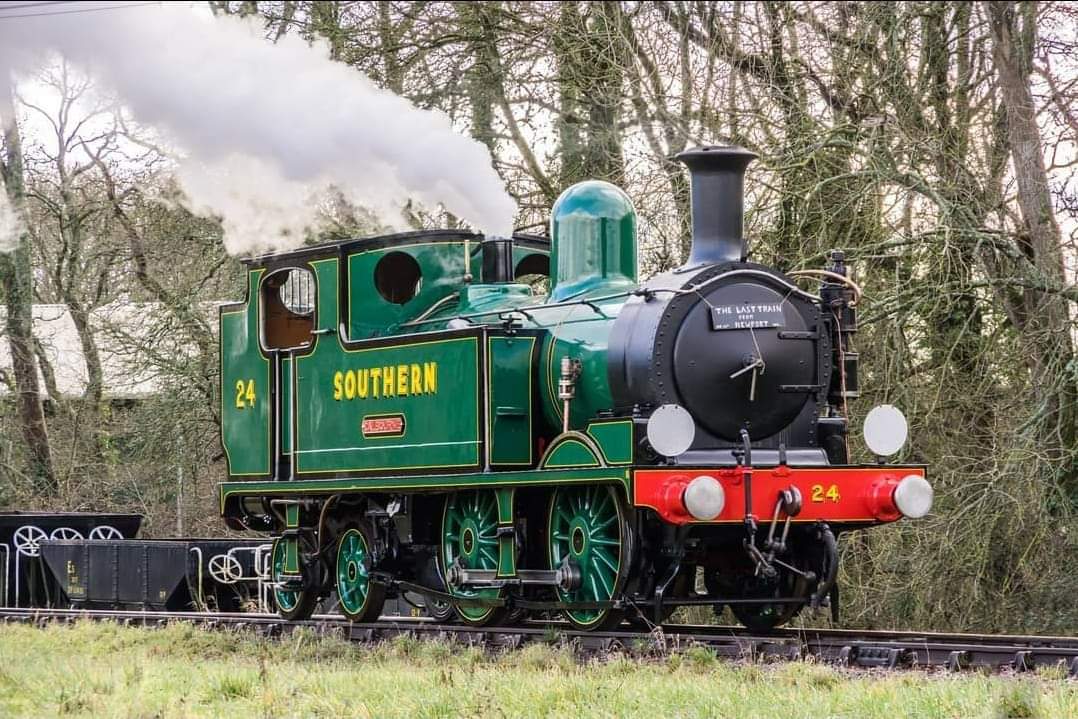
The 0-4-4T locomotive is a type of steam tank engine defined under the Whyte notation system as having no leading wheels, four coupled driving wheels on two axles, and four trailing wheels on two axles. The “T” suffix indicates that the engine carries its water and fuel on board, rather than in a separate tender.
This arrangement was widely used in suburban and rural passenger services, offering excellent balance, compactness, and smoother riding at moderate speeds. In the United States, the same configuration became known as the Forney locomotive, named after Matthias N. Forney, who patented his version between 1861 and 1864 for use on narrow and elevated railways.
Equivalent Classifications
The 0-4-4T locomotive corresponds to several other classification systems used around the world:
- UIC classification: B2 (German and Italian systems)
- French classification: 022
- Turkish classification: 24
- Swiss classification: 2/4
- Russian classification: 0-2-2
These equivalences indicate the same structural principle: a compact tank engine with two powered axles and a two-axle trailing bogie.
History and Development
The 0-4-4T wheel arrangement first appeared in Britain during the mid-19th century. The earliest examples were well-tank locomotives, built independently by John Chester Craven of the London, Brighton and South Coast Railway and James Cudworth of the South Eastern Railway in 1866.
Soon after, Matthew Kirtley of the Midland Railway introduced the 690 and 780 Classes (1869–1870), followed by Patrick Stirling’s designs for the Great Northern Railway, which produced 48 locomotives between 1873 and 1881.
By the 1870s, the side-tank version became dominant. Samuel Waite Johnson introduced it on the Great Eastern Railway in 1872, and it quickly became the standard configuration for British passenger tank locomotives until around 1900.
Design and Performance
The 0-4-4T locomotive was known for its excellent balance and stability, particularly in reverse running. The trailing bogie helped distribute weight evenly, improving ride quality and allowing for higher speeds on lightly built lines.
Its compact structure made it suitable for branch lines, commuter routes, and shunting, where tight turning radii and frequent stops were required.
British examples included some of the most successful suburban locomotives ever built, such as the LSWR O2, LSWR M7, Midland Railway 2228 Class, and the Caledonian Railway 439 Class.
The last British 0-4-4T design was the LMS Stanier Class 2 0-4-4T, built in 1932, which was directly inspired by the Midland Railway’s earlier 2228 Class.
Notable Examples and Preservation
Several 0-4-4T locomotives remain preserved in working or static condition:
- SECR H Class No. 263 – Operating on the Bluebell Railway.
- LSWR O2 Class No. W24 “Calbourne” – Preserved on the Isle of Wight Steam Railway.
- Metropolitan Railway E Class No. 1 – Preserved at the Buckinghamshire Railway Centre.
- Caledonian Railway No. 419 – Maintained by the Scottish Railway Preservation Society.
- Duke of Sutherland’s “Dunrobin” – Repatriated from Canada and restored at Beamish Museum.
In addition, replica projects are ongoing, such as the Class G5 Locomotive Company Limited, which is recreating a working NER Class O (LNER Class G5) to demonstrate the operational capabilities of the classic 0-4-4T design.
Use in Finland
In Finland, the Class F1 0-4-4T locomotives entered service with the Finnish State Railways (SVR) in 1885. Built by the Swiss Locomotive and Machine Works (SLM) in Winterthur, they were used until 1935 for passenger services. One preserved example, Locomotive No. 132, remains on display at the Finnish Railway Museum, complete with its builder’s plate from SLM locomotive No. 434 (1886).
Forney Locomotives in the United States
In America, the 0-4-4T configuration became famous as the Forney locomotive, named after engineer Matthias N. Forney. His design was patented between 1861 and 1864 and became essential for urban and elevated railways in cities such as New York, Boston, and Chicago.
The Forney design featured a single rigid frame supporting both the boiler and the rear coal-and-water tank, which rested on a swiveling trailing truck. The locomotives typically ran cab-first, optimizing weight distribution for tight curves and rapid reversals.
One of the best-known examples is the Sandy River Railroad Forney No. 1, used on narrow-gauge and rapid-transit systems, where agility and compact size were paramount.
Legacy
The 0-4-4T locomotive stands as one of the most influential tank engine configurations in the history of steam traction. Its combination of power, balance, and versatility made it a staple of suburban passenger service across Europe and North America for over half a century.
Although the arrangement fell out of favor with the advent of larger tank and tender locomotives, many preserved examples continue to operate on heritage railways. They remain a symbol of the golden age of commuter steam travel, bridging the gap between early innovation and modern efficiency.


