


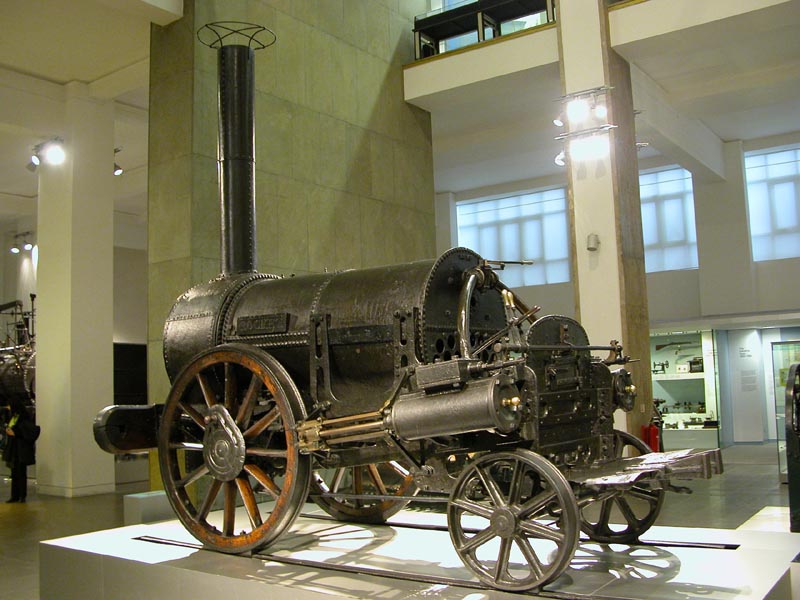
The 0-2-2 locomotive is a historic steam engine configuration defined by the Whyte notation system, representing no leading wheels, two driving wheels, and two trailing wheels. This wheel arrangement is one of the earliest used in railway history and was famously employed in Stephenson’s Rocket, the pioneering locomotive that won the Rainhill Trials of 1829.
The 0-2-2 wheel arrangement was primarily associated with early passenger locomotives designed for speed and stability rather than heavy hauling. Built by Robert Stephenson and Company, these locomotives were used on the Liverpool and Manchester Railway (L&MR) — the world’s first intercity railway.
Technical Classification
Equivalent classifications of the 0-2-2 locomotive include:
- UIC classification: A1 (German and Italian systems)
- French classification: 011
- Turkish classification: 12
- Swiss classification: 1/2
These equivalencies reflect its universal recognition as a two-driving-wheel locomotive with an additional trailing axle for balance and support.
Stephenson’s Rocket and the 0-2-2 Design
The most famous 0-2-2 locomotive was Stephenson’s Rocket, designed and built in 1829 by George and Robert Stephenson for the Rainhill Trials — a competition to determine the best design for the new Liverpool and Manchester Railway.
Unlike Stephenson’s earlier heavy freight designs, Rocket was built to be light, fast, and efficient. Its design placed the boiler forward over the driving axle to concentrate weight for traction, while the two trailing wheels supported the firebox and cab. This gave Rocket its characteristic 0-2-2 arrangement, differing from the later 2-2-0 “Planet” type which moved the cylinders to the front.
Rocket’s angled cylinders, located over the firebox, were a key innovation. The crew — both driver and fireman — operated from the same rear footplate, an unusual feature at the time that later became standard in locomotive design.
Other Early 0-2-2 Locomotives
Following the success of Rocket, Stephenson and Company built eight more locomotives with the 0-2-2 wheel arrangement for the Liverpool and Manchester Railway. These included:
- Meteor
- Comet
- Dart
- Arrow
- Phoenix
- North Star
- Northumbrian
- Majestic
The Northumbrian type closely resembled the rebuilt Rocket, featuring low, nearly horizontal cylinders for smoother operation.
However, the design’s lack of leading wheels made it less stable at speed, leading to its replacement by the 2-2-0 Planet type. The Planet locomotives had front-mounted cylinders below the smokebox and inside the frames, improving balance and steam efficiency. The Northumbrians thus became the last and only production locomotives with the 0-2-2 configuration.
Novelty and Competing Designs
Another locomotive entered in the Rainhill Trials was Novelty, designed by John Ericsson and John Braithwaite. It was a well-tank locomotive with an 0-2-2 configuration, though its orientation was unconventional — having similar-sized wheels at both ends and no defined “front” or “rear.” Some records describe Novelty as a 2-2-0WT, highlighting the ambiguity of its layout.
Novelty featured innovative design concepts, including vertical cylinders and a lightweight frame, but mechanical issues prevented it from finishing the trials. Despite this, it remains an important milestone in early locomotive experimentation.
Transition to Later Types
The 0-2-2 arrangement was soon rendered obsolete by evolving locomotive technology. The introduction of the 2-2-0 Planet type in the early 1830s marked a turning point in steam design. The Planets offered greater stability, power, and speed, allowing more efficient operation on longer routes.
Following the Planets, many railways adopted the 2-2-2 configuration, which added a leading axle for improved ride quality and balance at higher speeds. By the mid-19th century, the 0-2-2 type had effectively disappeared from mainline service.
Tank Engines and Railmotors
Although the 0-2-2 design vanished from standard locomotives, it reappeared in railmotors of the early 20th century. In these self-contained passenger units, the locomotive section often had an 0-2-2 wheel arrangement, permanently coupled to a coach.
For example, the London and South Western Railway (LSWR) built the C14 class with a similar but reversed 2-2-0T configuration. Due to their low adhesive weight, they performed poorly and were later rebuilt as 0-4-0T S14 locomotives to improve traction.
Legacy
The 0-2-2 locomotive occupies a significant place in railway history as a transitional design between the earliest experimental engines and more advanced passenger locomotives. Its most famous example, Stephenson’s Rocket, became a symbol of the Industrial Revolution and the dawn of modern railway transportation.
While the configuration itself was short-lived, its design principles — especially the placement of the boiler, cylinders, and driving axles — profoundly influenced subsequent locomotive engineering. Today, replicas of Rocket and its contemporaries remain on display in museums worldwide, illustrating the origins of railway innovation.


