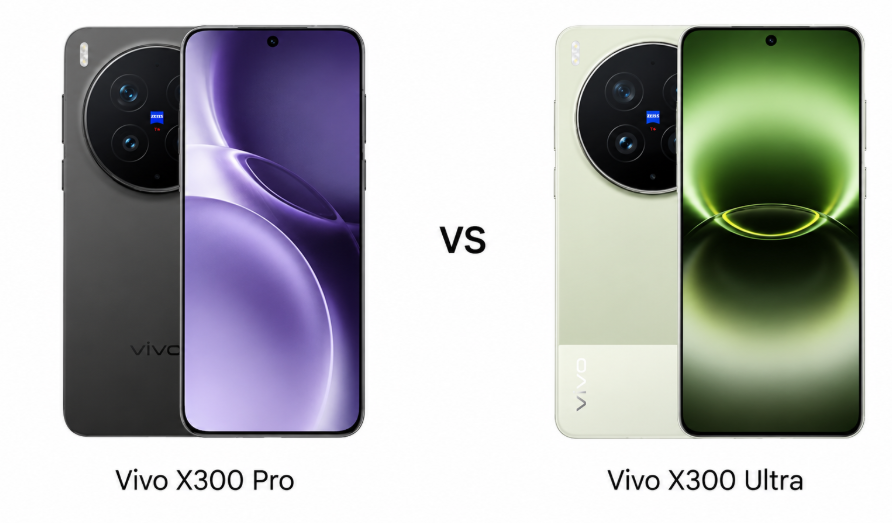
Vivo X300 Pro vs Vivo X300 Ultra is not just a question of which phone has better specifications. The real question is whether the Ultra’s extra camera hardware, sharper display and Snapdragon platform justify the much higher price.
The Vivo X300 Pro is already a serious flagship. It offers a 6.78-inch LTPO AMOLED display, MediaTek Dimensity 9500 performance, a 200MP ZEISS APO telephoto camera, a large 6,510mAh battery and 90W wired charging. Vivo’s official China page highlights the X300 Pro’s ZEISS 200MP APO super telephoto camera, Dimensity 9500 platform, 6,510mAh battery and OriginOS 6 software experience.
The Vivo X300 Ultra goes further. It adds a larger and sharper 6.82-inch display, Snapdragon 8 Elite Gen 5 power, a more advanced ZEISS Master camera system, 200MP clarity across key focal lengths, a 6,600mAh battery and professional imaging extras. Vivo’s global X300 Ultra page describes the phone as having a ZEISS Master Lenses Collection with 14mm ultra-wide, 35mm and 85mm focal lengths, plus optional 200mm and 400mm telephoto extenders.
For most buyers, the Vivo X300 Pro is the smarter value flagship. For serious mobile photographers, videographers and creators, the Vivo X300 Ultra is the more exciting device.
Vivo X300 Pro vs Vivo X300 Ultra: Quick Summary
The Vivo X300 Pro is the balanced flagship. It already delivers premium display quality, high-end performance, strong battery life and serious camera hardware.
The Vivo X300 Ultra is the creator flagship. It is built for users who want the best Vivo camera system, stronger video tools, a sharper display and Snapdragon performance.
PhoneArena lists the Vivo X300 Pro with a 6.8-inch 2800 x 1260 display, 6,510mAh battery and triple camera setup, while the X300 Ultra is listed with a 6.8-inch 3168 x 1440 display, 6,600mAh battery, Snapdragon 8 Elite Gen 5 and triple camera setup.
That tells the story clearly.
The Pro already gives you most flagship essentials. The Ultra adds premium upgrades mainly for display resolution, chipset preference, camera hardware and professional imaging.
Design and Build Quality
Both phones offer flagship-grade construction.
The Vivo X300 Pro and Vivo X300 Ultra use premium glass-and-metal designs with modern flagship durability. Both are expected to feel expensive in hand, and both target users who want a high-end Android experience.
The difference is identity.
The X300 Pro feels like a premium daily flagship with serious cameras. The X300 Ultra feels more like a camera-first flagship built around professional imaging hardware.
The Ultra’s larger camera system and optional lens accessories make it feel closer to a hybrid between a smartphone and a compact creator tool.
For everyday use, the build-quality difference may not be dramatic. For buyers who care about camera prestige and professional imaging branding, the Ultra feels more special.
Display: Ultra Gets the Sharper and Smoother Panel
The Vivo X300 Ultra has the better display on paper.
The X300 Pro uses a 6.78-inch LTPO AMOLED panel with 120Hz refresh rate and 2800 x 1260 resolution. Vivo India’s X300 Pro specification page lists a 6.78-inch AMOLED display with 2800 x 1260 resolution and 1–120Hz LTPO refresh rate.
The X300 Ultra increases the resolution to 3168 x 1440 and adds a smoother 144Hz refresh rate in several specification listings and launch reports. PhoneArena lists the Ultra with a 3168 x 1440 display, while TechRadar reports that the X300 Ultra has a 6.82-inch OLED display with 144Hz refresh rate.
That makes the Ultra better for gaming, media, reading, editing photos and viewing high-resolution content.
However, the X300 Pro display is already excellent. Most users will not feel shortchanged.
Display Verdict
The Vivo X300 Ultra wins the display category.
Its sharper QHD+ resolution and 144Hz refresh rate give it the edge for users who want the best possible screen.
The Vivo X300 Pro remains more than good enough for most buyers. It still offers a premium LTPO AMOLED experience with high brightness, smooth refresh and strong media support.
If you want maximum display quality, choose the Ultra. If you want strong value, the Pro is already excellent.
Performance: Dimensity 9500 vs Snapdragon 8 Elite Gen 5
The Vivo X300 Pro uses MediaTek’s Dimensity 9500, while the Vivo X300 Ultra uses Qualcomm’s Snapdragon 8 Elite Gen 5.
The Dimensity 9500 is a flagship chip and should deliver excellent performance for gaming, multitasking, AI features, camera processing and daily use. Vivo’s official China page highlights the X300 Pro as using a Blue Crystal x Dimensity 9500 platform.
The X300 Ultra has the advantage for users who prefer Qualcomm’s Snapdragon platform. The Verge reported that the X300 Ultra is powered by Snapdragon 8 Elite Gen 5 and paired with a 6,600mAh battery.
For gaming, the Ultra’s Snapdragon chip and Adreno graphics ecosystem may be more attractive. For general daily performance, both phones should feel extremely fast.
The real difference will be sustained performance, thermal tuning and app optimization rather than basic speed.
Performance Verdict
The Vivo X300 Ultra wins for peak performance and gaming preference.
Snapdragon flagship chips usually attract gamers because of broad optimization, emulator support and GPU confidence.
The Vivo X300 Pro is still powerful enough for nearly everyone. Unless you are a heavy gamer, benchmark-focused user or Snapdragon loyalist, the Pro’s Dimensity 9500 should not feel like a compromise.
RAM and Storage
Both phones offer flagship memory and storage configurations.
The supplied comparison lists both devices with up to 16GB RAM and 1TB UFS 4.1 storage. The Verge also reported that the X300 Ultra would be available in configurations ranging from 12GB/256GB to 16GB/1TB.
This means storage is not a major reason to upgrade from Pro to Ultra.
Both phones can handle large apps, 4K video files, high-resolution photos, games and long-term usage.
For creators, 1TB storage is especially useful because high-resolution photos and 4K/8K video can consume space quickly.
Camera: The Biggest Difference
The camera system is the main reason to consider the Vivo X300 Ultra.
The X300 Pro already has serious imaging hardware. Vivo’s China page highlights its ZEISS 200MP APO super telephoto camera, gimbal-grade main camera and Vivo’s self-developed imaging chips.
The X300 Ultra pushes harder. Vivo’s global X300 Ultra page describes a ZEISS Master Lenses Collection spanning 14mm ultra-wide, 35mm and 85mm focal lengths, with 200MP clarity for documentary-style shooting and cinematic close-ups.
The Verge reported that the X300 Ultra was launched as a flagship “designed for professional photography,” with a camera system developed with ZEISS, including 14mm ultra-wide, 35mm documentary camera and 85mm 200MP gimbal-grade APO telephoto lens.
This is where the Ultra earns its name.
Main Camera Comparison
The Vivo X300 Ultra has the more ambitious main camera system.
The X300 Pro uses a strong main camera and a 200MP telephoto lens, making it one of the best camera phones in its class.
The Ultra, however, is designed around a more professional focal-length setup. Its 35mm main camera approach is meant to feel closer to documentary and street photography than a standard smartphone wide lens. Vivo’s X300 Ultra page specifically highlights 35mm and 85mm focal lengths as part of the ZEISS Master Lenses Collection.
For ordinary users, the X300 Pro camera will already be excellent.
For users who care about focal length, natural perspective, portrait rendering and professional-style shooting, the Ultra offers a more specialized camera experience.
Telephoto and Zoom
Both phones offer serious zoom capability, but the Ultra goes further.
The Vivo X300 Pro includes a 200MP ZEISS APO telephoto camera, which Vivo promotes heavily for multi-focal portrait photography and long-range shooting.
The X300 Ultra adds optional telephoto extenders. Vivo says the Ultra supports a lightweight 200mm equivalent Gen 2 extender and a 400mm equivalent Gen 2 Ultra extender.
TechRadar also reported that the X300 Ultra launched with 200mm and 400mm telephoto lens attachments, including a 400mm accessory designed for long-range photography.
This makes the Ultra far more interesting for photography enthusiasts who want to experiment with long-range shooting.
For most users, though, the X300 Pro’s telephoto system is already more than enough.
Ultrawide Camera
The Vivo X300 Ultra has a more complete professional lens system.
Its camera system includes a 14mm ultra-wide lens, which Vivo positions as part of the ZEISS Master Lenses Collection.
The X300 Pro also has a high-end ultrawide camera, but the Ultra’s overall camera philosophy is more advanced.
The Ultra is not only about megapixels. It is about offering a more coherent set of focal lengths for creators: ultra-wide, documentary-style main and powerful telephoto.
That makes it more flexible for travel, architecture, street, portrait, landscape and video work.
Video Recording
The Vivo X300 Ultra is the stronger video phone.
The Verge reported that the Ultra supports multi-focal 4K at 120fps, 10-bit Log video recording and professional-grade ACES post-production workflow compatibility.
Digital Camera World’s review described the X300 Ultra as one of the strongest Android video phones, noting support for 8K video, 4K at 120fps, 10-bit Log, Dolby Vision, manual controls, external lenses and ND filter support.
The X300 Pro also supports advanced video features, including high-frame-rate 4K and professional shooting modes.
But the Ultra is clearly built for people who take mobile video seriously.
If video is central to your work, the Ultra is the better option.
Selfie Camera
Both phones are strong for selfies and front-camera video.
The supplied comparison lists both with 50MP autofocus selfie cameras capable of 4K video. The Ultra adds gyro-EIS and HDR features in the comparison data, giving it a small advantage for vlogging and handheld front-camera recording.
For most users, the difference will be minor.
Both phones should handle video calls, selfies, reels, vlogs and social media content well.
The Ultra is better for creators who want more stable and polished front-camera video.
Battery Life
Battery life is close, but the Vivo X300 Ultra has a small advantage.
The Vivo X300 Pro has a 6,510mAh battery, which Vivo highlights on its official China page.
The Vivo X300 Ultra has a 6,600mAh battery, according to The Verge and PhoneArena.
The difference is only 90mAh, so real-world endurance may depend more on display resolution, refresh rate, chipset efficiency and user behavior.
The Ultra has a sharper and faster display, which may use more power. The Pro has a slightly smaller battery but also a lower-resolution 120Hz screen.
In daily use, both should be strong battery performers.
Charging
The Vivo X300 Ultra has a slight charging advantage.
The supplied comparison lists the X300 Pro with 90W wired charging and 40W wireless charging, while the Ultra gets 100W wired charging and 40W wireless charging.
That is an upgrade, but not a huge one.
Both phones should charge quickly. The Ultra may save some time on wired charging, but this is unlikely to be the main reason to pay extra.
If battery and charging are your top priorities, both phones are strong. The Ultra simply has the slightly better spec sheet.
Connectivity and USB
Both phones support modern flagship connectivity.
The supplied comparison lists Wi-Fi 7, Bluetooth 5.4 and USB-C 3.2 on both devices. The Ultra adds DisplayPort support, which can be useful for connecting the phone to external displays.
That matters for creators and productivity users.
If you want to review photos or videos on a monitor, connect to a larger screen or use the phone in a more desktop-like setup, DisplayPort support gives the Ultra an advantage.
For most users, both phones offer enough connectivity.
Satellite Features
The Ultra has the more advanced satellite communication option.
The supplied comparison lists optional satellite connectivity on the X300 Pro and emergency SOS via satellite on the 1TB model of the X300 Ultra.
Satellite features can be useful in emergencies, especially in areas without normal mobile coverage.
However, availability may depend heavily on region, carrier support, model variant and local regulation.
Buyers should confirm whether satellite functions work in their country before treating this as a major purchase reason.
Software and Updates
The Vivo X300 Pro has the clearer software-support advantage in the supplied comparison.
The comparison lists the Pro with Android 16, OriginOS 6 and five Android upgrades. The Ultra also runs Android 16 and OriginOS 6, but the provided table only clearly confirms five Android upgrades for the Pro.
In practice, Vivo may offer strong support for both premium models, but buyers should verify official update promises in their region.
Software support matters because expensive phones should last several years.
A $1,000-plus flagship should not be judged only by launch specs. It should also receive timely operating system upgrades, security patches and camera improvements.
Price Difference
The biggest issue is price.
The supplied comparison estimates the Vivo X300 Pro around $1,000 and the Vivo X300 Ultra around $1,500. TechRadar reported China launch pricing for the X300 Ultra from 6,999 yuan to 8,999 yuan, roughly about $1,012 to $1,300 before regional taxes and import costs.
Digital Camera World’s review noted a very high European price of around €1,999 for the Ultra, showing that global pricing can vary significantly.
That means the Ultra’s value depends heavily on your market.
If the gap is only moderate, the Ultra may be tempting. If the gap is around $500 or more, the Pro becomes much easier to recommend for most people.
Is the Ultra Worth the Extra $500?
For most buyers, no.
The Vivo X300 Pro already gives you flagship performance, an excellent display, a huge battery, fast charging and a serious ZEISS camera system.
The Ultra is worth the extra money only if you will actually use its upgrades.
Those upgrades include the sharper 1440p display, Snapdragon 8 Elite Gen 5 chip, more professional ZEISS camera system, advanced video tools, optional 200mm and 400mm lens accessories and DisplayPort output.
If those features sound exciting but not essential, save the money and choose the X300 Pro.
If you create content seriously, shoot a lot of video or want Vivo’s most advanced camera phone, the Ultra makes more sense.
Vivo X300 Pro Advantages
The Vivo X300 Pro has several major strengths.
It is cheaper, still extremely powerful and already has flagship-grade cameras. It also has a large battery, premium display, fast charging and a strong imaging system.
Its biggest advantage is value.
You get most of the flagship experience without paying Ultra money.
For many users, the X300 Pro is the more rational purchase because it is already more phone than most people need.
Vivo X300 Ultra Advantages
The Vivo X300 Ultra is the better phone for creators.
It offers a sharper display, Snapdragon performance, more advanced camera hardware, professional video tools, optional telephoto attachments and a more ambitious imaging system.
Digital Camera World described the Ultra as a powerful Android video phone with 8K video, 4K 120fps, 10-bit Log, Dolby Vision, manual controls and external lens support.
That is the Ultra’s real reason to exist.
It is not for people who only want a good phone. It is for people who want a phone that behaves more like a serious creative tool.
Which One Is Better for Photography?
The Vivo X300 Ultra is better for photography.
Its ZEISS Master Lenses Collection, 35mm documentary-style camera, 85mm 200MP telephoto and optional 200mm/400mm extenders make it more advanced than the Pro.
The X300 Pro is still excellent and will satisfy most mobile photographers.
But the Ultra gives more creative range and more professional-style options.
If photography is your main reason for buying, the Ultra is the better device.
Which One Is Better for Video?
The Vivo X300 Ultra is better for video.
Its advanced video features, including 4K 120fps, 10-bit Log, Dolby Vision, ACES workflow support and external lens options, make it a stronger creator phone.
The X300 Pro can still shoot high-quality video.
But the Ultra is clearly the model Vivo built to challenge the best camera phones and even attract users who might otherwise consider dedicated creator gear.
For vloggers, mobile filmmakers and video-focused creators, the Ultra is the stronger choice.
Which One Is Better for Gaming?
The Vivo X300 Ultra is likely better for gaming.
Its Snapdragon 8 Elite Gen 5 platform, 144Hz display and larger cooling-focused flagship design should appeal to gamers.
The X300 Pro’s Dimensity 9500 is also very powerful and should handle demanding games well.
But if gaming is a major priority, the Ultra’s Snapdragon platform and higher refresh display give it the edge.
That said, the price difference may still be difficult to justify for gaming alone.
Which One Is Better for Everyday Use?
The Vivo X300 Pro is better for everyday value.
It is powerful, polished, long-lasting and more affordable.
Most users will not need the Ultra’s optional lens accessories, pro video workflows or 1440p 144Hz display.
For social media, web browsing, messaging, streaming, photos, video calls and normal gaming, the X300 Pro is already more than enough.
The Ultra is better, but the Pro is easier to justify.
Which One Should Creators Buy?
Creators should seriously consider the Vivo X300 Ultra.
If you shoot paid content, travel photography, documentary-style video, product footage, YouTube clips or short films, the Ultra’s camera system and video tools could be worth the premium.
Its optional lens accessories also make it more flexible than a normal phone camera.
However, casual creators may still be better served by the X300 Pro.
If your content is mainly social media photos, reels and everyday video, the Pro is already very capable.
Which One Should Most Buyers Choose?
Most buyers should choose the Vivo X300 Pro.
It offers the better balance of price, performance, camera quality, battery life and daily usability.
The X300 Ultra is the better phone, but not automatically the better buy.
A phone can be technically superior and still poor value for most people.
The Ultra makes sense only if its specific upgrades matter to you.
If they do not, the X300 Pro is the smarter choice.
Final Verdict
The Vivo X300 Ultra is worth the extra money only for serious camera and video users.
It has the better display, stronger Snapdragon chip, more advanced ZEISS camera system, better video features, optional lens accessories and slightly better battery and charging specs.
The Vivo X300 Pro is the better value for most buyers.
It already offers a flagship display, Dimensity 9500 performance, premium ZEISS imaging, a 6,510mAh battery and fast charging at a lower price.
The Ultra is the dream phone. The Pro is the practical flagship.
Conclusion: Choose the Pro for Value, Ultra for Creation
Vivo X300 Pro vs Vivo X300 Ultra comes down to how much you care about professional imaging.
Choose the Vivo X300 Pro if you want a powerful, premium flagship with excellent cameras, strong battery life and better value.
Choose the Vivo X300 Ultra if you want Vivo’s most advanced camera phone, a sharper 144Hz display, Snapdragon 8 Elite Gen 5 performance, professional video tools and optional 200mm and 400mm telephoto accessories. Vivo positions the Ultra around its ZEISS Master Lenses Collection and expanded creative system, making it the more serious photography device.
For most people, the Vivo X300 Pro is the better buy.
For creators who will actually use the Ultra’s camera and video tools, the Vivo X300 Ultra may be worth paying extra for.