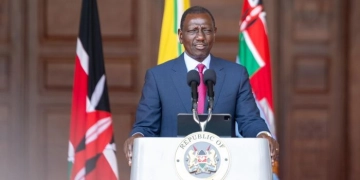
A fresh political and economic debate has erupted across East Africa after President William Ruto revealed that Uganda is set to acquire joint ownership of the Kenya Pipeline Company (KPC). The announcement, made during Ruto’s official tour of Uganda, signals one of the most consequential shifts in regional energy cooperation in recent years. The proposal has quickly become a headline topic, with many weighing the strategic benefits against concerns surrounding sovereignty and control of critical national infrastructure. At the heart of the controversy is the planned Initial Public Offering, which would allow Uganda to directly invest in Kenya’s fuel transport backbone.
Kenya to Sell Majority Stake in KPC
Ruto confirmed that Kenya will privatize KPC by selling 65 percent of its shares, retaining only a 35 percent government stake. The majority stake will be listed on the Nairobi Securities Exchange, giving room for Uganda and other East African investors to buy in. The president described KPC as a regional asset rather than a purely Kenyan enterprise, arguing that shared ownership will enhance economic integration across the region.
The decision follows a joint ministerial meeting in Nairobi where Kenya and Uganda endorsed a new cooperation framework focused on shared infrastructure ownership. According to Ruto, the offering will be conducted transparently through the stock market, opening strategic participation to the wider East African community.
Pipeline Expansion to Deepen Regional Cooperation
Beyond the share sale, the two countries are pursuing an expanded oil pipeline that will run from Eldoret to Kampala and onward to the borders of Rwanda and the Democratic Republic of Congo. Ruto emphasized that the cross-border route will strengthen energy distribution, reduce transport costs, and improve supply reliability for landlocked countries.
Both governments will co-own and co-finance the extended line, a move expected to elevate regional collaboration and create a seamless energy corridor across East Africa.
SGR Extension Becomes Part of the Deal
In his remarks, Ruto added that Kenya and Uganda are also progressing plans to extend the Standard Gauge Railway from Naivasha to Kampala. The railway will connect with the Malaba–Kampala line and eventually link to the DRC, forming a major transport artery for cargo and passenger movement. Ruto described the project as central to improving trade and reducing logistical bottlenecks that have long hindered regional commerce.
Museveni’s Remarks Ignite Debate, Ruto Responds
The announcement follows earlier comments by Ugandan President Yoweri Museveni about the need for dependable Indian Ocean access — comments that drew mixed reactions in Kenya and sparked local political discussions. Ruto, however, downplayed any tensions, stating that Museveni’s remarks were misinterpreted by some media outlets. He said the joint pipeline and railway initiatives aim to promote cooperation, not rivalry, and reinforce East Africa’s shared economic vision.
IPO Expected by March 2026
According to Ruto, the privatization of KPC is scheduled to be completed through an Initial Public Offering by March 31, 2026. Once the shares are floated, Uganda will have a clear path to formal co-ownership, marking a historic entry into Kenya’s most strategic fuel infrastructure.
As the region reacts, supporters view the deal as a bold step toward integration and shared prosperity, while critics warn of political risks and questions over long-term control. What remains certain is that the proposed partnership is set to redefine regional energy governance and reshape East Africa’s infrastructure landscape for years to come.