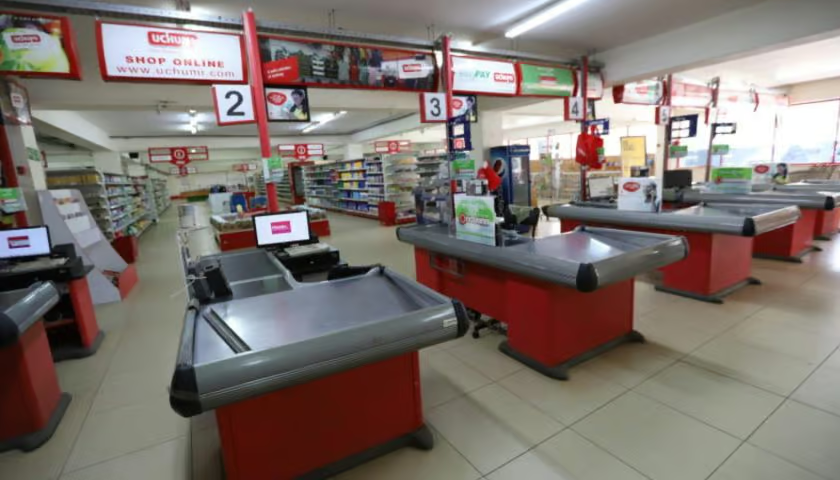
Kenya’s Uchumi Supermarkets has reported a modest profit of approximately US$68,000 (Sh8.8 million) for the year ending June 2025. This marks a rare positive financial outcome for the retailer, which has struggled in recent years. However, this profit largely stems from rental income, with retail sales contributing only a small portion of the earnings.
Profit Driven by Rental Income
Uchumi’s financial recovery comes after a loss of roughly US$382,000 (Sh49.7 million) in the previous year. The company’s latest financial reports, released under its company voluntary arrangement (CVA), show an improvement in both sales revenue and gross profit. Sales revenue rose to US$946,231 (Sh123.01 million), up from US$503,077 (Sh65.4 million), while gross profit climbed to US$213,077 (Sh27.7 million) after accounting for cost of sales of US$733,154 (Sh95.31 million).
Despite the improvement in retail activity, the biggest contributor to the profit was rental income, which surged to US$482,308 (Sh62.7 million) from US$103,846 (Sh13.5 million). This increase was largely due to the leasing of Uchumi’s Lang’ata Hyper branch to China Square starting in June 2024.
Financial Restructuring and CVA Progress
The CVA, which was initiated in March 2020, is a six-year debt settlement plan that is set to end in June 2026. According to the report, Uchumi has paid approximately 95% of the US$1.89 million (Sh245.86 million) it set out to clear by the end of the period. The majority of the payments have gone to banks, which have received about US$1.13 million (Sh146.5 million). Additionally, trade creditors and landlords have been paid nearly US$75,692 (Sh9.84 million), and staff salary arrears have been partially cleared with US$52,538 (Sh6.83 million).
However, Uchumi’s recovery remains vulnerable to external factors, particularly the ongoing legal battle over a 17-acre land parcel in Kasarani. The High Court recently ruled in favor of the Kenya Defence Forces, granting them ownership of the land, which Uchumi valued at around US$18.31 million (Sh2.38 billion). An appeal is still pending, and a ruling unfavorable to Uchumi could jeopardize its recovery unless fresh capital is injected or a revised plan is adopted.
Challenges and Future Outlook
While Uchumi’s recovery has been largely driven by rental income, its core retail operations still face significant challenges. The company must continue to narrow the gap between its targets and actual performance. Management has focused on improving efficiency, including the implementation of a new Enterprise Resource Planning (ERP) system to streamline operations across its stores.
Despite the legal challenges, Uchumi’s management remains cautiously optimistic, noting that the retailer has a clear path to recovery if it can successfully address both the legal dispute and its financial restructuring. The company’s ability to generate sustainable income through its real estate assets and improve its retail performance will be key to its future success.
Conclusion: A Delicate Balance for Uchumi
Uchumi’s profit recovery is a positive sign, but the company’s future remains uncertain, especially with the ongoing land dispute and the challenges within the retail sector. As the retailer continues to focus on leasing its properties and improving operations, its ability to secure a favorable outcome in the legal appeal will be crucial to its long-term viability.