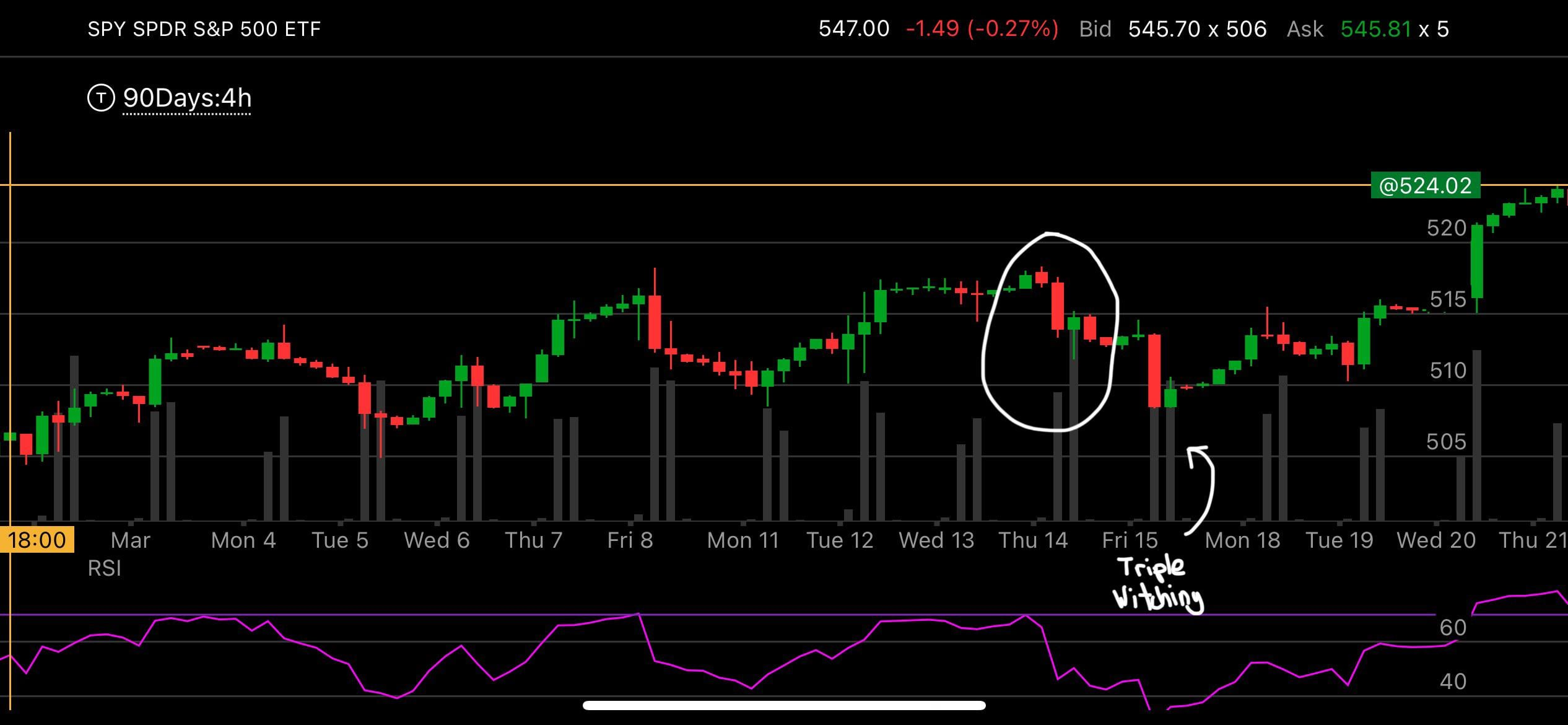
Triple witching is a stock market event that happens when several major derivatives contracts expire on the same day. It can create higher trading volume, sharper price swings, and unusual activity near the market close.
The event usually happens four times a year, on the third Friday of March, June, September, and December. These dates matter because stock options, stock index options, and stock index futures all expire around the same time.
For traders, triple witching can create opportunity. It can also create risk. Prices may move quickly as institutions, market makers, hedge funds, and other traders close, roll, hedge, or adjust positions before expiry.
However, triple witching does not guarantee a market rally or crash. Some triple witching days are highly volatile. Others pass with little drama. The final outcome depends on market conditions, positioning, news, interest rates, volatility, liquidity, and investor sentiment.
This guide explains what triple witching is, why it matters, when it happens, what the witching hour means, and how traders can approach it with better risk control.
What Is Triple Witching?
Triple witching is the simultaneous expiration of three types of stock market derivatives:
- Stock options
- Stock index options
- Stock index futures
These contracts all have expiry dates. When they expire at the same time, traders and institutions may need to close positions, exercise contracts, offset trades, or roll exposure into a later expiry.
This can increase trading volume and volatility, especially in the final hour of the trading session.
Triple witching is mainly associated with equity markets, especially U.S. markets. However, the concept matters globally because U.S. stock index futures and options influence international sentiment.
Why Is It Called Triple Witching?
The term “triple witching” comes from the idea that three different derivative expiries happen at once.
The word “witching” suggests an unusual or unpredictable market period. It is not a technical finance term in the strictest sense, but it has become widely used among traders, analysts, and financial media.
The “triple” part refers to the three expiring contract types:
| Contract Type | What It Represents |
|---|---|
| Stock options | Options on individual stocks |
| Stock index options | Options on indices such as the S&P 500 |
| Stock index futures | Futures contracts on stock indices |
When all three expire together, trading activity can become concentrated.
Triple Witching vs Quadruple Witching
Some traders also use the term quadruple witching.
Quadruple witching originally referred to the simultaneous expiration of four contract types:
- Stock options
- Stock index options
- Stock index futures
- Single stock futures
Single stock futures became less important in many markets, especially in the United States. Because of this, many traders now use triple witching and quadruple witching almost interchangeably.
In practical market commentary, triple witching usually refers to the quarterly expiry event that can increase stock market volume and volatility.
When Does Triple Witching Happen?
Triple witching normally happens on the third Friday of:
- March
- June
- September
- December
These months are important because they mark quarterly derivatives expiry cycles.
However, calendar adjustments can happen when the normal expiry date falls on a market holiday. Traders should always confirm the current year’s expiry calendar because exchanges, clearing organisations, and brokers may adjust dates.
Triple Witching Calendar
The general triple witching pattern is:
| Month | Usual Timing |
| March | Third Friday |
| June | Third Friday |
| September | Third Friday |
| December | Third Friday |
For 2026, the key dates are generally:
| Quarter | Triple Witching Date |
| March 2026 | March 20, 2026 |
| June 2026 | June 18 or June 19 adjustment period due to holiday calendar |
| September 2026 | September 18, 2026 |
| December 2026 | December 18, 2026 |
The June 2026 event needs special attention because June 19 is a U.S. market holiday. Traders should confirm the exact product expiry and trading schedule with their broker, exchange, or clearing calendar.
Why Triple Witching Matters
Triple witching matters because large amounts of derivatives exposure can expire at once.
This can affect:
- Trading volume
- Market liquidity
- Index levels
- Stock prices
- Futures pricing
- Options hedging
- Volatility
- Closing auction activity
- Short-term technical levels
Many large investors do not simply let contracts expire without planning. They may roll exposure to a later contract, close existing positions, hedge risk, or rebalance portfolios.
That activity can create unusual market behaviour.
What Happens During Triple Witching?
During triple witching, traders and institutions may need to decide what to do with expiring contracts.
They usually have three choices:
- Close the position.
- Roll the position to a later expiry.
- Let the contract expire or settle.
The decision depends on the type of contract, whether it is profitable, the trader’s strategy, and the underlying market price.
Why Volume Can Increase
Volume often rises because many market participants are active at the same time.
Options traders may close or exercise contracts. Futures traders may roll into the next contract month. Market makers may adjust hedges. Index funds may rebalance. Short-term traders may speculate on volatility.
This creates more transactions than a normal trading day.
Why Volatility Can Increase
Volatility can rise when large positions are adjusted quickly.
If many traders need to buy or sell the same stocks or indices, prices can move sharply. However, volatility is not guaranteed. Sometimes higher volume is absorbed smoothly by the market.
The strongest movement often happens when triple witching aligns with other major events such as:
- Central bank decisions
- Inflation data
- Employment reports
- Earnings warnings
- Geopolitical news
- Index rebalancing
- Large options positioning
- High market stress
What Is the Witching Hour?
The witching hour is the final hour of trading on triple witching day.
In U.S. markets, this usually refers to the last hour before the regular stock market closes. This period can be especially active because traders rush to close, offset, exercise, hedge, or roll expiring contracts.
The closing auction can also become important because many institutional trades are executed near the close.
Why the Final Hour Matters
The final hour matters because time is running out.
Options and futures contracts have expiry rules. Traders cannot delay decisions forever. If a position needs to be closed or rolled, the final hour may become a busy period.
This can create:
- Higher volume
- Faster price movement
- Wider spreads in some securities
- Sharp reversals
- Closing auction imbalances
- More short-term noise
Short-term traders often watch this period carefully, but beginners should be cautious because price action can become unpredictable.
What Contracts Expire During Triple Witching?
Triple witching involves three major contract categories.
Stock Options
A stock option gives the holder the right, but not the obligation, to buy or sell a stock at a set price before or at expiry.
There are two main types:
| Option Type | Meaning |
| Call option | Gives the right to buy the stock |
| Put option | Gives the right to sell the stock |
Options can be in the money, at the money, or out of the money.
Stock Index Options
Stock index options are options based on an index, such as the S&P 500, Nasdaq 100, Dow Jones Industrial Average, or Russell 2000.
These options are often used by institutions to hedge portfolios or speculate on broad market movement.
Stock Index Futures
Stock index futures are contracts based on future index value.
Examples include futures tied to major equity indices. Traders use them for hedging, speculation, and portfolio management.
Futures contracts must be settled, closed, or rolled before expiry depending on the contract rules and trader’s intention.
Options Expiring on Triple Witching
Options traders face important decisions on triple witching day.
If an option is in the money, it may have real value at expiry. If it is out of the money, it may expire worthless.
In-the-Money Options
An option is in the money when exercising it would have value.
For a call option, this means the stock price is above the strike price.
For a put option, this means the stock price is below the strike price.
A trader holding an in-the-money option may choose to close the option, exercise it, or let automatic exercise rules apply depending on broker and clearing rules.
Out-of-the-Money Options
An option is out of the money when exercising it would not be profitable.
For a call option, this means the stock price is below the strike price.
For a put option, this means the stock price is above the strike price.
Out-of-the-money options often expire worthless. The buyer loses the premium paid.
Option Sellers
Option sellers have different risks.
If the option they sold expires in the money, they may be assigned. This means they may need to buy or sell the underlying shares according to the option contract terms.
This is why option sellers must understand assignment risk before expiry.
Futures Expiring on Triple Witching
Futures contracts are different from options.
An option gives a right. A futures contract creates an obligation.
When a futures contract nears expiry, the trader usually has three choices:
| Action | Meaning |
| Close | Exit the position before expiry |
| Roll | Close the expiring contract and open a later one |
| Settle | Allow the contract to settle under contract rules |
Most short-term futures traders do not want delivery or final settlement exposure. They usually close or roll positions before expiry.
What Does It Mean to Roll a Futures Contract?
Rolling means moving exposure from an expiring contract to a later contract.
For example, a trader may close a June index futures position and open a September index futures position.
This keeps market exposure but avoids expiry in the current contract.
Rolling can involve costs because the later contract may trade at a different price from the expiring contract.
Why Triple Witching Can Affect Stock Prices
Triple witching can affect stock prices because of hedging and expiry-related flows.
Market makers and institutions often hedge options exposure by buying or selling the underlying stock or index futures.
When options move closer to expiry, hedging needs can change quickly. This is especially true when the underlying price is near a major strike price.
Pinning Around Strike Prices
Sometimes a stock or index may appear to trade near a major options strike price into expiry. This is often called pinning.
Pinning can happen when large options open interest exists around a strike and hedging activity pulls price toward that area.
However, pinning is not guaranteed. Strong news or broad market pressure can overwhelm expiry effects.
Gamma and Expiry
Gamma measures how quickly an option’s delta changes as the underlying price moves.
Near expiry, gamma can become more powerful, especially for at-the-money options.
This can force market makers to adjust hedges quickly as prices move. In some cases, this can increase volatility. In other cases, hedging flows may dampen movement.
Beginners do not need to master advanced options Greeks immediately, but they should understand that options positioning can influence short-term price action.
Does Triple Witching Always Cause Volatility?
No. Triple witching does not always cause major volatility.
Some triple witching days are active but orderly. Others are volatile. Some are almost forgettable.
The impact depends on market context.
Triple witching is more likely to matter when:
- Options positioning is large
- Major indices are near important strike levels
- Volatility is already elevated
- News events are active
- Market liquidity is weak
- Investors are heavily hedged
- Index rebalancing happens at the same time
- The market is near major technical levels
It may matter less when markets are calm, positioning is balanced, and liquidity is strong.
How Weekly Options Changed Triple Witching
Triple witching used to stand out more because many derivatives expired on the same quarterly dates.
Today, weekly and even shorter-dated options are widely available. This spreads expiry activity across more dates.
As a result, triple witching can still be important, but it is not always as dramatic as older market commentary suggests.
However, quarterly expiry still matters because institutional portfolios, index products, and futures rolls can remain significant.
How to Prepare for Triple Witching
Preparation matters more than prediction.
A trader should not assume the market will rise or fall simply because triple witching is approaching.
Instead, traders should review:
- Current market trend
- Major support and resistance levels
- Options open interest
- Index futures expiry
- Economic calendar
- Central bank events
- Earnings schedule
- Volatility levels
- News headlines
- Position size
- Stop-loss rules
Step-by-Step Triple Witching Preparation
A simple preparation process may look like this:
| Step | Action |
| 1 | Mark the triple witching date on your calendar |
| 2 | Check major economic events that week |
| 3 | Review market trend and technical levels |
| 4 | Watch volume and volatility |
| 5 | Avoid oversized positions |
| 6 | Be cautious during the final hour |
| 7 | Use limit orders where appropriate |
| 8 | Review risk before holding through expiry |
This process helps traders avoid being surprised by expiry-driven market movement.
How to Trade Triple Witching
There is no single best way to trade triple witching.
Different traders use different approaches depending on experience, risk tolerance, and strategy.
1. Trade the Build-Up
Some traders watch the week leading up to triple witching.
Markets may move as institutions adjust positions before the actual expiry day. This can create trends, reversals, or range-bound behaviour.
A trader may look for breakouts, support and resistance reactions, or volatility expansion.
2. Trade the Witching Hour
Some short-term traders focus on the final hour of trading.
This can be active, but it can also be noisy. Beginners should be careful because price can reverse quickly.
A trader who enters during the witching hour should have a clear stop-loss, target, and exit plan.
3. Avoid Trading the Event
Avoiding triple witching is also a valid choice.
Some traders prefer to reduce exposure and wait until the market becomes clearer. Not every event needs to be traded.
Protecting capital is part of trading discipline.
4. Use Smaller Position Sizes
Because volatility can increase, traders may reduce position size.
A smaller position can help manage emotional pressure and reduce the effect of sudden price moves.
5. Focus on Liquid Markets
Triple witching affects liquid stocks, indices, ETFs, options, and futures most clearly.
Illiquid stocks can have wider spreads and poor execution. Traders should be careful with thinly traded securities.
Example Triple Witching Trading Plan
Here is a simple educational example.
A trader sees that the S&P 500 is approaching a key resistance level during triple witching week. Volume is rising, but price has not broken out yet.
The trader creates this plan:
| Plan Element | Example |
| Market | S&P 500 ETF or index-related instrument |
| Setup | Breakout above resistance |
| Entry | Only after confirmed close above resistance |
| Stop-loss | Below breakout level |
| Target | Next resistance zone |
| Risk | 1% of account |
| Event rule | Avoid entering in final 15 minutes |
This plan does not predict the market. It simply defines conditions before taking action.
Triple Witching and Long-Term Investors
Long-term investors do not usually need to change their strategy because of triple witching.
If an investor owns quality companies for years, one expiry event may not matter much.
However, long-term investors should understand that triple witching can create short-term noise. A stock or index may move sharply for technical reasons unrelated to business fundamentals.
This can create opportunities for patient investors, but it can also tempt people into unnecessary trading.
Triple Witching and Day Traders
Day traders may pay more attention to triple witching because intraday movement can increase.
However, day traders should watch for:
- Fast reversals
- False breakouts
- Wider spreads
- Unusual volume
- Closing auction volatility
- News-driven moves
- Reduced signal quality near expiry
A day trader should not trade bigger simply because volume is higher.
Triple Witching and Options Traders
Options traders must be especially careful during triple witching.
Important risks include:
- Assignment risk
- Exercise risk
- Pin risk
- Rapid time decay
- Volatility changes
- Liquidity shifts
- Spread widening
- Margin changes
Options positions should be reviewed before expiry day, not only during the final hour.
Triple Witching and Futures Traders
Futures traders must watch contract expiry and rollover schedules.
A trader who wants to maintain exposure may need to roll into the next contract.
A trader who does not want expiry exposure should close the position before the deadline.
Futures contracts have specific rules, so traders must understand the contract they are trading.
Common Mistakes Traders Make During Triple Witching
Assuming Volatility Is Guaranteed
Triple witching can increase volume, but it does not always create large price movement.
Trading Without a Plan
Entering trades because “it is triple witching” is not a strategy.
Ignoring Expiry Rules
Options and futures have specific rules. Traders should understand exercise, assignment, settlement, and rollover.
Holding Options Without Understanding Assignment
Option sellers can face assignment risk. Buyers can also face exercise decisions.
Using Too Much Leverage
Volatile sessions can punish oversized trades quickly.
Chasing the Final Hour
The witching hour can be noisy. Late entries may have poor risk-reward.
Forgetting News Context
Triple witching during a calm market is different from triple witching during a crisis, central bank week, or major geopolitical event.
Risk Management During Triple Witching
Risk management is essential during expiry events.
Practical rules include:
- Reduce position size if volatility rises.
- Use stop-losses where suitable.
- Avoid entering without a clear exit.
- Check spreads before placing orders.
- Avoid market orders in thin conditions.
- Know contract expiry rules.
- Close or roll positions early if needed.
- Do not wait until the final minutes to manage risk.
- Avoid trading products you do not understand.
Position Sizing Example
Assume a trader has a $2,000 account and wants to risk 1% on one trade.
That means the maximum risk is $20.
If the trade setup requires a stop-loss $0.50 away from entry, the trader can calculate position size like this:
$20 ÷ $0.50 = 40 shares
The trader can buy 40 shares if they want to keep the risk near $20.
If volatility increases and the stop-loss must be $1 away, the position size should fall:
$20 ÷ $1 = 20 shares
This is how traders adjust risk when markets become more volatile.
Best Practices for Triple Witching
Prepare before expiry day.
Know which contracts are expiring.
Avoid making emotional decisions in the final hour.
Use smaller size if price action becomes unstable.
Check the economic calendar.
Watch major index levels.
Respect liquidity conditions.
Do not assume the market must move in one direction.
Review open options and futures positions before expiry.
Use limit orders when spreads are wide.
Keep a trading journal to track how triple witching affects your strategy.
Key Takeaways
- Triple witching happens when stock options, stock index options, and stock index futures expire around the same time.
- It usually occurs on the third Friday of March, June, September, and December.
- Calendar adjustments can happen when the usual date falls on a market holiday.
- Triple witching can increase volume and volatility.
- The final hour of trading is called the witching hour.
- Traders may close, roll, offset, exercise, or settle expiring contracts.
- Options traders should understand exercise, assignment, and moneyness.
- Futures traders should understand settlement and rollover.
- Triple witching does not guarantee a rally or sell-off.
- Weekly options have reduced some of the uniqueness of quarterly expiry.
- Risk management matters more than prediction.
- Beginners should avoid trading expiry events without a clear plan.
Frequently Asked Questions
What is triple witching?
Triple witching is when stock options, stock index options, and stock index futures expire around the same time on the same trading day.
When does triple witching happen?
Triple witching usually happens on the third Friday of March, June, September, and December.
Why is it called triple witching?
It is called triple witching because three types of derivatives expire at the same time.
What is the witching hour?
The witching hour is the final hour of trading on triple witching day. It can see higher volume and sharper price movement.
Does triple witching always cause volatility?
No. Triple witching can increase volume and volatility, but some events pass with limited market impact.
What contracts expire during triple witching?
The main contracts are stock options, stock index options, and stock index futures.
What is the difference between triple witching and quadruple witching?
Quadruple witching includes single stock futures in addition to the three main contract types. In modern market commentary, the terms are often used loosely.
What happens to options on triple witching day?
Options may be exercised, assigned, closed, rolled, or allowed to expire depending on whether they are in the money or out of the money.
What happens to futures on triple witching day?
Futures traders may close, roll, offset, or settle contracts depending on the contract and their strategy.
Can beginners trade triple witching?
Beginners should be cautious. Triple witching can create fast, noisy price action. It is safer to study the event first and trade only with a clear plan.
Is triple witching bullish or bearish?
Triple witching is not automatically bullish or bearish. Market direction depends on positioning, news, trend, liquidity, and investor sentiment.
How should traders prepare for triple witching?
Traders should check expiry dates, review open positions, reduce risk if needed, watch key levels, and avoid waiting until the final minutes to manage trades.
Conclusion
Triple witching is an important quarterly market event because stock options, stock index options, and stock index futures expire around the same time. This can increase trading volume, create short-term volatility, and make the final hour of trading especially active.
However, triple witching should not be treated as a guaranteed trading signal. It does not automatically mean stocks will rise or fall. Some expiry days are volatile, while others are calm.
The best approach is preparation. Know the date, understand which contracts expire, review your positions early, and avoid oversized trades. Options traders should understand exercise and assignment. Futures traders should understand settlement and rollover. Stock traders should watch liquidity, volume, and key technical levels.
Triple witching can create opportunity, but it can also punish careless trading. Use a plan, manage risk, and do not let expiry-day noise replace disciplined analysis.
Trading stocks, options, futures, and leveraged products involves significant risk and may not be suitable for all investors. Options and futures can expire worthless or create obligations. Past performance does not guarantee future results. Always conduct your own research and consider seeking independent financial advice.
Read Also: Pine Script: How to Use TradingView Code