


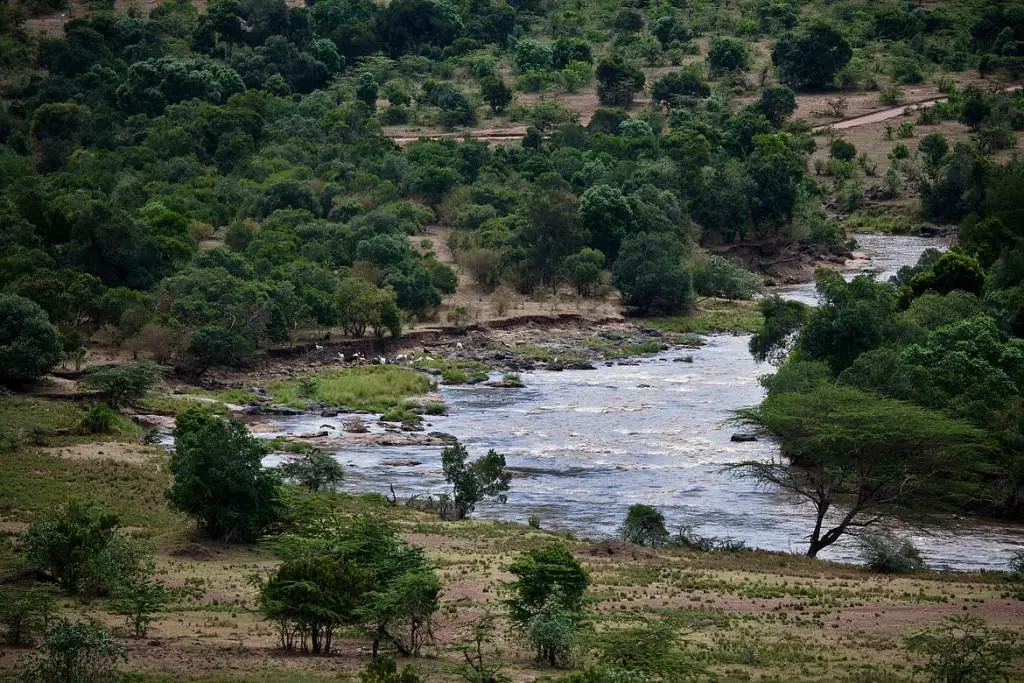
Stretching across the southwestern reaches of Bomet County, the Trans Mara Forest is one of the last surviving jewels of the vast Mau Forest Complex — Kenya’s largest remaining continuous block of indigenous forest. Spanning 344 square kilometers, this forest forms a critical ecological corridor between the Mau highlands and the Maasai Mara National Reserve, providing refuge to a wide array of flora and fauna, including the rare Yellow-Backed Duiker, a species found nowhere else in Kenya.
The Mau Complex, covering approximately 2,773 km², is subdivided into seven forest zones — Mau Narok, Maasai Mau, Eastern Mau, Western Mau, South Mau, South West Mau, and Trans Mara Forest. Collectively, these forests occupy about 14.5% of Kenya’s total gazetted forest area, underscoring their immense environmental importance. Within this network, Nyakweri Forest, the largest remaining section of Trans Mara, serves as a vital wildlife dispersal area for species migrating in and out of the Maasai Mara.
Historically, Trans Mara District was carved out of Narok County in 1994, with its administrative headquarters at Kilgoris. Both the Mara Triangle and Trans Mara Forest were part of this district until 2010, when the new constitution restored the region to Narok County. Despite its extraordinary biodiversity and proximity to one of Africa’s most famous wildlife reserves, the Trans Mara Forest remains underdeveloped for tourism, a paradox considering its ecological wealth and scenic appeal.
The forest was gazetted in 1941 as a Forest Reserve, yet over the decades, it has suffered from extensive human interference. Between 1979 and 1986, large-scale logging operations and illegal land clearances drastically altered its lower zones. Even the once pristine bamboo belts were degraded, replaced by tea plantations and agricultural plots. These activities not only disrupted habitats but also accelerated soil erosion and reduced the area’s carbon storage capacity.
However, one of the unique aspects of Trans Mara Forest lies in the Maasai community’s deep-rooted conservation ethos. Traditionally, the Maasai regard the forest as sacred — a life-giving source akin to their cherished cattle. Their custodianship has been instrumental in preserving portions of the forest’s natural integrity. Today, community-led conservation groups such as the Saparingo Rangers continue to protect the forest through dialogue, education, and participatory management, emphasizing coexistence rather than confrontation.
The Trans Mara Forest remains an ecological lifeline — a living testament to Kenya’s natural beauty and cultural resilience. Protecting it is not just a matter of environmental stewardship but also of honoring the communities that have safeguarded it for generations.


