


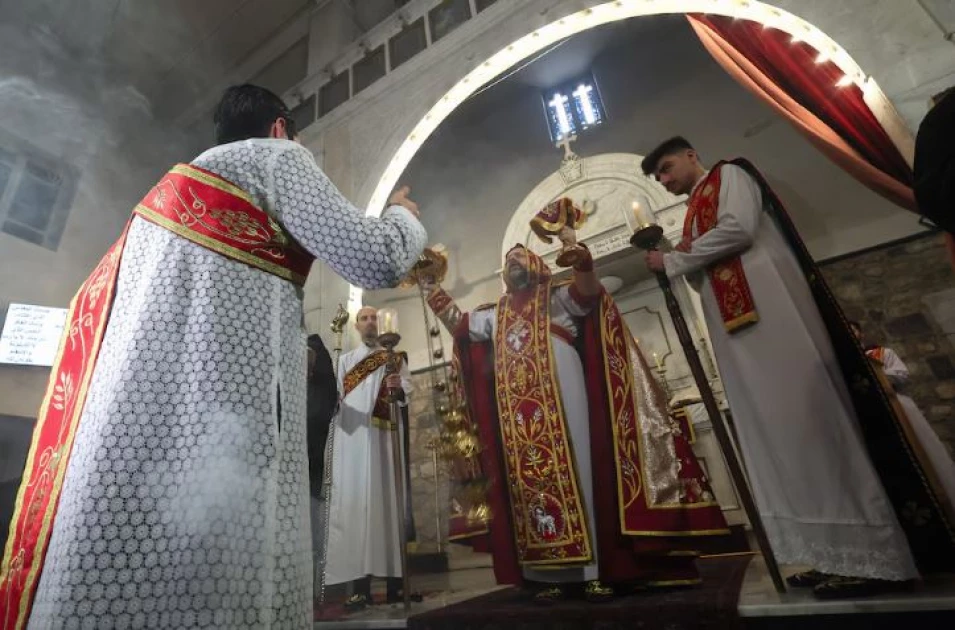
Before the civil war erupted in 2011, Syria was home to about one million Christians, according to analyst Fabrice Balanche, who says their number has dwindled to about 300,000. Syria’s Christians Face Fear and Uncertainty. As the festive season approaches, Syria’s Christian community is gripped with fear and apprehension under the rule of new Islamist leaders. Church leaders have called for toned-down Christmas celebrations this year, reflecting a cautious approach despite assurances from Hayat Tahrir al-Sham (HTS), the Islamist group now in control, that religious freedoms will be upheld. The self-imposed constraints underscore the challenge facing the HTS leadership: rebuilding trust among Syria’s diverse religious and ethnic minorities, many of whom remain deeply scarred by decades of dictatorship and 13 years of civil war.
Ahmed al-Sharaa, the de facto leader of HTS, has attempted to reassure minorities, including Christians, that they will be safe under the group’s administration. Formerly a commander in the Sunni Islamist faction once aligned with al-Qaeda, Sharaa has shed his militant image for a more statesmanlike approach, often meeting Western officials in business suits rather than traditional jihadist attire. He has publicly stated that HTS will neither seek revenge against supporters of the former Alawite-led regime of Bashar al-Assad nor oppress other religious minorities.
However, for many Christians, Sharaa’s promises ring hollow. On December 18, gunmen attacked a Greek Orthodox church in Hama, vandalizing headstones in a nearby cemetery and attempting to destroy a cross. The attack sent shockwaves through the Christian community, despite a swift response from HTS authorities, who arrested the perpetrators and issued public apologies.
In the predominantly Christian neighborhood of Bab Touma in Damascus, residents have reported incidents of intimidation. SUVs with loudspeakers blasting jihadist anthems patrolled the streets, while an armored vehicle drove through a Christian quarter with a menacing message on its window: “Your day is coming, Oh worshippers of the cross.” While HTS has taken steps to address these provocations, such displays exacerbate lingering fears within the community.
Bishop Andrew Bahhi of St. George’s Syriac Orthodox Church described the atmosphere as tense but cautiously optimistic. He acknowledged HTS’s prompt response to recent incidents but emphasized that the community remains vigilant. “The community is watching to see if the groups currently in power are genuinely committed to establishing a civil society that offers equal opportunities for all,” Bahhi said.
Deep Wounds and Distrust
Syria’s Christian population, alongside other minorities, carries the deep scars of war and decades of authoritarian rule. The community, once thriving, has dwindled significantly over the years due to emigration and conflict. Christians, who include Syriac, Greek, and Armenian Orthodox followers, as well as Catholics, have often felt like pawns caught between warring factions in the civil war.
For individuals like Emilia Katarina, the trauma of Syria’s recent history is deeply personal. Emilia lost her eldest son and husband during the war. Her son, Firas Azar, vanished in 2012 after being detained at a checkpoint by Assad’s forces. Two years later, a shell fired by the rebel group Jaish al-Islam killed her husband and left her and her daughter injured. Sitting beside a portrait of her husband wrapped in the Syrian flag, Emilia shared her lingering fear. “Whenever I hear a sound at night, I jump. Fear is deeply ingrained in us,” she said, clutching a photograph of her missing son.
Her daughter, Mary, voiced the family’s mistrust of the Islamist rulers. “The ideology does not change in an hour,” she said. “We are afraid of this ideology.” Their sentiment reflects the broader skepticism among Syria’s Christians, who question whether HTS’s overtures signal a genuine shift or are merely cosmetic gestures to gain legitimacy. Syria’s Christians Face Fear and Uncertainty
A Community Walking on Eggshells
In response to the uncertainty, church leaders have advised Christians to observe Christmas with restraint. Bishop Bahhi urged young people to avoid public displays of celebration, advising women to dress modestly and keep images of Father Christmas within church premises. He also suggested foregoing the customary practice of distributing sweets on the streets, a tradition that once brought joy to Christian neighborhoods during the holiday season.
The presence of armed, bearded men patrolling the streets of Damascus is a stark reminder of the power dynamics at play. For many Christians, the sight evokes memories of the darker days of the civil war. The challenges faced by Syria’s Christian community mirror those of other minority groups, including Muslim Kurds, Shi’ites, and the Druze, all of whom fear that Sunni Islamist rule could undermine their way of life.
HTS officials have made attempts to engage with Christian leaders, with representatives meeting Bishop Bahhi and others shortly after the fall of Assad’s regime. While the group promised not to harm minorities, skepticism remains high. “How truthful and serious he is? We don’t know,” Bahhi admitted. Syria’s Christians Face Fear and Uncertainty
Trust Remains Fragile
The fragility of trust is compounded by the fragmented nature of Syria’s post-war reality. Even if HTS succeeds in earning the confidence of Christians, the mosaic of other armed Islamist factions operating in the region presents an unpredictable and volatile threat.
During a recent sermon at St. George’s Church, Bishop Bahhi encouraged the faithful to hold onto hope and faith in these challenging times. Among the congregation, Emilia Katarina sat quietly, tears streaming down her cheeks. Rising from her seat, she approached the altar to light a candle and whispered a heartfelt prayer. “Maybe God will answer my prayers and bring back my son,” she said softly. Syria’s Christians Face Fear and Uncertainty
A Nation at a Crossroads
Syria’s new Islamist rulers face a daunting task: bridging deep divides and proving their commitment to tolerance and equality. For Christians and other minorities, the scars of war and mistrust run deep, and it will take more than promises to heal the wounds of the past.
As Christmas approaches, the cautious celebrations in Syria’s Christian neighborhoods serve as a poignant reminder of the uncertainty that hangs over the nation. Whether HTS can establish a civil society that respects the rights of all remains an open question, one that will define Syria’s future for years to come.


