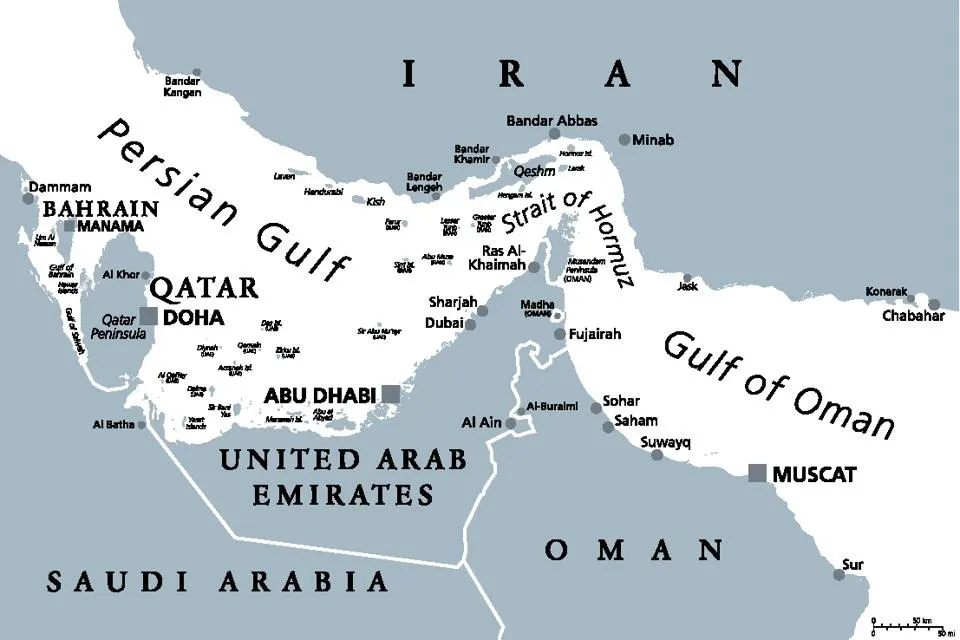
The Strait of Hormuz stands as one of the most strategically significant waterways in the world. Serving as the maritime bridge between the Persian Gulf and the Gulf of Oman, this narrow corridor is vital not only for regional geopolitics but also for the uninterrupted flow of global energy supplies.
Positioned between Iran to the north and the United Arab Emirates and Oman to the south, the Strait forms a critical passage for global maritime commerce. It connects the resource-rich Arabian Peninsula with international markets through the Arabian Sea and, ultimately, the Indian Ocean.
Why the Strait of Hormuz Matters
This slender channel handles roughly 20% to 30% of the world’s seaborne oil trade, making it indispensable to the global energy market. Crude oil and petroleum products from Saudi Arabia, Iran, Iraq, Kuwait, and Qatar all pass through this narrow maritime bottleneck en route to customers in Asia, Europe, and beyond.
In addition to oil, the Strait is a major artery for liquefied natural gas (LNG) shipments, especially from Qatar, one of the world’s leading LNG exporters. A disruption in this vital passage would have profound consequences on energy prices and supply chains around the globe.
Geography and Navigational Characteristics
- The narrowest width of the Strait is just 33 kilometers, but only 3.5 kilometers in each direction are designated for shipping lanes, making it extremely sensitive to maritime disruptions or blockades.
- The depth of the navigable channels ranges between 46 and 61 meters, with the deepest points reaching up to 91 meters. However, some areas near the Iranian coastline are significantly shallower, dipping to 15–30 meters, which poses challenges for large vessels.
- Despite its limited width, the Strait handles thousands of oil tankers and cargo ships annually, thanks to carefully marked international shipping lanes governed by maritime law.
Legal and Strategic Significance
Under international maritime law, particularly the United Nations Convention on the Law of the Sea (UNCLOS), the Strait of Hormuz is classified as an international waterway. This legal status guarantees freedom of navigation to all nations, which is critical for global commerce and the free flow of resources.
However, due to its geopolitical position, the Strait often becomes a flashpoint for regional tensions. Iran, which borders the northern edge, has occasionally threatened to block the Strait in response to sanctions or military actions, raising fears of conflict and disruptions to oil shipments.
Global Context: Other Strategic Straits
In geographical terms, a strait is a narrow, naturally formed water passage that connects two larger bodies of water. Like the Strait of Hormuz, several other straits play key roles in global trade and geopolitics:
- Strait of Gibraltar: Links the Mediterranean Sea to the Atlantic Ocean, located between Spain and Morocco.
- Bering Strait: Connects the Arctic Ocean to the Pacific Ocean, separating Russia’s Siberia from Alaska.
The Strait of Hormuz remains a critical artery for the world’s economy. Any threat to its stability sends shockwaves through global markets, highlighting just how dependent modern civilization remains on this narrow but mighty maritime passage.