A university-led lunar orbiter designed to hunt for water on the Moon is almost ready for launch. Lunar Trailblazer, a NASA-backed mission, is set to fly aboard a SpaceX Falcon 9 rocket no earlier than February 26, 2024, from Kennedy Space Center in Florida. The spacecraft will ride as a rideshare payload alongside the Athena lunar lander, built by Intuitive Machines, marking another step in NASA’s quest to understand and utilize lunar water resources.
A Mission to Find Lunar Water
Lunar Trailblazer is designed to pinpoint water ice and liquid water trapped in lunar rocks. Unlike past lunar missions, which have hinted at the presence of water, this probe will conduct detailed mapping of permanently shadowed regions and track how water signatures change over time.
The spacecraft will measure:
✅ Micro-cold traps—regions less than a football field in size where water could accumulate.
✅ Water movement—how water and water-like molecules freeze, thaw, and evaporate on the Moon.
✅ Lunar surface temperatures—monitoring how water behavior changes during extreme temperature fluctuations throughout a lunar day.
The Technology Behind Lunar Trailblazer
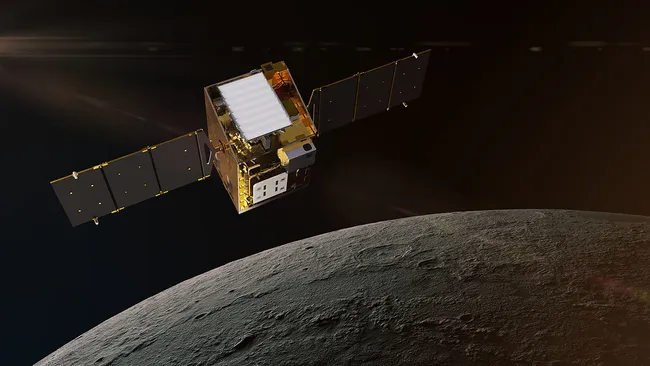
The 440-pound (200 kg) orbiter, developed by Lockheed Martin, is built on the company’s Curio platform, a scalable small satellite system designed for cost-efficient deep-space exploration.
The probe carries two key instruments:
🔹 High-resolution Volatiles and Minerals Moon Mapper (HVM3) – Provided by NASA’s Jet Propulsion Laboratory (JPL), this instrument will detect water molecules and other volatile substances.
🔹 Lunar Thermal Mapper (LTM) – Developed by the University of Oxford, LTM will analyze the Moon’s surface temperature variations, helping scientists determine how water interacts with the environment.
These instruments will allow researchers to better understand the Moon’s water cycle—an essential step toward sustained lunar exploration.
“Lunar Trailblazer shares a good bit of heritage with the GRAIL spacecraft that explored lunar gravity,” said Bronson Collins, chief engineer of the mission.
A Fast-Paced, High-Risk, Low-Cost Mission
Lunar Trailblazer is part of NASA’s Small Innovative Missions for Planetary Exploration (SIMPLEx) program, which prioritizes low-cost, high-impact science missions. As such, the probe follows a “single-string spacecraft architecture”, meaning it lacks redundancy in critical systems—an intentional tradeoff to reduce costs and development time.
To further save costs, the spacecraft incorporates commercial off-the-shelf components rather than custom-built hardware. While this increases risk, it enables faster, more affordable space exploration.
“That product line is intended to enable lower-cost, faster access to space,” said Ryan Pfeiffer, Lockheed Martin program manager for Lunar Trailblazer.
Journey and Mission Timeline
🚀 Launch Date: February 26, 2024 (no earlier than)
🌕 Arrival at the Moon: 4–7 months after launch
📡 Mission Duration: 1 year or more
💥 End of Mission: Surface impact (controlled crash)
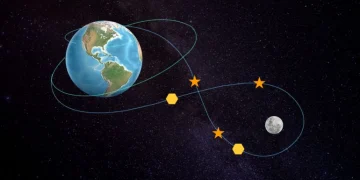
After launch, Lunar Trailblazer will take four to seven months to reach the Moon, depending on the chosen trajectory. Once in lunar orbit, the spacecraft will conduct a year-long investigation before being intentionally crashed into the Moon’s surface for disposal.
“The lunar environment is really challenging,” Pfeiffer noted, citing the harsh radiation exposure and extreme temperature shifts that spacecraft must endure.
Why Lunar Water Matters
Understanding the Moon’s water distribution and behavior is essential for future space exploration. The data collected by Lunar Trailblazer could support:
🌙 Sustained lunar habitation under Artemis – By identifying accessible water resources for astronauts.
🚀 Fuel production for deep-space missions – Water can be split into hydrogen and oxygen, essential components for rocket fuel.
🔬 Insights into planetary evolution – Helping scientists understand how water arrived on the Moon and its role in the solar system’s history.
“It’s important for us to know how our solar system has evolved over time,” said Whitley Poyser, Lockheed Martin’s director of deep-space exploration. “Appraising the Moon’s water resources will help us understand how best to use them.”
A Stepping Stone for Mars Exploration
NASA envisions long-term human presence on the Moon as a testing ground for Mars missions. Studying lunar water will teach scientists and engineers how to extract and use resources in space, a capability that will be critical for future Mars missions.
“There is so much that we will learn being at the Moon to help us know how to effectively live at Mars,” Poyser said.
With Lunar Trailblazer now at Cape Canaveral, undergoing final pre-launch preparations, the countdown is on for this groundbreaking mission that could redefine our understanding of water on the Moon and pave the way for human expansion beyond Earth. 🚀🌕