
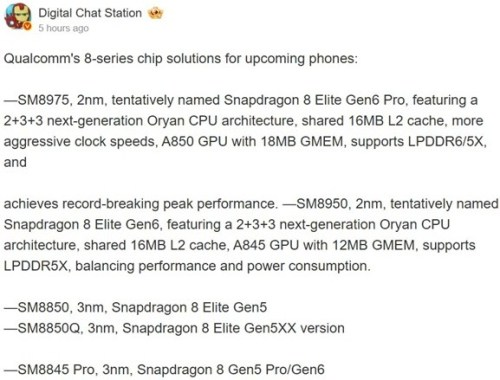
Snapdragon 8 roadmap details have surfaced online, suggesting Qualcomm may be preparing a more crowded flagship chip lineup than expected. The leaked roadmap points to two additional 3nm Snapdragon 8-series chips, alongside previously rumored 2nm flagship processors under the Snapdragon 8 Elite family.
The information comes from tipster Digital Chat Station and remains unofficial for now. Qualcomm has not announced the new chips, and final names may change before launch. Still, the leak gives an early look at how Qualcomm could structure its next wave of premium Android processors.
According to the report, Qualcomm is working on a Snapdragon 8 Elite Gen 5XX version with the internal part number SM8850Q, as well as a Snapdragon 8 Gen 5 Pro with the internal part number SM8845 Pro. Both are said to be based on a 3nm manufacturing process.
These chips would sit alongside the rumored Snapdragon 8 Elite Gen 6 and Snapdragon 8 Elite Gen 6 Pro, which are expected to move to a more advanced 2nm process. If accurate, Qualcomm’s flagship roadmap could include several performance tiers instead of one simple annual flagship chip.
Qualcomm’s Current Snapdragon 8 Lineup
Qualcomm officially introduced the Snapdragon 8 Elite Gen 5 as its flagship mobile platform, positioning it as a major performance and AI upgrade for premium Android devices.
The Snapdragon 8 Elite Gen 5 uses the SM8850 platform number. It replaced the previous Snapdragon 8 Elite generation and brought improvements in CPU performance, GPU power, AI processing, gaming, imaging and connectivity.
Qualcomm also launched the Snapdragon 8 Gen 5 as a lower-tier premium chip. That chip uses the SM8845 platform number and is designed to offer strong flagship-style performance at a slightly lower level than the Elite version.
The newly leaked chips appear to build on these existing platforms. The SM8850Q could be a revised or enhanced version of the Snapdragon 8 Elite Gen 5, while the SM8845 Pro could be a stronger version of the Snapdragon 8 Gen 5.
Snapdragon 8 Elite Gen 5XX: What the Leak Suggests
The Snapdragon 8 Elite Gen 5XX version is reportedly identified by the part number SM8850Q. That suggests it may be closely related to the Snapdragon 8 Elite Gen 5, which uses SM8850.
The “Q” suffix could point to a special edition, refreshed model or higher-binned variant, although that has not been confirmed. Qualcomm sometimes works with modified chip versions for specific device makers, gaming phones or mid-cycle refreshes.
If the Snapdragon 8 Elite Gen 5XX exists, it may give Android brands another premium option before the full 2nm Snapdragon 8 Elite Gen 6 generation arrives.
This could be useful for manufacturers that want to release late-cycle flagships with improved performance without waiting for the next major chip family.
Snapdragon 8 Gen 5 Pro Could Fill a Key Gap
The second leaked 3nm chip is reportedly the Snapdragon 8 Gen 5 Pro, carrying the SM8845 Pro part number.
This chip could sit between the standard Snapdragon 8 Gen 5 and the Snapdragon 8 Elite Gen 5. That would give phone makers a more flexible option for premium devices that do not need the highest-end Elite platform.
The name is not final. Some reports suggest Qualcomm could eventually launch it as Snapdragon 8 Gen 5 Pro, while others suggest it could appear under a Snapdragon 8 Gen 6 name.
Either way, the idea is clear: Qualcomm may want more performance tiers inside the Snapdragon 8 family.
That could help smartphone brands build different types of flagship and near-flagship phones, including gaming phones, performance mid-range devices, slim flagships and value-focused premium models.
Why 3nm Still Matters
The leak is especially interesting because these two additional chips are said to remain on a 3nm process.
A smaller manufacturing process can help improve performance and efficiency, but not every chip needs to move to the newest node immediately. Newer process nodes are often more expensive, supply-limited and technically demanding.
By keeping some Snapdragon 8 chips on 3nm, Qualcomm may be able to offer strong performance at a lower cost than the upcoming 2nm Elite chips.
This matters for phone makers. If 2nm chips are more expensive, brands may use 3nm Snapdragon 8 variants in devices that need strong performance but cannot carry the highest flagship price.
The result could be a more layered Android flagship market, with 3nm chips serving premium and semi-premium devices while 2nm chips power the most expensive phones.
2nm Snapdragon 8 Elite Gen 6 Chips Also Rumored
The roadmap leak also connects to earlier reports about Qualcomm’s future 2nm chips.
Two major 2nm processors are expected under the Snapdragon 8 Elite line: Snapdragon 8 Elite Gen 6 and Snapdragon 8 Elite Gen 6 Pro. Their internal part numbers are reportedly SM8950 and SM8975.
The Snapdragon 8 Elite Gen 6 Pro is expected to be the stronger of the two. Reports suggest it could feature a more powerful GPU, improved memory support and higher-end specifications designed for ultra-premium Android phones.
The move to 2nm would be significant because it could improve performance, power efficiency and transistor density. That would help future Android flagships handle heavier gaming, AI, camera processing and multitasking workloads.
Snapdragon 8 Elite Gen 6 Pro Could Target Ultra Flagships
The Snapdragon 8 Elite Gen 6 Pro appears to be aimed at the highest tier of Android phones.
This could include ultra-premium devices such as future Galaxy Ultra models, gaming phones and high-end flagships from Chinese manufacturers. These are the devices where brands compete most aggressively on benchmarks, gaming performance, camera processing and AI features.
If the Pro version uses a stronger GPU and more advanced memory support, it could help Qualcomm give Android brands a clearer answer to Apple’s A-series chips and MediaTek’s top Dimensity processors.
However, the Pro chip may also be expensive. If 2nm production costs are high, phone makers may reserve the Snapdragon 8 Elite Gen 6 Pro for their most premium models.
That would make the lower 3nm Snapdragon 8 variants more important for mainstream flagships.
Why Qualcomm May Be Expanding the Roadmap
Qualcomm may be expanding the Snapdragon 8 roadmap because the Android market is no longer simple.
Not every flagship phone needs the exact same chip. Some brands want the absolute best processor for premium devices. Others want a strong chip with better pricing. Some want gaming performance. Others want efficiency, AI, imaging or slim-device thermal control.
A wider Snapdragon 8 lineup gives Qualcomm and phone makers more flexibility.
Instead of one flagship chip serving every premium phone, Qualcomm could offer multiple tiers: a standard 8-series chip, a Pro version, an Elite version and an Elite Pro version.
This strategy could help Qualcomm compete better against MediaTek, which has become much stronger in the flagship and premium Android space.
AI Is Becoming a Major Chip Priority
The next Snapdragon 8 chips are expected to focus heavily on AI.
Modern smartphones increasingly rely on AI for photography, video, voice assistants, translation, search, productivity features, gaming enhancements and background optimization.
That means future mobile processors need stronger neural processing units, faster memory, better GPU compute and more efficient power management.
Qualcomm has already placed AI at the centre of its Snapdragon branding. The next 3nm and 2nm chips will likely continue that direction.
For users, this could mean faster on-device AI features, better camera processing, smarter battery management and improved performance in apps that use local machine learning.
Gaming Could Be Another Major Focus
Qualcomm’s Snapdragon 8 chips are also important for mobile gaming. Premium Android phones often rely on Snapdragon processors for high frame rates, ray tracing features, thermal efficiency and GPU stability.
A broader chip lineup could allow gaming phone brands to choose more specific processors. A 3nm enhanced chip could power performance-focused phones at a lower cost, while a 2nm Elite Pro chip could power the most expensive gaming flagships.
The rumored Snapdragon 8 Elite Gen 6 Pro may be especially important if it brings a stronger GPU. Mobile games are becoming more demanding, and higher refresh-rate displays require more sustained performance.
Gaming phones also need chips that can manage heat well. A more efficient process node could help, but device cooling and software tuning will still matter.
Camera Processing Will Also Benefit
Smartphone camera performance increasingly depends on the chip, not just the camera sensor.
Modern phones use image signal processors and AI engines for HDR, night mode, portrait effects, video stabilization, autofocus, skin tones, object detection and real-time video processing.
Future Snapdragon 8 chips will likely improve camera processing again, especially for flagship phones with multiple sensors and advanced video modes.
This is important because many Android brands use camera quality as a major selling point. A stronger Snapdragon chip gives them more room to improve computational photography.
The 2nm Elite chips could bring the biggest improvements, but even updated 3nm variants may help premium phones deliver better imaging performance.
Why the Naming Could Become Confusing
The leaked roadmap also shows how confusing Qualcomm’s naming could become.
Snapdragon 8 Elite Gen 5, Snapdragon 8 Elite Gen 5XX, Snapdragon 8 Gen 5 Pro, Snapdragon 8 Elite Gen 6 and Snapdragon 8 Elite Gen 6 Pro are all similar names. For ordinary buyers, it may be difficult to know which chip is better.
This matters because smartphone buyers increasingly compare specs before purchasing. If chip names become too similar, users may not understand the difference between a true flagship and a near-flagship model.
Qualcomm and phone makers will need clear marketing. They must explain which chips are designed for ultra-premium phones, which are for value flagships and which are refreshed versions of older platforms.
Without that clarity, the expanded roadmap could create confusion.
What This Means for Android Phone Makers
For Android phone makers, the leaked roadmap could be good news.
More Snapdragon 8 options give brands more freedom when designing phones. A company could use the most expensive 2nm Elite Pro chip for its top flagship and a cheaper 3nm Pro chip for a more affordable performance model.
This could help brands build wider product portfolios without sacrificing too much performance.
It may also help with pricing. If 2nm chips are expensive, not every premium phone needs to use them. A strong 3nm chip could still deliver excellent performance while keeping the final phone price more competitive.
This could be especially important in markets such as India, China and Southeast Asia, where performance-focused phones often compete aggressively on price.
What This Means for Buyers
For buyers, the Snapdragon 8 roadmap could bring more choice but also more complexity.
High-end users may want phones with the latest 2nm Snapdragon 8 Elite Gen 6 Pro. These devices will likely offer the best performance, graphics and AI capabilities.
Users who want strong performance at a lower price may benefit from phones using 3nm Snapdragon 8 Gen 5 Pro or Snapdragon 8 Elite Gen 5XX chips.
The key will be understanding the difference between each processor. Buyers should not judge only by the Snapdragon 8 name. They should also look at benchmarks, battery life, thermal performance, update policy, camera results and real-world reviews.
The chip matters, but the whole phone experience matters more.
Launch Timing
Qualcomm usually announces its flagship Snapdragon chips around its annual Snapdragon Summit. The Snapdragon 8 Elite Gen 5 was introduced in September, so future flagship announcements could follow a similar timeline.
If the leaked roadmap is accurate, Qualcomm could reveal some of these new Snapdragon 8 chips later this year or around the next major Snapdragon event.
However, the final timeline remains uncertain. Chip names, launch order and device availability can change before official announcements.
Even after Qualcomm announces a chip, the first phones using it may arrive weeks or months later depending on each manufacturer’s launch schedule.
Competition With MediaTek and Apple
Qualcomm’s roadmap also needs to be viewed against its competitors.
Apple continues to push its A-series chips in iPhones, with strong CPU performance and tight hardware-software integration. MediaTek has also become a serious rival in Android flagships with its Dimensity series.
Qualcomm remains the most recognized premium Android chip brand, but the competition is stronger than before. That may explain why Qualcomm is preparing more chip variants and faster transitions to newer process nodes.
A wider Snapdragon 8 lineup could help Qualcomm defend different parts of the market. The Elite Pro chips can target the top performance crown, while 3nm variants can target broader premium adoption.
Why This Roadmap Matters
The Snapdragon 8 roadmap matters because it could shape the next generation of Android flagship phones.
Processors influence performance, gaming, battery life, camera quality, AI features and device pricing. A change in Qualcomm’s chip strategy can therefore affect dozens of future smartphones.
If Qualcomm offers both 3nm and 2nm Snapdragon 8 chips, phone makers will have more flexibility. Consumers may see more variety in flagship pricing and performance levels.
The downside is that the market may become harder to understand. Buyers will need to pay closer attention to exact chip names and not assume every Snapdragon 8 phone offers the same level of performance.
Final Thoughts
The latest Snapdragon 8 roadmap leak suggests Qualcomm is preparing a more complex flagship strategy. Alongside rumored 2nm Snapdragon 8 Elite Gen 6 and Snapdragon 8 Elite Gen 6 Pro chips, the company is also said to be working on two additional 3nm chips: Snapdragon 8 Elite Gen 5XX and Snapdragon 8 Gen 5 Pro.
If accurate, the move would give Qualcomm more options across the premium Android market. The 2nm chips could serve ultra-premium flagships, while the 3nm variants could power high-end phones with a better balance of performance, efficiency and cost.
The roadmap also reflects where the smartphone industry is heading. AI, gaming, camera processing and energy efficiency are becoming more important than simple benchmark scores.
Qualcomm has not confirmed these new chips, so the details should still be treated as rumors. But if the leak is correct, the next Snapdragon 8 generation could bring more choice, more power and more confusion to the Android flagship market.
Read Also: Apple M7 Chip Strategy Could Change the Mac Roadmap