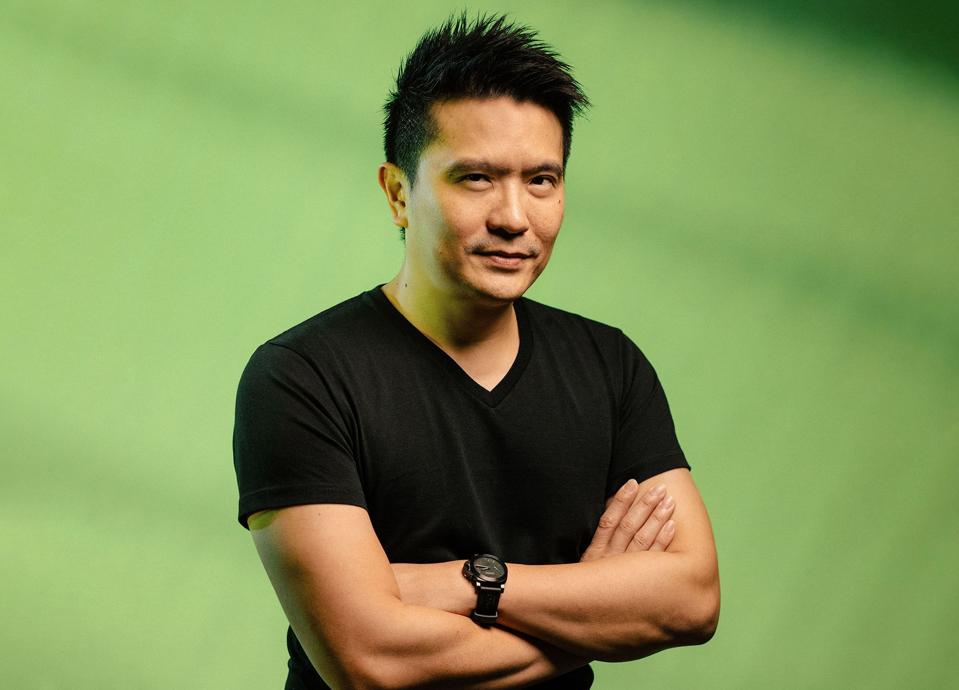
The Singapore Gaming Billionaire, Min-Liang Tan, is making a bold wager that artificial intelligence will reshape the gaming industry from top to bottom. As chairman and CEO of Razer, Tan has spent two decades building one of the world’s most recognized gaming brands. Now, his company is pivoting toward AI-powered tools designed to help both developers and players.
At Razer’s $75 million Singapore headquarters—instantly recognizable with its glowing green triple-snake logo—teams are working on software that could redefine gaming. Two key projects are in testing: QA Co-AI, a tool designed to help developers detect glitches faster and cut production costs, and Game Co-AI, which acts as a real-time coach for players. Tan believes these innovations will “completely disrupt the entire game industry.”
Razer’s AI move comes at a critical moment. The gaming hardware market, worth $42 billion, is struggling under inflation, rising costs, and slowing consumer demand. Roughly 90% of Razer’s sales still come from peripherals such as mice, keyboards, and headsets. Shifting into AI software offers the company a chance to unlock higher margins and diversify its revenue base.
The opportunity is massive. According to Market.US, AI in gaming is forecast to grow from $2.3 billion in 2023 to $28 billion by 2033. Analysts suggest this could help Razer transition from a hardware-heavy business into a high-margin software platform. “The AI tools could transform Razer into a gameplay architect,” notes Loo Wee Teck of Euromonitor International.
Investors are watching closely. Tan and billionaire board member Lim Kaling control about two-thirds of privately held Razer, alongside backer CVC Capital Partners. The company went private in 2022 in a $3.2 billion deal but is already being eyed for a possible future IPO. Tan admits monetization is still developing but envisions subscription models and licensing deals for its AI products.
Razer is not without competition. U.S. firms like Unity Technologies and Mobalytics already dominate game testing and coaching, while Tencent and Krafton are pushing their own AI capabilities in Asia. Still, Tan is confident. With ties to 55,000 game developers and esports partnerships that include elite players like Faker and teams such as OpTic and Sentinels, Razer has deep roots in the global gaming community.
The company’s AI tools are also practical. QA Co-AI can identify 25% more bugs than manual testing and cut testing time by half, saving developers up to 40% in production costs. Game Co-AI, meanwhile, learns from esports pros and can coach casual players through difficult quests without needing YouTube tutorials. For developers, this means faster releases; for players, it means seamless skill improvement.
Tan is scaling up fast. Razer plans to expand its AI team in Singapore from 50 to 150 specialists and set up hubs in Europe and the U.S. Singapore’s government is supporting the hiring drive, reinforcing the country’s role as an AI hub. “We’re pulling the entire ecosystem together,” says Razer’s chief strategy officer Li Meng Lee.
Financially, Razer remains strong, with global revenue above $1 billion and a software base of 200 million users. Yet profit pressures remain. In 2024, Razer Asia-Pacific posted revenue of $551 million but profits dropped more than 90% to $3 million. Tan dismissed concerns, saying the report doesn’t capture global earnings and emphasized that the company is investing heavily in future growth.
For Tan, an avid gamer since childhood, the move into AI feels like a natural extension of Razer’s mission. From pioneering cloud gaming with Razer Synapse in 2006 to developing fintech tools like Razer Gold, the company has consistently experimented beyond hardware. Now, Tan sees AI as the next great frontier.
“AI will increase productivity across the industry,” he says. “That means developers can do more in less time—and gamers will have more time to play.”
With his bold push into AI, the Singapore Gaming Billionaire is betting big that the next chapter of global gaming will be written not just with hardware but with intelligence.