


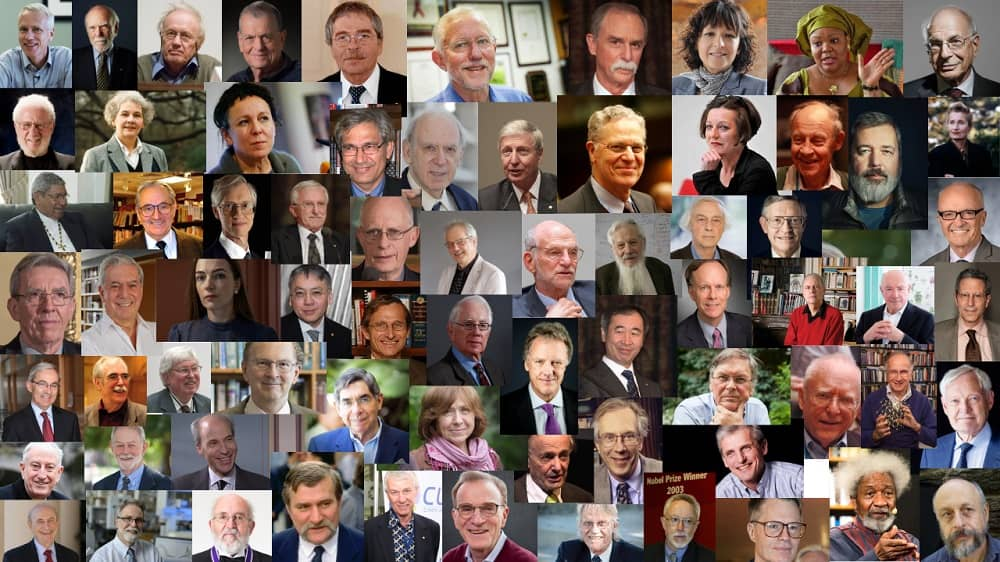
A group of 75 Nobel laureates has sent a powerful letter to world leaders, urging support for the Iranian people in their fight for democracy and freedom. This letter highlights the dire human rights situation in Iran and expresses solidarity with the ongoing democratic uprising.
Human Rights Concerns: The laureates’ letter expresses deep concern over the worsening human rights conditions in Iran, where 80% of the population lives below the poverty line, and the regime executes a citizen every six hours. In May 2023 alone, there were 144 executions, making Iran the country with the highest number of executions per capita.
Global Support: The Nobel laureates join a growing chorus of international support, which includes statements from 117 former world leaders, the majority of the US House of Representatives, and many European parliaments. They endorse Maryam Rajavi’s Ten-Point Plan, which calls for:
- A secular republic based on freedom and democracy.
- Universal suffrage and free elections.
- A market economy.
- Gender, religious, and ethnic equality.
- A non-nuclear Iran.
- A foreign policy based on peaceful coexistence.
Solidarity with Iranian People: The signatories, prominent individuals from five continents, recognize and support the Iranian people’s four-decade-long struggle for freedom and democracy, rejecting both the ousted Shah’s dictatorship and the ruling clerics. They call for the Iranian Revolutionary Guards Corps (IRGC) to be listed as a terrorist organization by free nations worldwide.
Joint Letter of the Nobel Laureates
To:
- Joe Biden, President of the United States
- Charles Michel, President of the European Council
- Rishi Sunak, Prime Minister of the United Kingdom
- Justin Trudeau, Prime Minister of Canada
Copies to:
- Leaders of 27 member states of the European Union
Message: The laureates express their deep concern over the appalling human rights situation in Iran and urge global leaders to support the Iranian people’s quest for democracy and freedom. They highlight the severe crackdown on protests, with hundreds killed, including children, and tens of thousands arrested. The letter emphasizes the importance of international solidarity and calls for listing the IRGC as a terrorist entity to curb its brutality and export of violence.
Signatories: The letter is signed by distinguished Nobel laureates, including:
Signatories:
- Lech Walesa, President of Poland 1990-1995, Nobel Prize, Peace 1983, Poland
- Oscar Arias Sanchez, (President of Costa Rica 2006-2010), Nobel Prize, Peace 1986, Costa Rica
- Professor Svetlana Alexievich, Nobel Prize, Literature 2015, Belarus
- Professor Harvey J Alter, Nobel Prize, Medicine 2020, USA
- Professor Robert Aumann, Nobel Prize, Economics 2018, USA-Israel
- Professor Barry C Barish, Nobel Prize, Physics 2017, USA
- Professor Georg Bednorz, Noble Prize, Physics 1987, Germany
- Carlos Filipe Ximenes Belo, Nobel Prize, Peace 1996, East Timor
- Professor Bruce Beutler, Nobel Prize, Medicine, 2011, USA
- Dmitry Buratov, Nobel Prize, Peace 2021, Russia
- Professor Emmanuelle Charpentier, Nobel Prize, Chemistry 2020, Germany-France
- Professor Thomas Cech, Nobel Prize, Chemistry 1989, USA
- Professor Aaron Ciechanover, Nobel Prize, Chemistry 2004, Israel
- Professor John Maxwell Coetzee, Nobel Prize, Literature 2003, South Africa
- Professor Elias Corey, Nobel Prize, Chemistry 1990, USA
- Professor Johann Deisenhofer, Nobel Prize, Chemistry 1988, USA-Germany
- Professor Peter Doherty, Nobel Prize, Medicine 1996, Australia
- Professor Gerhard Ertl, Nobel Prize, Chemistry 2007, Germany
- Professor Jerome Friedman, Nobel Prize, Physics 1990, USA
- Professor Joachim Frank, Nobel Prize, Chemistry 2017, USA
- Madam Leymah Roberta Gbowee, Nobel Prize, Peace 2011, Liberia
- Professor Reinhard Genzel, Nobel Prize, Physics 2020, Germany
- Professor Sheldon Glashow, Nobel prize, Physics 1979, USA
- Professor John Lewis Hall, Nobel Prize, Physics 2005, USA
- Professor Oliver Hart, Nobel Prize, Economics 2016, USA
- Professor Alan Heeger, Nobel prize, Chemistry 2000, USA
- Professor Dudley Herschbach, Nobel Prize, Chemistry 1986, USA
- Professor Roald Hoffmann, Nobel Prize, Chemistry 1981, USA
- Professor Jules Hoffmann, Nobel Prize, Medicine 2011, France
- Professor Robert Huber, Nobel Prize, Chemistry, 1988, Germany
- Professor Tim Hunt, Nobel Prize, Medicine 2001, UK
- Sir Kazuo Ishiguro, Nobel Prize, Literature 2017, UK-Japan
- Elfriede Jelinek, Noble prize, Literature 2004, Austria
- Professor William Kaelin Jr., Nobel Prize, Medicine 2019, USA
- Professor Takaaki Kajita, Nobel Prize, Physics 2015, Japan
- Professor Daniel Kahneman, Nobel Prize, Economics 2002, USA-Israel
- Professor Wolfgang Ketterle, Nobel Prize, Physics 2001, USA-Germany
- Professor Brian Kobilka, Nobel Prize, Chemistry 2012, USA
- Professor Roger D. Kornberg, Nobel Prize, Chemistry 2006, USA
- Professor Finn Kydland, Nobel Prize, Economics 2004, Norway
- Professor Jean-Marie Gustave Le Clézio, Nobel Prize, Literature 2008, France
- Professor Anthony Legett, Nobel Prize, Physics 2003, UK-USA
- Professor Morio Vargas Llosa, Nobel Prize, Literature 2010, Peru
- Professor David MacMillan, Nobel Prize, Chemistry 2021, UK-USA
- Professor Eric Maskin, Nobel Prize, Economics 2007, USA
- Professor John C. Mather, Nobel Prize, Physics 2006, USA
- Oleksandra Matvichuk, Nobel Prize, Peace 2022, Ukraine
- Professor Morten P. Meldal, Nobel Prize, Chemistry 2022, Denmark
- Professor Michel Mayor, Nobel Prize, Physics 2019, Switzerland
- Professor Patrick Modiano, Nobel Prize, Literature 2014, France
- Professor Paul Modrich, Nobel Prize, Chemistry 2015, USA
- Professor William Moerner, Nobel Prize, Chemistry 2014, USA
- Herta Muller, Nobel Prize, Literature 2009, Germany
- Professor Alice Munro, Nobel Prize, Literature 2013, Canada
- Professor Christiane Nüsslein-Volhard, Nobel Prize, Medicine 1995, Germany
- Professor Orhan Pamuk, Nobel Prize, Literature 2006, Turkey
- Professor Christopher Pissarides, Nobel Prize, Economics 2010, UK-Cyprus
- Professor John Polanyi, Nobel Prize, Chemistry 1986, Canada
- Professor David Politzer, Nobel Prize, Physics 2004, USA
- Professor Sir Peter Ratcliffe, Nobel Prize, Medicine 2019, UK
- Professor Charles Rice, Nobel Prize, Medicine 2020, USA
- Professor Sir Richard J. Roberts, Nobel Prize, Medicine 1993, UK-USA
- Professor Michael Rosbash, Nobel Prize, Medicine 2017, USA
- Professor Jean-Pierre Sauvage, Nobel Prize, Chemistry 2016, France
- Professor Randy Schekman, Nobel Prize, Medicine 2013, USA
- Professor Richard Schrock, Nobel Prize, Chemistry 2005, USA
- Professor Gregg Semenza, Nobel Prize, Medicine 2019, USA
- Professor Vernon Smith, Nobel Prize, Economics 2002, USA
- Professor Wole Soyinka, Nobel Prize, Literature 1986, Nigeria
- Professor Jack Szostak, Nobel Prize, Medicine 2009, USA
- Professor Joseph Taylor, Nobel Prize, Physics 1993, USA
- Professor Olga Tokarczuk, Nobel Prize, Literature 2018, Poland
- Professor Eric Wieschaus, Nobel Prize, Medicine 1995, USA
- Professor David J. Wineland, Nobel Prize, Physics 2012, USA
- Professor Robert Wilson, Nobel Prize, Physics 1978, USA
The Nobel laureates’ letter is a testament to the global support for the Iranian people’s struggle for democracy and human rights. It calls on world leaders to take decisive action in support of a free and democratic Iran.


