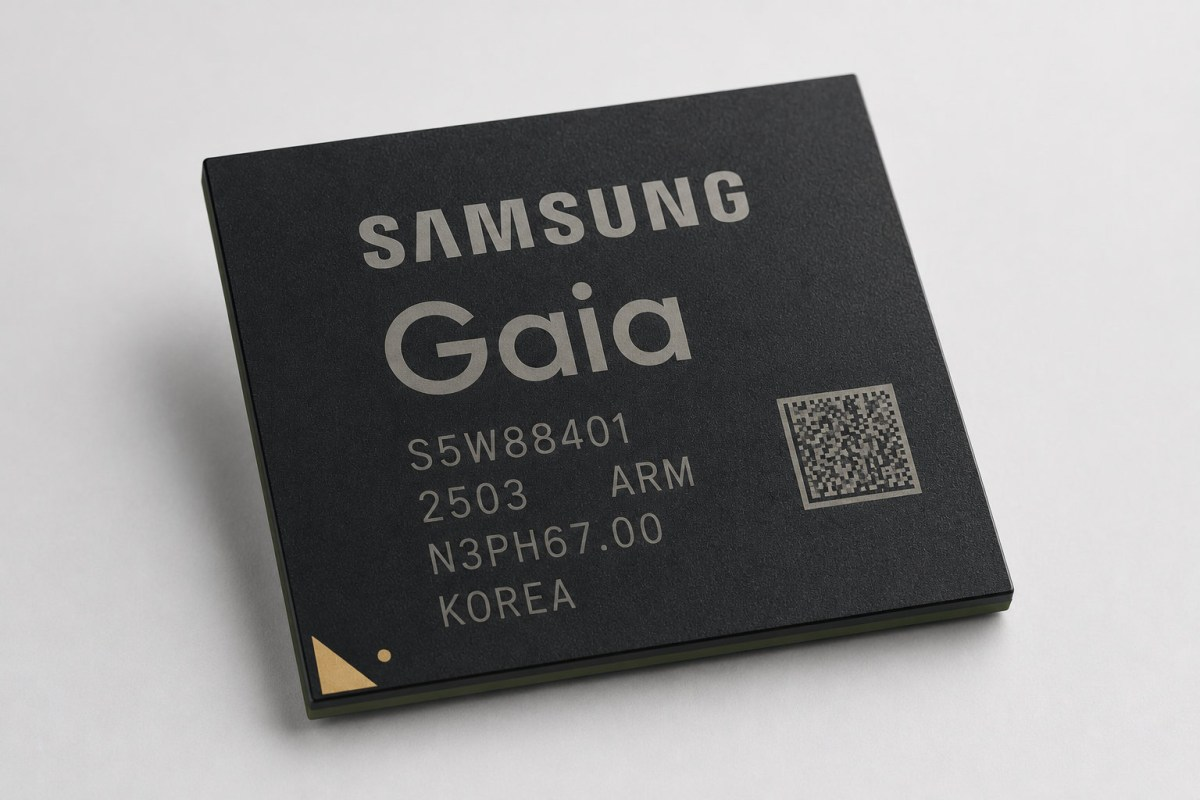
Samsung is reportedly preparing to expand its semiconductor ambitions with a dedicated artificial intelligence accelerator designed for personal computers, signaling another step in the industry’s race to bring more AI processing directly onto devices.
According to reports from South Korea, the technology giant is developing a new AI chip, codenamed “Gaia,” that is intended for edge AI computing in PCs and other intelligent devices. The processor is reportedly being manufactured using a 4-nanometer fabrication process and features a neural processing unit (NPU) architecture optimized for AI workloads.
The reported project reflects a broader industry trend as chipmakers increasingly focus on specialized processors capable of running AI models locally rather than relying entirely on cloud computing. This shift is being driven by growing demand for faster response times, stronger privacy protections, lower latency, and reduced dependence on internet connectivity.
Although Samsung has not officially confirmed the project, reports indicate that prototype versions of the chip have already been supplied to selected customers for evaluation. If development proceeds as planned, commercial production could begin next year.
The move would position Samsung alongside other semiconductor companies investing heavily in AI hardware as demand for AI-enabled personal computers, robotics, and edge computing continues to accelerate.
Samsung AI Chip Targets Edge Computing
The reported AI accelerator, known internally as Gaia, is designed to improve AI performance on personal computers through a dedicated neural processing unit.
Unlike traditional CPUs or graphics processors that handle a wide range of computing tasks, an NPU is specifically engineered to accelerate artificial intelligence operations such as image recognition, speech processing, large language model inference, and other machine learning workloads.
According to the report, Samsung’s AI chip will use a 4nm manufacturing process, allowing the company to balance computing performance with power efficiency.
The processor is expected to target PC edge AI computing, where AI tasks are executed directly on the device instead of being processed remotely in cloud data centers.
Running AI locally offers several advantages, including lower latency, improved privacy, and the ability to continue functioning even with limited internet access.
The report also suggests the processor could find applications beyond traditional computers, including physical AI systems such as robots.
Background: Why AI Chips Matter
Artificial intelligence is rapidly changing the personal computer industry.
Until recently, most AI workloads relied on powerful cloud servers. However, advances in semiconductor technology now allow many AI functions to run directly on consumer devices.
This transition has created growing demand for dedicated AI accelerators that complement CPUs and GPUs.
Modern AI-powered PCs increasingly use NPUs to perform functions such as:
- Real-time language translation
- AI-assisted image generation
- Intelligent video conferencing
- Speech recognition
- Document summarization
- Productivity assistance
- Local chatbot processing
By processing these tasks on-device, manufacturers can improve speed while reducing reliance on remote cloud infrastructure.
The rise of AI PCs has become one of the semiconductor industry’s fastest-growing segments, encouraging companies to invest in specialized silicon.
Key Details From the Report
According to the Korean report, Samsung’s new processor carries the internal codename Gaia.
The chip reportedly uses a 4-nanometer manufacturing process and incorporates an optimized neural processing architecture designed specifically for AI computing.
Prototype versions have reportedly already been delivered to selected major customers for testing.
Mass production is reportedly targeted for next year, although Samsung has not publicly confirmed a launch timeline.
Beyond PCs, the chip is also expected to support physical AI applications, including robotics and other intelligent edge devices.
One of its reported strengths is high performance per watt, an increasingly important metric as manufacturers seek to deliver more computing capability while minimizing energy consumption.
Optimized Neural Processing
The reported Gaia processor focuses on neural processing rather than general-purpose computing.
Dedicated NPUs are becoming increasingly important as AI software grows more demanding.
Instead of sending every AI request to remote servers, modern devices can execute many AI tasks locally, improving both responsiveness and privacy.
Built Using a 4nm Process
Samsung is reportedly manufacturing Gaia using a 4nm fabrication process.
Smaller manufacturing nodes generally allow chip designers to improve efficiency while packing more transistors into the processor.
This can translate into better performance and lower power consumption compared with older process technologies.
Focus on Performance Per Watt
Power efficiency is expected to be one of Gaia’s primary selling points.
AI workloads often consume significant computing resources, making energy efficiency particularly important for laptops and other portable devices.
Delivering strong AI performance without rapidly draining battery life is becoming a key competitive factor in the emerging AI PC market.
Impact on the Semiconductor Industry
If Samsung launches Gaia, the company would expand beyond memory chips and mobile processors into another fast-growing segment of artificial intelligence hardware.
Demand for AI accelerators has increased rapidly as software developers integrate generative AI capabilities into operating systems and productivity applications.
The AI PC market is expected to become increasingly competitive over the next several years as hardware manufacturers seek processors capable of handling advanced AI features locally.
Samsung’s experience in semiconductor manufacturing could provide advantages in producing efficient AI hardware at scale.
The reported project may also strengthen Samsung’s broader semiconductor ecosystem by complementing its existing memory products, foundry services, and mobile chip business.
Market and Industry Context
Artificial intelligence has become one of the semiconductor industry’s strongest investment themes.
Major technology companies are racing to develop specialized silicon capable of accelerating AI workloads across servers, smartphones, laptops, vehicles, industrial systems, and robotics.
The concept of edge AI has gained particular momentum because processing data locally offers several advantages over cloud-only computing.
Organizations increasingly value:
- Faster response times
- Better protection of sensitive information
- Lower bandwidth requirements
- Reduced cloud infrastructure costs
- Improved reliability in environments with limited connectivity
These benefits are driving investment in dedicated AI processors across multiple device categories.
Robotics also represents an emerging opportunity.
As industrial automation becomes more intelligent, robots require increasingly capable processors that can analyze sensor data and make decisions in real time without relying entirely on cloud services.
The reported Gaia processor appears positioned to support both traditional computing and these newer intelligent systems.
What Comes Next
Samsung has not officially announced the Gaia processor, meaning many technical details remain unknown.
Industry observers will likely watch for confirmation regarding:
- Official product specifications
- AI performance benchmarks
- Power consumption
- Customer partnerships
- Commercial availability
- Supported AI frameworks
- Integration into future Samsung hardware
If reports prove accurate, additional information could emerge as Samsung moves closer to production next year.
Investors will also monitor whether Gaia becomes a standalone accelerator for third-party manufacturers or forms part of Samsung’s broader computing ecosystem.
Expert Analysis
The reported Gaia project reflects how rapidly AI computing priorities are changing.
Only a few years ago, most AI innovation focused on cloud infrastructure.
Today, hardware companies increasingly recognize that consumers and businesses want AI capabilities running directly on their own devices.
Local AI processing improves responsiveness, reduces operating costs, and addresses growing concerns around data privacy.
For Samsung, developing a dedicated AI accelerator could diversify its semiconductor portfolio while leveraging its advanced manufacturing capabilities.
The company’s expertise in memory technology and chip fabrication provides a strong foundation for expanding into AI silicon.
However, commercial success will ultimately depend on software optimization, developer support, customer adoption, and competitive performance against established AI processor providers.
Until Samsung officially confirms Gaia, the reported specifications should be viewed as preliminary.
Frequently Asked Questions
What is Samsung’s Gaia AI chip?
According to reports, Gaia is a dedicated AI accelerator being developed by Samsung for PCs and edge AI applications.
What manufacturing process does Gaia reportedly use?
Reports indicate the processor is being built using Samsung’s 4nm manufacturing technology.
What is an NPU?
An NPU, or Neural Processing Unit, is a specialized processor designed to accelerate artificial intelligence and machine learning workloads.
What is edge AI?
Edge AI refers to artificial intelligence that runs directly on a device instead of relying on remote cloud servers.
Has Samsung officially announced Gaia?
No. The information currently comes from reports, and Samsung has not publicly confirmed the processor.
When could the chip enter production?
According to the report, Samsung aims to begin mass production next year.
Conclusion
Samsung is reportedly preparing to enter another important segment of the AI semiconductor market with the development of the Gaia AI accelerator for PCs.
While the company has yet to officially unveil the processor, the reported specifications suggest a focus on efficient on-device AI computing powered by a dedicated neural processing architecture and manufactured using a 4nm process.
As AI becomes a defining feature of next-generation personal computers, demand for specialized processors capable of delivering fast, energy-efficient local AI performance is expected to continue rising.
If Gaia reaches commercial production as reported, it could strengthen Samsung’s position in the rapidly expanding AI hardware industry while adding another competitor to the growing market for edge AI processors.
Read Also: Why Water Can Defeat a 1000kg Stone