Samsung Health data collected for the normal operation of the company’s fitness and wellness platform will not be deleted when a user withdraws permission for separate AI training and modelling, Samsung has said after an earlier consent notice triggered privacy concerns.
The South Korean technology company issued an in-app clarification after some Samsung Health users encountered a message asking them to approve the use of health information for artificial intelligence development. The original notice appeared to warn that withdrawing consent could result in health data being deleted and prevent information from syncing with a Samsung account.
That language prompted criticism because Samsung Health can contain highly sensitive records, including activity measurements, sleep information, body data, medication details, health records and menstrual-cycle information. Reports about the original prompt also said certain data used in AI development could be subject to human review.
Samsung now says information collected specifically for AI training and modelling is maintained separately from data required to provide Samsung Health services. If a user withdraws AI consent, only the separately collected AI-development information will be deleted and excluded from future modelling work.
Existing records stored for the ordinary operation of Samsung Health will remain available, according to the company’s clarification. Samsung also said it was revising the wording of the notice to make the distinction clearer and more accurate.
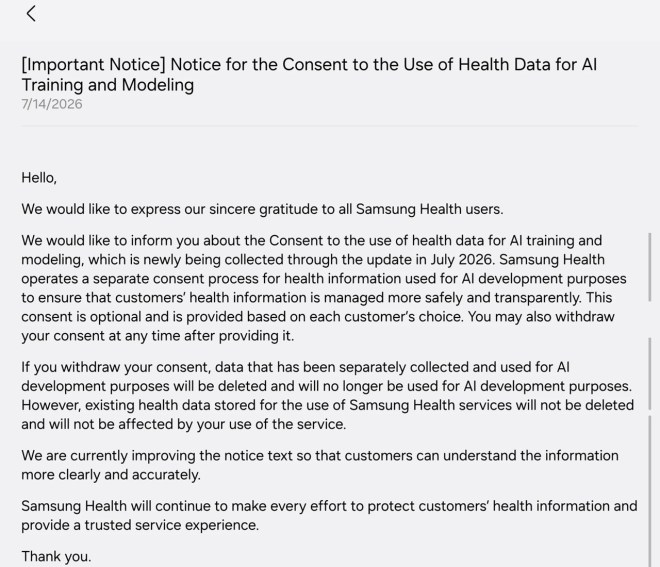
The clarification addresses the most serious concern raised by the original message: that refusing to contribute health information to AI development could erase a user’s existing wellness history. However, Samsung did not fully explain in its reported notice why the original wording appeared to connect AI consent with cloud syncing.
SamMobile said its testing showed Samsung Health continued to sync after AI-training permission was withdrawn, but that finding comes from third-party testing rather than a detailed public explanation from Samsung.
Samsung Health Data Will Remain After AI Opt-Out
Samsung’s clarification draws a distinction between two categories of information handled within the Samsung Health ecosystem.
The first category is information used to deliver the app’s ordinary services. This may include records needed to show a user’s activity history, exercise sessions, sleep patterns, health measurements and other wellness information within the application.
The second category consists of information collected separately for AI training and modelling.
According to Samsung, withdrawing consent affects only the second category. Data gathered specifically for AI development will be deleted and will no longer be used to train or improve the company’s models.
The company says information already stored for the normal delivery of Samsung Health services will not be removed.
That distinction is central to understanding the controversy.
Users initially interpreted the notice as meaning that they had to choose between allowing Samsung to use sensitive health information for AI development and retaining cloud access to their wellness records.
Samsung’s new explanation indicates that this was not the company’s intended message.
The company acknowledged that the language needed improvement and said it was working to present the information more clearly.
For users, the clarification means that withdrawing permission for AI training should not automatically eliminate the health history needed for standard Samsung Health functions.
However, questions remain about how Samsung separates the two datasets, which information is copied into the AI-development environment and how long it takes to delete data after permission is withdrawn.
Background: Why This Story Matters
The dispute matters because health information is among the most sensitive categories of personal data collected by consumer technology platforms.
A fitness or wellness application may contain far more than a daily step count.
Depending on the devices and services connected to it, Samsung Health can process information related to sleep, heart rate, physical activity, body composition and other personal wellness indicators. Samsung’s public product pages describe the platform as a service for tracking information including exercise, sleep and heart-rate data, often through connected devices such as Galaxy Watch and Galaxy Ring.
Some users may also enter information about medication, menstrual cycles, food intake or medical records.
These datasets can provide significant value when used responsibly.
They can help software identify trends, create personalised recommendations and improve health-related algorithms.
However, the same information can expose intimate details about a person’s routines, physical condition and lifestyle.
That makes consent especially important.
A user deciding whether to provide health information for AI training should receive a clear explanation of what will be collected, why it is needed, whether people may review it, how long it will be retained and what happens after consent is withdrawn.
Confusion becomes particularly serious when access to an important app feature appears to depend on that consent.
The original notice reportedly said users who withdrew consent would no longer be able to synchronise health data with their Samsung accounts and that synced information would be deleted unless retention was legally required.
This created the impression that AI consent was effectively a condition for retaining cloud backup and cross-device syncing.
Privacy concerns therefore focused not only on data collection but also on whether the user’s choice was genuinely voluntary.
What Samsung Said in Its Clarification
Samsung’s updated position is that health information collected for AI development is separate from information used to operate Samsung Health.
The company said withdrawing consent would lead to deletion of the separately collected AI-training data.
It also said that information stored for existing Samsung Health services would remain unaffected.
That means a user should not lose ordinary app records merely because they no longer wish to contribute information to AI modelling.
Samsung also acknowledged that the earlier notice did not communicate the distinction clearly enough.
The company said it was improving the text to ensure users receive more accurate and understandable information.
This is an important admission because privacy notices must communicate consequences in a way that ordinary users can understand.
A technically accurate policy may still create problems if the language is ambiguous, overly broad or appears to connect unrelated services.
Samsung’s explanation suggests that the original warning may have referred to deletion from the separate AI-development environment rather than deletion of every record associated with Samsung Health.
However, the reported wording did not make that separation obvious.
AI-Training Data Is Kept Separately
Samsung says data collected for AI training and modelling is handled separately from information required to provide Samsung Health services.
This separation is important because it allows the company to remove one dataset without disrupting another.
In practice, the approach could mean that Samsung maintains a service environment used to run the app and a separate development environment containing information approved for model training.
The company’s clarification did not provide technical details about how the separation works.
It also did not publicly specify whether information used for AI training is anonymised, pseudonymised or otherwise altered before being added to development datasets.
Those details matter because removing a person’s name does not always make health data impossible to link back to an individual.
Combinations of age, location, activity patterns, medical information and device identifiers can sometimes remain highly distinctive.
Samsung’s assurance that the datasets are separate is therefore useful, but users may still seek more information about the safeguards protecting the development data.
Withdrawing Consent Deletes AI Development Data
Users who withdraw consent will have the information collected separately for AI development deleted, according to Samsung.
The data will also no longer be used for AI training or modelling.
This gives users a mechanism to reverse an earlier decision.
The practical effectiveness of that mechanism depends on how the deletion process operates.
For example, users may want to know whether deletion occurs immediately, whether it covers backup copies and whether data already incorporated into a completed model can be removed from that model.
AI systems can create a difficult distinction between deleting source data and reversing the effects of completed training.
Once information has contributed to a model, deleting the original record does not necessarily remove every statistical influence it may have had on the finished system.
Samsung’s reported clarification focused on deleting the separately collected data and ending its future use. It did not describe whether already trained models would be changed.
Existing Samsung Health Records Will Not Be Deleted
The most important reassurance is that existing Samsung Health service data will remain intact.
Users should therefore be able to withdraw AI consent without losing the information used to provide the standard app experience.
This includes data stored within the service rather than information copied or collected separately for development purposes.
Samsung’s official support guidance continues to explain that users can sync Samsung Health information through Samsung Cloud by activating the feature in the application’s settings.
However, Samsung’s reported clarification did not directly address every question about what happens to cloud syncing after AI consent is withdrawn.
SamMobile reported that syncing remained available during its own test after consent was revoked.
That provides some reassurance, but an explicit explanation from Samsung would offer greater certainty across different regions, app versions and account configurations.
Samsung Is Rewriting the Notice
Samsung said it was improving the language used in the consent notice.
This step is significant because the dispute appears to have been driven partly by presentation rather than only by the underlying data policy.
Users must be able to distinguish among several actions:
Consent to use health information for the normal app service.
Consent to store and synchronise information through a Samsung account.
Consent to use separate information for AI development.
Permission for human review during model development.
The right to withdraw optional AI consent.
The consequences of withdrawing each permission.
Combining these issues in one warning can make it difficult for users to understand what they are approving.
A revised notice should explain each purpose separately and avoid suggesting that refusing optional AI development will lead to the loss of unrelated app functions.
What the Original Notice Reportedly Said
The controversy began when users reported seeing a prompt titled “Consent to the Use of Health Data for AI Training and Modelling.”
The notice reportedly asked Samsung Health users to allow the company to use a wide range of information to improve AI models and health-related algorithms.
Reports said the listed information could include activity data, sleep information, nutrition records, body measurements, medication details, medical records and menstrual-cycle information.
The notice also reportedly stated that human reviewers might examine some information where necessary during the AI-training process.
Human review is common in some data-labelling and model-evaluation systems, but it creates additional privacy concerns.
Users may be comfortable with automated analysis while feeling differently about an employee or contractor potentially viewing personal records.
The original warning said that withdrawing permission would prevent users from syncing health data with their Samsung accounts, according to reports published before Samsung’s clarification.
It also said health information would be deleted unless the company was legally required to retain it.
That wording led many readers to conclude that all cloud-stored Samsung Health records would be erased.
Samsung now says that interpretation was incorrect and that the deletion applies only to information collected separately for AI development.
Why Users Raised Privacy Concerns
The response from users was not simply opposition to artificial intelligence.
Many technology users accept that companies need data to test and improve digital services.
The concern was whether Samsung had provided a meaningful choice.
Consent is generally considered stronger when it is specific, informed and freely given.
A user should understand what they are accepting and should be able to refuse optional processing without losing an unrelated core service unless that processing is genuinely necessary to provide the service.
The original Samsung notice appeared to create a trade-off.
Users seemed to be told that they could refuse AI training, but doing so could cost them cloud syncing and previously stored health information.
That led critics to question whether the option was truly voluntary.
Health data intensified the concern because it may reveal information that users would not ordinarily share with advertisers, software developers or human reviewers.
The risk is not limited to embarrassment.
Sensitive health information can become important in employment, insurance, financial or personal contexts if it is mishandled or exposed.
Even where a company has no intention of using information for those purposes, users want confidence that strong technical and contractual safeguards are in place.
Samsung’s Growing Use of AI in Health Services
The consent dispute comes as Samsung expands the role of artificial intelligence across its connected health products.
The company announced new Galaxy Watch and Samsung Health capabilities in June 2026 that were designed to move the platform from passive tracking toward more proactive and personalised guidance.
Samsung has positioned AI as a core component of its broader connected-care strategy.
The company wants smartphones, wearables and health software to analyse multiple signals and provide insights that are more useful than isolated measurements.
For example, an AI system may combine sleep, activity and heart information to identify patterns or generate personalised recommendations.
Such features require extensive testing and large datasets.
A model trained on narrow or unrepresentative information may perform poorly for users with different ages, body types, routines or health conditions.
This creates a business incentive for Samsung to obtain access to varied real-world information.
However, the value of better models does not eliminate the need for clear consent.
As technology companies expand into health-related AI, transparency will become a major factor in whether users trust the resulting services.
Impact on Samsung Health Users
The clarification should reassure users who feared that opting out of AI development would wipe out years of fitness and wellness records.
According to Samsung, ordinary Samsung Health data will remain available.
Only information collected separately for training and modelling will be deleted after consent is withdrawn.
Users should nevertheless review the updated notice carefully when it becomes available in their region.
Samsung Health features and consent screens may vary depending on country, app version, device and applicable privacy law.
Users should also distinguish between deleting AI-development data and deleting a Samsung Health account.
Account deletion, service-data removal and AI-consent withdrawal are separate actions that may have different consequences.
People who rely on long-term health histories should maintain awareness of their syncing and backup settings.
A device replacement, account change or accidental reset can create data-loss risks unrelated to AI consent.
Samsung’s support information explains that syncing can be managed from the Samsung Health settings menu.
The clarification also gives users an opportunity to reconsider whether they want their information included in AI development.
Some may decide that contributing data is worthwhile if it helps improve health features.
Others may prefer to keep their information limited to the operation of their own accounts.
Both choices should be presented in a clear and non-punitive way.
Impact on Samsung and Its AI Strategy
The controversy creates a trust challenge for Samsung as the company accelerates investment in AI-powered services.
Samsung competes not only on hardware performance but also on the quality of its software ecosystem.
Health platforms are especially dependent on long-term user trust because they gather information continuously across phones, watches, rings and other connected devices.
A confusing consent experience can undermine that relationship.
Users may become less willing to record detailed information or activate advanced features if they believe their data could be used in ways they do not fully understand.
Samsung’s quick clarification reduces some of that risk.
By stating that service data will remain intact, the company has addressed the most alarming interpretation of the original notice.
However, the episode shows that privacy communication must be treated as part of product design rather than as a legal formality.
The wording displayed inside an application directly affects adoption, user confidence and brand reputation.
Samsung will need to ensure that its revised notice is consistent across regions and accurately describes the practical behaviour of the application.
Impact on the Wider Technology Industry
Samsung is not the only company trying to balance AI development with user privacy.
Technology businesses increasingly depend on personal information to train, evaluate and improve AI systems.
At the same time, regulators and consumers are demanding more control over how that information is collected.
The tension is particularly strong in health technology.
Wearables and wellness applications can generate continuous streams of information.
Unlike a single search request or social-media post, health records can reveal patterns over months or years.
This makes them potentially valuable for developing predictive and personalised tools.
It also makes them more sensitive.
Technology companies must therefore separate optional AI-development purposes from the basic operation of a product.
They should also provide consent choices that are understandable and easy to reverse.
The Samsung case may encourage other app developers to examine whether their own notices clearly distinguish service processing, cloud storage, analytics and model training.
Data Privacy and Consent in AI Development
A strong AI consent process should answer several basic questions.
What information is collected?
The notice should identify the types of data involved without relying only on broad terms such as “health information.”
Why is the information needed?
The company should explain the intended models, services or research purposes as clearly as possible.
Will people see the information?
Where human review is possible, the notice should describe who may conduct it and what protections apply.
How is the data protected?
Users should know whether information is encrypted, anonymised, pseudonymised or separated from account identifiers.
How long will it be stored?
A clear retention period gives users a better understanding of the duration of the risk.
What happens after consent is withdrawn?
The company should explain which records are deleted, whether service data remains and whether completed AI models are affected.
Will refusing consent reduce other services?
Any connection between optional AI development and standard product functions should be made explicit and justified.
Samsung’s clarification answers some of these questions, particularly those concerning deletion of ordinary service data.
Other questions remain open based on the available information.
African Consumer and Regulatory Context
The issue also matters for African users as smartphones and wearable devices become increasingly important tools for fitness and wellness management.
Samsung has a significant consumer electronics presence across African markets.
Users may connect Galaxy phones and watches to Samsung Health to track activity, sleep and other personal information.
Data-protection frameworks are also developing across the continent.
Countries including Kenya, Nigeria, South Africa, Rwanda, Uganda and others have adopted laws governing personal information.
The exact legal obligations differ, but health information generally receives heightened protection because of its sensitivity.
For African consumers, international technology companies may store or process data across borders.
That creates questions about which privacy standards apply, where the information is held and how users can exercise their rights.
Clear in-app communication is especially important where users may not easily access company privacy teams or navigate complex legal policies.
Samsung’s revised notice should therefore be understandable across different markets and not depend on technical or legal language that ordinary users may struggle to interpret.
Market and Industry Context
Consumer technology companies are racing to turn health platforms into AI-powered personal assistants.
The ambition is to move beyond counting steps or displaying heart-rate measurements.
Companies want their software to identify patterns, produce summaries and deliver recommendations tailored to each user.
This could create new value for device makers.
Health insights may encourage users to remain within a single ecosystem of watches, phones, rings, earbuds and cloud services.
The stronger the software experience, the more difficult it may become for users to switch to a rival platform.
However, AI-powered health services also create reputational and regulatory risks.
A flawed recommendation could mislead a user.
A biased model may work less effectively for certain groups.
A data breach could expose highly personal information.
An unclear consent process could attract regulatory scrutiny.
Companies therefore need to develop health AI cautiously and avoid presenting wellness insights as professional medical diagnosis where that is not their approved purpose.
Samsung’s own health-product materials commonly state that consumer wellness features are intended for fitness and general well-being rather than formal medical diagnosis unless specifically authorised.
What Samsung Has Not Fully Explained
Samsung’s clarification resolves the central deletion concern, but several issues remain unclear.
The first is cloud syncing.
The company reportedly did not directly address the earlier warning that withdrawing AI consent would disable syncing with a Samsung account.
SamMobile said syncing remained active after withdrawal during its testing.
However, users would benefit from a direct statement explaining whether this behaviour applies globally and across all supported app versions.
The second issue is human review.
Reports on the original notice said certain health information might be reviewed by people when necessary for AI development.
Samsung’s reported clarification did not explain who may conduct that review, how identifying information is limited or whether external contractors could be involved.
The third issue is the treatment of information already used to train a model.
Deleting a source record is different from reversing its historical contribution to an existing model.
The available notice does not describe Samsung’s approach to that technical question.
The fourth issue is regional availability.
It is unclear whether every Samsung Health user received the same notice or whether the consent system was introduced only in selected countries, app versions or accounts.
What Comes Next
Users should watch for revised language in the Samsung Health application.
Samsung has said the notice will be improved so that the separation between service data and AI-development data is clearer.
The company may also issue additional explanations if questions about syncing continue.
Regulators could examine the consent process, particularly in jurisdictions with strict rules governing sensitive health information and optional data processing.
The most important test will be whether withdrawing consent works consistently in practice.
Users should be able to opt out without losing unrelated health records or essential account functions.
Samsung will also continue expanding AI-powered health features across Galaxy devices.
As those services become more advanced, requests for access to user information may become more common.
The company’s success will depend partly on whether people believe its privacy controls are understandable and trustworthy.
Expert Analysis
Samsung’s clarification appears to correct a communication problem that risked becoming a broader trust problem.
The company’s underlying position is now more reasonable than the original notice appeared to suggest.
Optional AI-training data is treated separately, and withdrawing consent should remove that development dataset without erasing information required for the user’s ordinary Samsung Health experience.
The remaining weakness is incomplete clarity around syncing.
Third-party testing suggests that cloud synchronisation remains available after users opt out, but Samsung should state that position directly rather than leaving users to rely on unofficial tests.
The episode also illustrates a larger challenge for consumer AI.
Technology companies increasingly want permission to use personal information for purposes that are related to, but not strictly required for, the service the user originally selected.
Companies may view AI training as essential to future product improvement.
Users may view it as a separate and optional use of their information.
Both perspectives can coexist, but only when consent choices are clearly separated.
Samsung also needs to recognise that health information demands a higher standard than ordinary app analytics.
A confusing notice about theme preferences or navigation statistics may cause minor frustration.
A confusing notice about medical records, medication or menstrual information can produce serious concern.
The company’s decision to rewrite the notice is therefore appropriate.
The strongest version of the policy would provide granular controls, allowing users to understand which categories of information they are contributing rather than presenting one broad permission covering every type of health data.
Frequently Asked Questions
What did Samsung clarify about Samsung Health data?
Samsung said data used to operate Samsung Health is separate from information collected specifically for AI training and modelling.
Withdrawing AI consent will delete the separately collected development data, while ordinary Samsung Health service records will remain intact.
Will Samsung delete my health history if I reject AI training?
Samsung says existing information stored for the normal operation of Samsung Health will not be deleted solely because AI-training consent is withdrawn.
Only data collected separately for AI development will be removed.
Will Samsung Health cloud syncing stop after opting out?
Samsung’s reported clarification did not directly resolve all concerns about cloud syncing.
However, SamMobile reported that syncing continued during its own test after AI consent was withdrawn.
What information could be used for AI training?
Reports on the original consent notice said the covered categories could include activity, sleep, nutrition, body measurements, medication, medical records and menstrual-cycle information.
The precise information available may depend on the data a user records and the services connected to Samsung Health.
Could people review Samsung Health data?
Reports about the initial notice said human review could take place when necessary during AI training and modelling.
The available clarification did not provide detailed information about the circumstances or safeguards governing such reviews.
Why does Samsung want health data for AI?
Large and varied datasets can help companies train and test algorithms used to produce personalised health insights, identify patterns and improve wellness features.
Samsung has been expanding AI-powered capabilities across Samsung Health and Galaxy wearable devices.
Is consent to AI training compulsory?
The notice reportedly allows users to withdraw permission.
Samsung’s clarification says withdrawing consent will stop the use of separately collected information for AI development without deleting ordinary service data.
Conclusion
Samsung’s clarification on Samsung Health data addresses the most serious concern raised by its original AI-training notice.
The company says users who withdraw permission for AI development will not lose health information stored for the ordinary operation of Samsung Health.
Instead, only information collected separately for AI training and modelling will be deleted and excluded from future development work.
Samsung has also acknowledged that the original wording did not present this distinction clearly enough and has promised to improve the notice.
That is an important step, but the company should provide a more direct explanation of cloud syncing, human review and the treatment of data already used in completed AI models.
As Samsung adds more artificial intelligence to its health ecosystem, users will be asked to make increasingly complex decisions about personal information.
Those decisions must be supported by consent notices that are specific, understandable and free from unnecessary pressure.
AI-powered health services may offer valuable insights, but their long-term success will depend on more than technological capability.
They will also depend on whether users trust the companies handling some of their most private information.
Read Also:Wife Wins 80% Share of Matrimonial Home