The first Austronesian settlers arrived in Samoa around 1000 B.C., and early Samoans traded and intermarried with Fijian and Tongan nobility. The fa’amatai system of titles and nobility developed, which dominates Samoan politics to this day; all but two seats in the legislature are reserved for matai, or heads of families. A Dutch explorer was the first European to spot the islands in 1722. Christian missionaries arrived in the 1830s and were followed by an influx of American and European settlers and influence. By the 1880s, Germany, the UK, and the US had trading posts and claimed parts of the kingdom. In 1886, an eight-year civil war broke out, with rival matai factions fighting over royal succession and the three foreign powers providing support to the factions. Germany, the UK, and the US all sent warships to Apia in 1889 and came close to conflict, but a cyclone damaged or destroyed the ships of all three navies.
At the end of the civil war in 1894, Malietoa LAUPEPA was installed as king, but upon his death in 1898, a second civil war over succession broke out. When the war ended in 1899, the Western powers abolished the monarchy, giving the western Samoan islands to Germany and the eastern Samoan islands to the US. The UK abandoned claims in Samoa and received former German territory in the Solomon Islands.
New Zealand occupied Samoa during World War I but was accused of negligence and opposed by many Samoans, particularly an organized political movement called the Mau (“Strongly Held View”) that advocated for independence. During the 1918-1919 influenza pandemic, about 20% of the population died. In 1929, New Zealand police shot into a crowd of peaceful Mau protestors, killing 11, in an event known as Black Sunday. In 1962, Samoa became the first Polynesian nation to reestablish its independence as Western Samoa but dropped the “Western” from its name in 1997. The Human Rights Protection Party dominated politics from 1982 until Prime Minister FIAME Naomi Mata’afa’s Fa’atuatua i le Atua Samoa ua Tasi (FAST) party gained a majority in elections in 2021.
Geography
Location
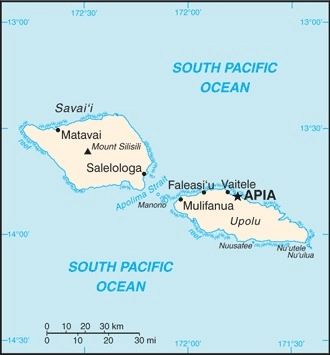
Oceania, group of islands in the South Pacific Ocean, about halfway between Hawaii and New Zealand
Geographic coordinates
13 35 S, 172 20 W
Map references
Oceania
Area
total : 2,831 sq km
land: 2,821 sq km
water: 10 sq km
comparison ranking: total 177
Area – comparative
slightly smaller than Rhode Island
Land boundaries
total: 0 km
Coastline
403 km
Maritime claims
territorial sea: 12 nm
contiguous zone: 24 nm
exclusive economic zone: 200 nm
Climate
tropical; rainy season (November to April), dry season (May to October)
Terrain
two main islands (Savaii, Upolu) and several smaller islands and uninhabited islets; narrow coastal plain with volcanic, rugged mountains in interior
Elevation
highest point: Mount Silisili 1,857 m
lowest point: Pacific Ocean 0 m
Natural resources
hardwood forests, fish, hydropower
Land use
agricultural land: 17.8% (2022 est.)
arable land: 4.1% (2022 est.)
permanent crops: 11.4% (2022 est.)
permanent pasture: 2.3% (2022 est.)
forest: 57.8% (2022 est.)
other: 24.4% (2022 est.)
Irrigated land
0 sq km (2022)
Population distribution
about three quarters of the population lives on the island of Upolu
Natural hazards
occasional cyclones; active volcanism
volcanism: Savai’I Island (1,858 m), which last erupted in 1911, is historically active
Geography – note
occupies an almost central position within Polynesia
People and Society
Population
total: 208,853 (2024 est.)
male: 105,920
female: 102,933
comparison rankings: total 184; female 184; male 184
Nationality
noun: Samoan(s)
adjective: Samoan
Ethnic groups
Samoan 96%, Samoan/New Zealander 2%, other 1.9% (2011 est.)
note: data represent the population by country of citizenship
Languages
Samoan (Polynesian) (official) 91.1%, Samoan/English 6.7%, English (official) 0.5%, other 0.2%, unspecified 1.6% (2006 est.)
Religions
Protestant 54.9% (Congregationalist 29%, Methodist 12.4%, Assembly of God 6.8%, Seventh Day Adventist 4.4%, other Protestant 2.3%), Roman Catholic 18.8%, Church of Jesus Christ 16.9%, Worship Centre 2.8%, other Christian 3.6%, other 2.9% (includes Baha’i, Muslim), none 0.2% (2016 est.)
Age structure
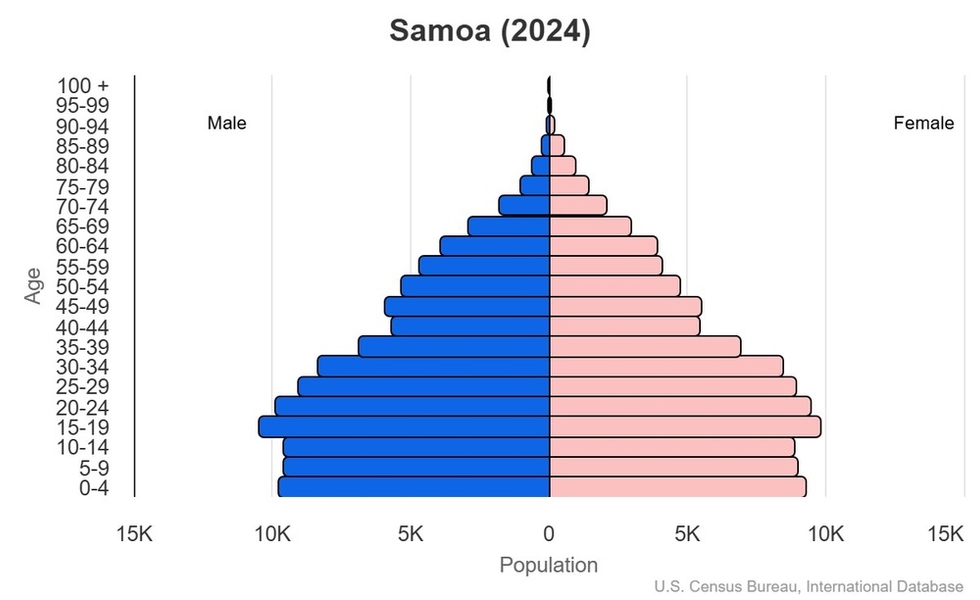
0-14 years: 26.9% (male 28,952/female 27,173)
15-64 years: 65.9% (male 70,225/female 67,427)
65 years and over: 7.2% (2024 est.) (male 6,743/female 8,333)
2024 population pyramid:
Dependency ratios
total dependency ratio: 51.7 (2024 est.)
youth dependency ratio: 40.8 (2024 est.)
elderly dependency ratio: 11 (2024 est.)
potential support ratio: 9.1 (2024 est.)
Median age
total: 27.4 years (2024 est.)
male: 27 years
female: 27.8 years
comparison ranking: total 158
Population growth rate
0.65% (2024 est.)
comparison ranking: 134
Birth rate
18.8 births/1,000 population (2024 est.)
comparison ranking: 75
Death rate
5.4 deaths/1,000 population (2024 est.)
comparison ranking: 184
Net migration rate
-6.9 migrant(s)/1,000 population (2024 est.)
comparison ranking: 216
Population distribution
about three quarters of the population lives on the island of Upolu
Urbanization
urban population: 17.5% of total population (2023)
rate of urbanization: -0.03% annual rate of change (2020-25 est.)
Major urban areas – population
36,000 APIA (capital) (2018)
Sex ratio
at birth: 1.05 male(s)/female
0-14 years: 1.07 male(s)/female
15-64 years: 1.04 male(s)/female
65 years and over: 0.81 male(s)/female
total population: 1.03 male(s)/female (2024 est.)
Maternal mortality ratio
59 deaths/100,000 live births (2020 est.)
comparison ranking: 93
Infant mortality rate
total: 17.3 deaths/1,000 live births (2024 est.)
male: 20.9 deaths/1,000 live births
female: 13.6 deaths/1,000 live births
comparison ranking: total 87
Life expectancy at birth
total population: 75.7 years (2024 est.)
male: 72.8 years
female: 78.7 years
comparison ranking: total population 124
Total fertility rate
2.33 children born/woman (2024 est.)
comparison ranking: 77
Gross reproduction rate
1.14 (2024 est.)
Contraceptive prevalence rate
16.6% (2019/20)
Drinking water source
improved:
urban: 100% of population
rural: 98% of population
total: 98.4% of population
unimproved:
urban: 0% of population
rural: 2% of population
total: 1.6% of population (2020 est.)
Health expenditure
6.8% of GDP (2021)
15.2% of national budget (2022 est.)
Physician density
0.56 physicians/1,000 population (2021)
Sanitation facility access
improved:
urban: 99.5% of population
rural: 99.5% of population
total: 99.5% of population
unimproved:
urban: 0.5% of population
rural: 0.5% of population
total: 0.5% of population (2020 est.)
Obesity – adult prevalence rate
47.3% (2016)
comparison ranking: 8
Alcohol consumption per capita
total: 2.18 liters of pure alcohol (2019 est.)
beer: 2.01 liters of pure alcohol (2019 est.)
wine: 0 liters of pure alcohol (2019 est.)
spirits: 0.17 liters of pure alcohol (2019 est.)
other alcohols: 0 liters of pure alcohol (2019 est.)
comparison ranking: total 127
Tobacco use
total: 20.5% (2025 est.)
male: 28.6% (2025 est.)
female: 12.3% (2025 est.)
comparison ranking: total 65
Children under the age of 5 years underweight
3.4% (2019)
comparison ranking: 75
Currently married women (ages 15-49)
61.7% (2023 est.)
Child marriage
women married by age 15: 0.9% (2020)
women married by age 18: 7.4% (2020)
men married by age 18: 2% (2020)
Education expenditure
5.5% of GDP (2024 est.)
12.9% national budget (2024 est.)
comparison ranking: Education expenditure (% GDP) 42
Literacy
total population: 98% (2019 est.)
male: 98.3% (2019 est.)
female: 97.7% (2019 est.)
Environment
Environment – current issues
soil erosion; deforestation; invasive species; overfishing
Environment – international agreements
party to: Biodiversity, Climate Change, Climate Change-Kyoto Protocol, Climate Change-Paris Agreement, Comprehensive Nuclear Test Ban, Desertification, Endangered Species, Hazardous Wastes, Law of the Sea, Nuclear Test Ban, Ozone Layer Protection, Ship Pollution, Wetlands
signed, but not ratified: none of the selected agreements
Climate
tropical; rainy season (November to April), dry season (May to October)
Land use
agricultural land: 17.8% (2022 est.)
arable land: 4.1% (2022 est.)
permanent crops: 11.4% (2022 est.)
permanent pasture: 2.3% (2022 est.)
forest: 57.8% (2022 est.)
other: 24.4% (2022 est.)
Urbanization
urban population: 17.5% of total population (2023)
rate of urbanization: -0.03% annual rate of change (2020-25 est.)
Air pollutants
particulate matter emissions: 7.78 micrograms per cubic meter (2019 est.)
carbon dioxide emissions: 0.25 megatons (2016 est.)
methane emissions: 0.27 megatons (2020 est.)
Waste and recycling
municipal solid waste generated annually: 27,399 tons (2011 est.)
municipal solid waste recycled annually: 9,864 tons (2013 est.)
percent of municipal solid waste recycled: 36% (2013 est.)
Total renewable water resources
0 cubic meters (2017 est.)
Government
Country name
conventional long form: Independent State of Samoa
conventional short form: Samoa
local long form: Malo Sa’oloto Tuto’atasi o Samoa
local short form: Samoa
former: Western Samoa
etymology: the name’s meaning and origin are unclear; some assert that it can mean “place of the moa bird” of Polynesian mythology, or it could be a local chieftain’s name
Government type
parliamentary republic
Capital
name: Apia
geographic coordinates: 13 49 S, 171 46 W
time difference: UTC+13 (18 hours ahead of Washington, DC, during Standard Time)
Administrative divisions
11 districts; A’ana, Aiga-i-le-Tai, Atua, Fa’asaleleaga, Gaga’emauga, Gagaifomauga, Palauli, Satupa’itea, Tuamasaga, Va’a-o-Fonoti, Vaisigano
Legal system
mixed system of English common law and customary law; judicial review of legislative acts involving fundamental citizen rights
Constitution
history: several previous (pre-independence); latest 1 January 1962
amendment process: proposed as an act by the Legislative Assembly; passage requires at least two-thirds majority vote by the Assembly membership in the third reading, provided at least 90 days have elapsed since the second reading, and assent of the chief of state; passage of amendments affecting constitutional articles on customary land or constitutional amendment procedures also requires at least two-thirds majority approval in a referendum
International law organization participation
has not submitted an ICJ jurisdiction declaration; accepts ICCt jurisdiction
Citizenship
citizenship by birth: no
citizenship by descent only: at least one parent must be a citizen of Samoa
dual citizenship recognized: no
residency requirement for naturalization: 5 years
Suffrage
21 years of age; universal
Executive branch
chief of state: TUIMALEALI’IFANO Va’aletoa Sualauvi II (since 21 July 2017)
head of government: Prime Minister FIAME Naomi Mata’afa (since 24 May 2021)
cabinet: Cabinet appointed by the chief of state on the advice of the prime minister
elections/appointments: chief of state indirectly elected by the Legislative Assembly to serve a 5-year term (2-term limit); election last held on 23 August 2022 (next to be held in 2026); following legislative elections, the leader of the majority party is usually appointed prime minister by the chief of state, approved by the Legislative Assembly
election results: TUIMALEALI’IFANO Va’aletoa Sualauvi II (independent) unanimously reelected by the Legislative Assembly
Legislative branch
legislature name: Legislative Assembly (Fono)
legislative structure: unicameral
number of seats: 51 (all directly elected)
electoral system: plurality/majority
scope of elections: full renewal
term in office: 5 years
most recent election date: 4/9/2021 to 11/26/2021
parties elected and seats per party: Faatuatua ile Atua Samoa ua Tasi (FAST) (32); Human Rights Protection Party (HRPP) (22)
percentage of women in chamber: 13%
expected date of next election: March 2026
Judicial branch
highest court(s): Court of Appeal (consists of the chief justice and 2 Supreme Court judges and meets once or twice a year); Supreme Court (consists of the chief justice and several judges)
judge selection and term of office: chief justice appointed by the chief of state on the advice of the prime minister; other Supreme Court judges appointed by the Judicial Service Commission, a 3-member body chaired by the chief justice and includes the attorney general and an appointee of the Minister of Justice; judges normally serve until retirement at age 68
subordinate courts: District Court; Magistrates’ Courts; Land and Titles Courts; village chief councils
Political parties
Fa’atuatua i le Atua Samoa ua Tasi or FAST
Human Rights Protection Party or HRPP
Tautua Samoa Party or TSP
Diplomatic representation in the US
chief of mission: Ambassador Pa’olelei LUTERU (since 7 July 2021); note – also Permanent Representative to the UN
chancery: 685 Third Avenue, 44th Street, 11th Floor, Suite 1102, New York, NY 10017
telephone: [1] (212) 599-6196
FAX: [1] (212) 599-0797
email address and website:
[email protected]
About | Samoa Permanent Mission to the United Nations
consulate(s) general: Pago Pago (American Samoa)
Diplomatic representation from the US
chief of mission: the US Ambassador to New Zealand is accredited to Samoa
embassy: 5th Floor, Accident Corporation Building, Matafele Apia
mailing address: 4400 Apia Place, Washington DC 20521-4400
telephone: [685] 21-436
FAX: [685] 22-030
email address and website:
[email protected]
https://ws.usembassy.gov/
International organization participation
ACP, ADB, AOSIS, C, FAO, G-77, IBRD, ICAO, ICCt, ICRM, IDA, IFAD, IFC, IFRCS, ILO, IMF, IMO, Interpol, IOC, IPU, ITU, ITUC (NGOs), MIGA, OPCW, PIF, Sparteca, SPC, UN, UNCTAD, UNESCO, UNIDO, UPU, WCO, WHO, WIPO, WMO, WTO
Independence
1 January 1962 (from New Zealand-administered UN trusteeship)
National holiday
Independence Day Celebration, 1 June (1962); note – 1 January 1962 is the date of independence from the New Zealand-administered UN trusteeship, but it is observed in June
Flag description
red with a blue rectangle in the upper hoist-side quadrant bearing five white, five-pointed stars that represent the Southern Cross constellation; red stands for courage, blue for freedom, and white for purity
note: similar to the flag of Taiwan
National symbol(s)
Southern Cross constellation (five five-pointed stars)
National colors
red, white, blue
National anthem
name: “O le Fu’a o le Sa’olotoga o Samoa” (The Banner of Freedom)
lyrics/music: Sauni Liga KURESA
note: adopted 1962; also known as “Samoa Tula’i” (Samoa Arise)
Economy
Economic overview
ower middle-income Pacific island economy; enormous fishing and agriculture industries; significant remittances; growing offshore financial hub; recently hosted Pacific Games to drive tourism and infrastructure growth
Real GDP (purchasing power parity)
$1.366 billion (2023 est.)
$1.258 billion (2022 est.)
$1.328 billion (2021 est.)
note: data in 2021 dollars
comparison ranking: 205
Real GDP growth rate
8.58% (2023 est.)
-5.31% (2022 est.)
-7.08% (2021 est.)
note: annual GDP % growth based on constant local currency
comparison ranking: 7
Real GDP per capita
$6,300 (2023 est.)
$5,800 (2022 est.)
$6,200 (2021 est.)
note: data in 2021 dollars
comparison ranking: 167
GDP (official exchange rate)
$938.189 million (2023 est.)
note: data in current dollars at official exchange rate
Inflation rate (consumer prices)
2.2% (2024 est.)
7.9% (2023 est.)
11% (2022 est.)
note: annual % change based on consumer prices
comparison ranking: 66
GDP – composition, by sector of origin
agriculture: 11% (2023 est.)
industry: 10.9% (2023 est.)
services: 67.7% (2023 est.)
note: figures may not total 100% due to non-allocated consumption not captured in sector-reported data
comparison rankings: services 48; industry 187; agriculture 73
GDP – composition, by end use
household consumption: 87.7% (2023 est.)
government consumption: 18.2% (2023 est.)
investment in fixed capital: 34.5% (2023 est.)
investment in inventories: 2.6% (2023 est.)
exports of goods and services: 28.8% (2023 est.)
imports of goods and services: -61.9% (2023 est.)
note: figures may not total 100% due to rounding or gaps in data collection
Agricultural products
coconuts, bananas, taro, tropical fruits, pineapples, mangoes/guavas, papayas, root vegetables, milk, avocados (2023)
note: top ten agricultural products based on tonnage
Industries
food processing, building materials, auto parts
Industrial production growth rate
-1.9% (2023 est.)
note: annual % change in industrial value added based on constant local currency
comparison ranking: 176
Labor force
57,200 (2024 est.)
note: number of people ages 15 or older who are employed or seeking work
comparison ranking: 187
Unemployment rate
4.6% (2024 est.)
5% (2023 est.)
5% (2022 est.)
note: % of labor force seeking employment
comparison ranking: 86
Youth unemployment rate (ages 15-24)
total: 11.9% (2024 est.)
male: 7.4% (2024 est.)
female: 20.9% (2024 est.)
note: % of labor force ages 15-24 seeking employment
comparison ranking: total 112
Population below poverty line
21.9% (2018 est.)
note: % of population with income below national poverty line
Remittances
28.24% of GDP (2023 est.)
33.61% of GDP (2022 est.)
29.43% of GDP (2021 est.)
note: personal transfers and compensation between resident and non-resident individuals/households/entities
Budget
revenues: $342.18 million (2021 est.)
expenditures: $297.736 million (2021 est.)
note: central government revenues (excluding grants) and expenses converted to US dollars at average official exchange rate for year indicated
Public debt
49.1% of GDP (2017 est.)
comparison ranking: 108
Taxes and other revenues
25% (of GDP) (2021 est.)
note: central government tax revenue as a % of GDP
comparison ranking: 44
Current account balance
$39.966 million (2023 est.)
-$74.107 million (2022 est.)
-$114.446 million (2021 est.)
note: balance of payments – net trade and primary/secondary income in current dollars
comparison ranking: 82
Exports
$346.187 million (2023 est.)
$175.377 million (2022 est.)
$97.774 million (2021 est.)
note: balance of payments – exports of goods and services in current dollars
comparison ranking: 198
Exports – partners
India 26%, NZ 14%, USA 12%, American Samoa 10%, Australia 9% (2023)
note: top five export partners based on percentage share of exports
Exports – commodities
refined petroleum, integrated circuits, coconut oil, fish, insulated wire (2023)
note: top five export commodities based on value in dollars
Imports
$560.987 million (2023 est.)
$512.002 million (2022 est.)
$430.011 million (2021 est.)
note: balance of payments – imports of goods and services in current dollars
comparison ranking: 203
Imports – partners
NZ 20%, Singapore 19%, China 17%, Australia 10%, Fiji 9% (2023)
note: top five import partners based on percentage share of imports
Imports – commodities
refined petroleum, poultry, cars, plastic products, milk (2023)
note: top five import commodities based on value in dollars
Reserves of foreign exchange and gold
$507.74 million (2024 est.)
$447.09 million (2023 est.)
$321.163 million (2022 est.)
note: holdings of gold (year-end prices)/foreign exchange/special drawing rights in current dollars
comparison ranking: 166
Debt – external
$269.974 million (2023 est.)
note: present value of external debt in current US dollars
comparison ranking: 118
Exchange rates
tala (SAT) per US dollar –
Exchange rates:
2.754 (2024 est.)
2.738 (2023 est.)
2.689 (2022 est.)
2.556 (2021 est.)
2.665 (2020 est.)
Energy
Electricity access
electrification – total population: 98.3% (2022 est.)
electrification – urban areas: 100%
electrification – rural areas: 97.9%
Electricity
installed generating capacity: 54,000 kW (2023 est.)
consumption: 141.846 million kWh (2023 est.)
transmission/distribution losses: 17.284 million kWh (2023 est.)
comparison rankings: transmission/distribution losses 23; consumption 194; installed generating capacity 194
Electricity generation sources
fossil fuels: 59.7% of total installed capacity (2023 est.)
solar: 15.1% of total installed capacity (2023 est.)
wind: 0.1% of total installed capacity (2023 est.)
hydroelectricity: 18.9% of total installed capacity (2023 est.)
biomass and waste: 6.3% of total installed capacity (2023 est.)
Petroleum
refined petroleum consumption: 2,000 bbl/day (2023 est.)
Carbon dioxide emissions
335,000 metric tonnes of CO2 (2023 est.)
from petroleum and other liquids: 335,000 metric tonnes of CO2 (2023 est.)
comparison ranking: total emissions 195
Energy consumption per capita
23.476 million Btu/person (2023 est.)
comparison ranking: 128
Communications
Telephones – fixed lines
total subscriptions: 5,000 (2022 est.)
subscriptions per 100 inhabitants: 2 (2022 est.)
comparison ranking: total subscriptions 201
Telephones – mobile cellular
total subscriptions: 134,000 (2022 est.)
subscriptions per 100 inhabitants: 60 (2022 est.)
comparison ranking: total subscriptions 189
Broadcast media
state-owned TV station privatized in 2008; 4 privately owned TV stations; about a half-dozen privately owned radio stations and one state-owned; TV and radio broadcasts of several stations from American Samoa are available (2019)
Internet country code
.ws
Internet users
percent of population: 58% (2023 est.)
Broadband – fixed subscriptions
total: 2,000 (2022 est.)
subscriptions per 100 inhabitants: 1 (2022 est.)
comparison ranking: total 203
Transportation
Civil aircraft registration country code prefix
5W
Airports
4 (2025)
comparison ranking: 179
Merchant marine
total: 13 (2023)
by type: general cargo 3, oil tanker 1, other 9
comparison ranking: total 155
Ports
total ports: 1 (2024)
large: 0
medium: 0
small: 0
very small: 1
ports with oil terminals: 1
key ports: Apia
Military and Security
Military and security forces
no regular military forces; Samoa Police Service (includes a maritime unit) (2025)
Military – note
informal defense ties exist with New Zealand, which pledged to afford assistance to Samoa in the conduct of its international relations under the 1962 Treaty of Friendship; New Zealand naval vessels patrol Samoan waters
Samoa has a “shiprider” agreement with the US, which allows local maritime law enforcement officers to embark on US Coast Guard (USCG) and US Navy (USN) vessels, including to board and search vessels suspected of violating laws or regulations within Somoa’s designated exclusive economic zone (EEZ) or on the high seas; “shiprider” agreements also enable USCG personnel and USN vessels with embarked USCG law enforcement personnel to work with host nations to protect critical regional resources (2025)