Raila Amolo Odinga was born on January 7, 1945, in Maseno, then part of the Colony and Protectorate of Kenya. He was the son of Jaramogi Oginga Odinga, Kenya’s first Vice President after independence, and Mary Juma Odinga (Mary Ajuma). Raised in a politically active family, young Raila was exposed early to ideas of governance, justice, and the struggle for freedom — influences that would shape his lifelong pursuit of democracy and equality.
Education and Early Career
Raila began his education at Kisumu Union Primary School before moving to Maranda Primary and later Maranda High School in Bondo, Siaya County. In 1962, he left Kenya for East Germany, where he studied German at the Herder Institute in Leipzig before enrolling for technical studies in Magdeburg.
In 1970, he graduated with a degree in Mechanical Engineering from the Technical University of Magdeburg. Upon returning to Kenya, he lectured at the University of Nairobi’s Mechanical Engineering Department until 1974, later joining the Kenya Bureau of Standards (KEBS), where he rose to the rank of Deputy Director in 1978.
Political Struggles, Detention and Exile
Raila’s political activism took shape in the 1970s and 1980s, as he opposed the one-party rule of President Daniel arap Moi. His defiance led to multiple detentions. In 1982, he was accused of involvement in a failed coup attempt and was imprisoned without trial for six years. Between 1988 and 1991, he faced further arrests for his continued push for multi-party democracy.
In 1991, after facing persecution, he fled to Norway where he lived in political exile until returning home in 1992.
Return to Kenya and Political Career
After his return, Raila joined his father’s party, the Forum for the Restoration of Democracy (FORD–K), and was elected Member of Parliament for Lang’ata Constituency. Following Jaramogi’s death in 1994 and ensuing internal conflicts within FORD–K, Raila moved to the National Development Party (NDP).
He contested the 1997 presidential election under the NDP banner, finishing third but retaining his parliamentary seat. His party later allied with KANU, and he was appointed Minister for Energy in 2001.
In 2002, he played a pivotal role in uniting opposition parties under the National Rainbow Coalition (NARC), which defeated KANU in that year’s election. He served as Minister for Roads, Public Works, and Housing from 2003 to 2005.
Prime Minister and National Leadership
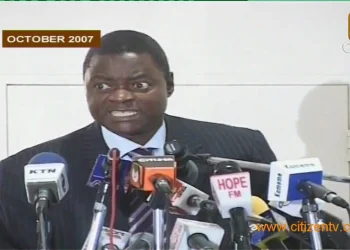
Raila Odinga ran for president five times — in 1997, 2007, 2013, 2017, and 2022. The 2007 election remains one of Kenya’s most contentious, sparking widespread violence that left over 1,000 people dead. A peace accord brokered by former UN Secretary General Kofi Annan led to the creation of a Coalition Government, where Raila was appointed Prime Minister on April 17, 2008, serving until 2013 under President Mwai Kibaki.
Following the abolition of the Prime Minister’s post under the 2010 Constitution, he continued to lead the Orange Democratic Movement (ODM) and headed several coalitions, including CORD, NASA, and Azimio la Umoja. Beyond national politics, Raila served as the African Union High Representative for Infrastructure Development, promoting continental integration and connectivity.
Personal Life and Legacy
Raila Odinga was married to Ida Odinga (née Anyango Oyoo), and together they had four children — Fidel (deceased), Rosemary, Raila Jr., and Winnie. Affectionately known as “Baba”, Raila was celebrated for his charisma, resilience, and deep connection with the Kenyan people.
His political journey was one of persistence and principle, defined by detention, exile, and unrelenting reform advocacy. He championed constitutional change, multi-party democracy, and national unity.
Final Years and Passing
After a lifetime dedicated to Kenya’s political transformation, The Right Honourable Raila Amolo Odinga passed away on October 15, 2025, in Kochi, India, following a cardiac arrest while receiving medical treatment.
He leaves behind a towering legacy — as a patriot, reformer, and symbol of resilience, whose struggle for justice and democracy forever changed the course of Kenya’s history.