Net Worth: $15 Million (Adjusted for Inflation)
Category: Richest Politicians › Presidents
Birthdate: January 9, 1913 – April 22, 1994
Birthplace: Yorba Linda, California
Height: 5 ft 10 in (1.8 m)
Profession: Lawyer, Politician, Author, Military Officer
Nationality: United States of America
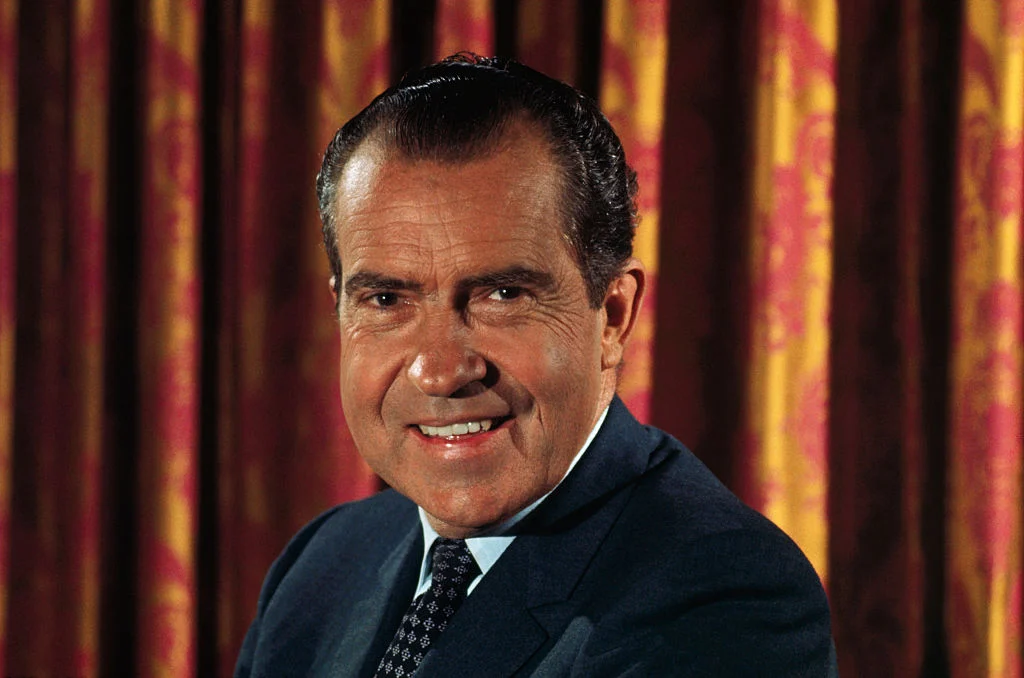
What Was Richard Nixon’s Net Worth?
At the time of his death in 1994, former U.S. President Richard Nixon had a net worth equivalent to $15 million after adjusting for inflation. Nixon accumulated his wealth through political earnings, real estate investments, book deals, and speaking engagements.
Despite being remembered for the Watergate scandal, Nixon’s legacy also includes ending U.S. involvement in the Vietnam War, opening diplomatic relations with China, and establishing the Environmental Protection Agency (EPA).
His financial journey reflects a modest upbringing, a rise to power, and a post-presidential career that restored his financial standing through highly lucrative book deals and international consulting work.
Early Life and Education
Richard Nixon was born in Yorba Linda, California, to a Quaker family. His parents, Francis Nixon and Hannah Nixon, ran a small lemon farm, but financial struggles forced them to relocate to Whittier, California. Nixon had four brothers, two of whom died young from tuberculosis.
Despite his family’s poverty, Nixon excelled in academics and debate, earning a scholarship to Whittier College, where he graduated with a B.A. in History in 1934. He then attended Duke University School of Law, where he received his law degree in 1937.
Early Career and Military Service
Legal Career
- After passing the California bar, Nixon joined Wingert and Bewley, a small law firm in Whittier.
- Opened his own law office in La Habra, California in 1938.
- Moved to Washington, D.C. in 1942, working for the Office of Price Administration (OPA).
Military Service (1942-1946)
- Joined the U.S. Navy during World War II, serving in the South Pacific Combat Air Transport Command.
- Promoted to Lieutenant Commander before being honorably discharged in 1946.
His military service helped shape his political identity, portraying him as a disciplined patriot during his future elections.
Political Career and Financial Growth
House of Representatives and Early Political Success (1946-1953)
- 1946: Nixon defeated Democrat Jerry Voorhis to win a seat in the U.S. House of Representatives.
- 1948: Gained national attention for his role in exposing Alger Hiss, a suspected Communist spy.
- 1950: Elected to the U.S. Senate, defeating Helen Gahagan Douglas in a controversial campaign.
Nixon built a reputation as a staunch anti-Communist, which made him a natural running mate for Dwight D. Eisenhower in the 1952 presidential election.
Vice Presidency (1953-1961)
- Served as Vice President under Eisenhower for eight years.
- Gained financial stability with a government salary and investment opportunities.
- Survived the “Checkers Speech” scandal, where he defended his campaign finances on national television.
First Presidential Run and Setback (1960-1962)
- 1960: Lost to John F. Kennedy in a narrow and controversial election, largely due to his poor television performance in the first-ever televised debates.
- 1962: Ran for California Governor but lost, delivering his famous “You won’t have Nixon to kick around anymore” speech.
At this stage, Nixon’s political career seemed finished, and he returned to practicing law in New York, where he built his personal wealth through corporate law and consulting for business clients.
Presidency (1969-1974): Power, Wealth, and Scandal
Election Victory and First Term (1969-1972)
- Won the 1968 election, defeating Hubert Humphrey and George Wallace.
- Major domestic and foreign policy achievements:
- Ended U.S. involvement in Vietnam (1973).
- Opened diplomatic relations with China (1972).
- Created the Environmental Protection Agency (EPA).
- Signed the Anti-Ballistic Missile Treaty with the Soviet Union.
His re-election in 1972 was one of the biggest landslides in U.S. history, defeating George McGovern with 60.7% of the popular vote.
Watergate Scandal and Resignation (1972-1974)
- 1972: Nixon’s re-election campaign orchestrated the Watergate break-in.
- 1973-1974: The cover-up was exposed, and Nixon faced impeachment hearings.
- August 9, 1974: Resigned from the presidency, avoiding impeachment.
Financial Fallout from Watergate
- Lost his presidential salary and benefits.
- Owed hundreds of thousands in legal fees.
- Gerald Ford pardoned Nixon, shielding him from criminal prosecution but not financial liabilities.
Post-Presidency: Financial Comeback
Despite Watergate tarnishing his reputation, Nixon rebuilt his wealth through:
- Book Deals – Wrote ten books, including his memoirs, which sold millions of copies.
- Speaking Engagements – Traveled globally, advising business leaders and foreign governments.
- Real Estate Investments – Owned valuable properties, including the San Clemente estate.
By the late 1980s, Nixon had fully restored his wealth, earning millions from books and international consulting.
Real Estate and Personal Wealth
San Clemente Estate (“La Casa Pacifica”)
- 1969: Purchased a 5.5-acre oceanfront property in San Clemente, California, for $1.4 million (about $11 million today).
- Used as the “Western White House” during his presidency.
- 1980s: Sold the estate for an undisclosed amount.
New Jersey Residence
- Moved to Saddle River, New Jersey, where he lived until his death in 1994.
Nixon’s real estate investments and book royalties played a crucial role in his financial recovery after Watergate.
Personal Life and Death
Richard Nixon was married to Pat Nixon (née Thelma Catherine Ryan), a former teacher. The couple had two daughters, Tricia and Julie.
In 1993, Pat Nixon passed away from lung cancer. Nixon suffered a stroke in 1994, fell into a coma, and died on April 22, 1994, at 81 years old. He is buried alongside Pat Nixon at the Nixon Library in Yorba Linda, California.
Legacy: Political and Financial Impact
Political Legacy
- Nixon is remembered for both his achievements and failures.
- Foreign policy triumphs (China, Vietnam, Soviet diplomacy).
- Watergate remains one of the biggest political scandals in U.S. history.
Financial Legacy
- Lost millions post-Watergate but recovered through books and consulting.
- Maintained a $15 million net worth at the time of his death.
Conclusion
Richard Nixon’s financial journey was as dramatic as his political career. He rose from poverty, achieved wealth through politics and law, lost it all after Watergate, and then rebuilt his fortune through writing and consulting.
Despite his controversial legacy, Nixon secured his financial future, proving that even after the biggest political scandal in American history, financial redemption was possible.