


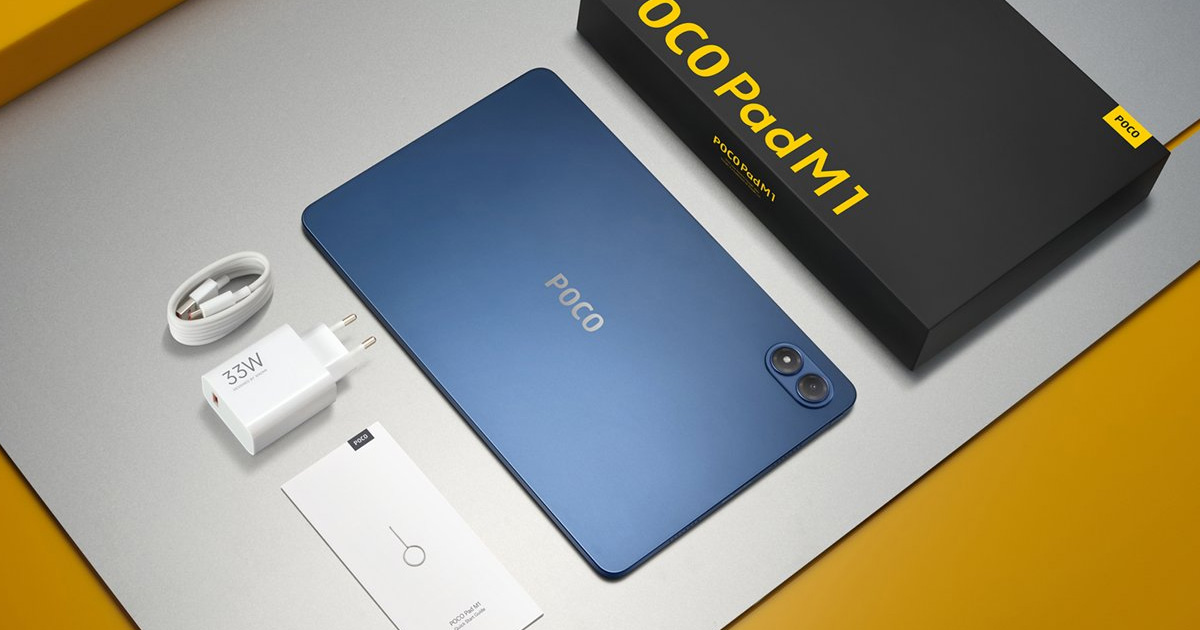
The Poco Pad M1 enters a familiar part of Xiaomi’s product strategy. The Poco Pad M1 is effectively a reworked Redmi Pad 2 Pro, aimed at buyers who want a large-screen Android tablet without moving into premium pricing. That gives it a clear role from the start. It is built for media, light productivity, casual gaming, and family use rather than for high-end creative work.
That approach makes sense in 2026. Android tablets still succeed or fail on a few core things: display quality, battery life, speaker output, and software behavior on a big screen. On those points, the Poco Pad M1 makes a strong first impression. It also adds optional accessories, which gives it more flexibility than many similarly priced tablets.
Specifications
| Category | Details |
|---|---|
| Display | 12.1-inch IPS LCD, 1600 x 2560, 120Hz, Dolby Vision, up to 600 nits |
| Chipset | Snapdragon 7s Gen 4 |
| RAM & Storage | 8GB RAM, 256GB UFS 2.2, microSD support |
| Rear Camera | 8MP wide |
| Front Camera | 8MP wide |
| Battery | 12,000mAh |
| Charging | 33W wired, 27W reverse wired |
| OS | Android 15, HyperOS 2 |
| Build | Glass front, aluminum frame, aluminum back, stylus support |
| Connectivity | Wi-Fi 6, Bluetooth 5.4, 3.5mm headphone jack, USB-C, no cellular |
Design and Build Quality
The Poco Pad M1 feels more premium than its price suggests. Xiaomi uses an aluminum unibody, flat sides, and a clean matte finish that gives the tablet a more serious look than many plastic rivals. In the hand, it feels rigid and well made. There is no obvious flex, and the chassis has the kind of solidity that matters on a large device.
At 610g, the Poco Pad M1 is not light, but it is within the normal range for a 12.1-inch tablet. Weight distribution is decent, so it does not feel awkward when held with two hands in landscape mode. However, it is still large enough that extended handheld reading will tire your wrists. That is not a flaw so much as the trade-off of choosing a screen this size.
The downside is grip. The finish attracts fingerprints more than expected, and the body is slippery enough that a case feels like a sensible purchase rather than an optional extra. Compared with the earlier Poco Pad and Redmi Pad Pro, this design is familiar, but the build remains one of the better points of the package. Repairability should also be fairly reasonable for the segment, since the design is conventional and Xiaomi accessories and spare parts tend to be easier to find than those for smaller brands.
Display Performance
The Poco Pad M1 uses a 12.1-inch IPS LCD with 1600 x 2560 resolution and a 120Hz refresh rate. At 249ppi, it is sharp enough for reading, office work, browsing, and streaming. You do not get OLED contrast, of course, but the panel still looks crisp and clean in normal use.
Brightness is good for an indoor-first tablet. Measured output of roughly 494 nits manually and 581 nits in auto mode is not class-leading, yet it is enough for comfortable use in bright rooms and shaded outdoor spaces. Direct sunlight remains a challenge, which is typical for an LCD tablet in this price range.
Color reproduction is respectable, and Dolby Vision support helps with compatible streaming apps like Netflix. The absence of HDR10 support is worth noting, though. That means HDR handling is narrower than the branding may initially suggest. Still, for general media use, the screen is easy to like.
Refresh rate behavior is one of the better tuned aspects of the display. The tablet can move between 30Hz, 48Hz, 50Hz, 60Hz, 90Hz, and 120Hz depending on the content. That keeps the interface fluid without wasting battery unnecessarily. In practice, scrolling feels smooth, video playback behaves sensibly, and games that support higher frame rates can benefit from the 120Hz ceiling.
Performance and Benchmarks
The Poco Pad M1 runs on Qualcomm’s Snapdragon 7s Gen 4, paired with 8GB of RAM and 256GB of UFS 2.2 storage. This is a mid-range platform through and through. It is not built to chase flagship numbers, but it is clearly stronger than the older Snapdragon 7s Gen 2 tablets it replaces.
CPU architecture matters here. The chipset uses one Cortex-A720 prime core at 2.7GHz, three additional Cortex-A720 cores at 2.4GHz, and four Cortex-A520 efficiency cores at 1.8GHz. That gives the Poco Pad M1 a sensible balance between burst speed and sustained everyday responsiveness. The Adreno 810 GPU is also a step up from the earlier generation, though still not a high-end graphics solution.
Benchmark performance places the tablet firmly where it should be. It is clearly ahead of the older Poco Pad and Redmi Pad Pro, and far ahead of entry-level tablets like the Redmi Pad SE. That means the Poco Pad M1 has enough headroom for more than just video playback and web browsing.
Real-world performance
In daily use, the Poco Pad M1 feels quick enough for the tasks most buyers will actually do. Apps open promptly, split-screen multitasking is smooth, and large websites or documents do not feel heavy. HyperOS 2 also helps here, since Xiaomi has done a decent job adapting multitasking to a larger display.
For office apps, streaming, note-taking, and general browsing, performance is more than adequate. Casual gaming is also fine. Lighter and moderately demanding titles run well, and the extra screen space makes the tablet a good fit for strategy games, card games, and media-heavy titles.
The limitations appear when you push it harder. UFS 2.2 storage is still slower than what you get in more expensive tablets, so large game installs, file transfers, and heavier creative apps do not feel especially fast. Even so, for its class, the Poco Pad M1 delivers good value.
Thermal performance
Thermal behavior is one of the tablet’s stronger points. In stress testing, the Poco Pad M1 reportedly showed no meaningful throttling. That is a useful result because tablets often stay under load for long stretches, whether for gaming, streaming, or multitasking.
That stability should translate well into daily use. The large aluminum body has enough area to dissipate heat effectively, and the chipset itself is not overly demanding. As a result, the Poco Pad M1 should remain comfortable during extended use and avoid the annoying frame-rate swings that weaker cooling systems can cause.
Camera Performance
Tablet cameras remain secondary, and the Poco Pad M1 does little to challenge that rule. You get an 8MP rear camera and an 8MP front camera, both capable of 1080p video. This is enough for utility, not for serious photography.
Main camera analysis
The rear camera is usable for document scanning, QR codes, and occasional reference shots. Detail is limited, dynamic range is modest, and the overall output looks plain. Still, that is normal for this class. Xiaomi has not tried to oversell it, which is fair.
Sensor behavior appears basic. There is no sign of advanced processing, and the small sensor struggles quickly when light gets uneven. HDR behavior is limited, which means bright skies and darker indoor elements can be hard to balance in the same frame.
Low-light performance
Low-light photography is predictably weak. Noise rises quickly, fine detail softens, and exposure becomes less stable. For a tablet, that is not disqualifying. Most buyers will use their phones when they actually care about image quality.
The front camera is similarly modest. It is acceptable for video calls in decent lighting, but it will not flatter you in dim rooms. That matters more because front cameras on tablets get far more use than rear cameras.
Video performance
Video recording is capped at 1080p30 on both cameras. There is electronic stabilization, which helps a little, but the overall result remains basic. Sharpness is limited, and dynamic range is narrow.
For video calls, online classes, and quick recordings, the cameras do the job. Beyond that, there is little to analyze. The Poco Pad M1 treats cameras as functional extras, not selling points.
Battery and Charging
Battery life is one of the Poco Pad M1’s strongest arguments. A 12,000mAh battery gives the tablet a healthy endurance buffer, and the test results back that up. An active use score of 14 hours 50 minutes is a very good result for a 12.1-inch tablet.
In real-world terms, that should mean long video sessions, several days of lighter family use, or a full workday of mixed reading, browsing, and streaming without much concern. The tablet’s efficient refresh-rate behavior also helps here, especially during video playback.
Charging is the more mixed part of the story. The Poco Pad M1 supports 33W wired charging, but the battery is so large that the charging experience still feels slow. Reaching full takes close to three hours, which is a long time by modern standards. Practical charging speed matters more than headline wattage, and here the tablet feels average at best.
On the other hand, 27W reverse wired charging is genuinely useful. That turns the tablet into a large backup battery for a phone or accessories, which can be especially handy while traveling.
Software and User Experience
The Poco Pad M1 ships with HyperOS 2 on Android 15, with HyperOS 3 expected later. Xiaomi’s tablet software has improved over the past few years, and this is now one of the better large-screen Android implementations in the mid-range segment.
UI fluidity is generally good. Animations are smooth, app switching is easy, and split-screen or floating-window features work as expected. The system also supports larger-screen layouts more thoughtfully than many budget Android tablets. You can have multiple apps visible at once, and the task manager makes better use of the extra space.
There is no Workstation mode here, which is worth mentioning. That keeps the Poco Pad M1 from feeling like a true laptop replacement. It is more of a media and light productivity tablet than a serious desktop-style machine.
Bloatware is not absent, but it is manageable. Xiaomi’s software includes extra features, AI image tools, Gemini, and Circle to Search, which add some practical value. Software support expectations are decent, though not exceptional by premium standards. Longevity potential looks good for a mid-range tablet because the chipset is modern enough and the thermal behavior is stable.
Connectivity and Extras
The Poco Pad M1 supports Wi-Fi 6, Bluetooth 5.4, a microSD slot, and a 3.5mm headphone jack. That is a solid set of extras for a tablet in this price range, and the inclusion of expandable storage still matters for media-heavy users.
The missing feature is obvious: there is no cellular version. For some buyers, that is fine. For others, especially students or professionals who travel, it will be a real limitation. Tethering works, but integrated LTE or 5G would have made the tablet much more flexible.
Stylus and keyboard accessory support also matter here. Xiaomi clearly wants the Poco Pad M1 to feel more useful than a basic streaming slab. The first-party accessories appear practical, and the stylus support broadens the target audience to note-takers and casual sketchers.
Audio and Multimedia
The Poco Pad M1 is very strong as a media tablet. The four-speaker setup produces loud, full sound with good stereo separation, and Dolby Atmos support helps make films and games sound more spacious. At normal 100% volume, the speakers appear genuinely good for the class.
The warning concerns Xiaomi’s Sound Boost feature. Pushing volume beyond 100% adds harshness rather than real quality. That means the tablet sounds best when used normally, not when pushed to its artificial extremes.
For streaming, gaming, and casual music playback, the Poco Pad M1 is easy to recommend. The large 12.1-inch display and solid speaker setup work well together, and the headphone jack remains a welcome bonus. This is one of the clearest reasons to consider the tablet over smaller and cheaper alternatives.
Competition and Market Position
The Poco Pad M1 sits in a fairly practical part of the tablet market. It is not an iPad rival, and it is not trying to be. Instead, it competes with devices like the Redmi Pad 2 Pro, Redmi Pad Pro, and Honor Pad X9.
Against the Redmi Pad 2 Pro, the Poco Pad M1 is effectively competing with its own twin. That means the better buy will usually depend on bundle pricing and accessory availability rather than on the tablet itself. If the Redmi variant comes with a case or keyboard, it may be the smarter purchase.
Against the Redmi Pad Pro, the Poco Pad M1 offers a newer chipset and larger battery. Against the Honor Pad X9, it offers a sharper display, stronger performance, and more battery headroom. In price-to-performance terms, the Poco Pad M1 is well positioned, though not dramatically cheaper than all rivals.
Brand strategy also matters. Poco has traditionally leaned on value, but the M1 feels more like a straightforward rebrand than a uniquely positioned product. That does not hurt the device itself, but it means buyers should compare prices carefully rather than assuming the Poco name guarantees the best deal.
Verdict
The Poco Pad M1 is a good large-screen Android tablet with clear strengths and sensible compromises. Its display is sharp and fluid, battery life is strong, the speakers are above average, and the build quality feels better than expected at this level.
Its weaknesses are also easy to see. Charging is slow in practical terms, cameras are basic, there is no cellular option, and official accessory availability may be inconsistent depending on region. Resale strength should be decent for a Xiaomi tablet, though not especially high, and repairability should be fair rather than excellent.
Overall, the Poco Pad M1 offers solid value for money if your priorities are media, light productivity, and reliable everyday use. It is not exciting, but it is competent in the areas that matter most for a mid-range tablet.
Why This Phone Matters in Africa
The Poco Pad M1 matters in Africa because tablet buyers in many markets tend to prioritize battery life, media use, schoolwork, and shared family usage over raw prestige. On those points, the tablet makes sense. A 12,000mAh battery, loud speakers, a large display, microSD support, and a headphone jack all fit practical needs well.
Pricing sensitivity also matters. Buyers want devices that can serve as entertainment screens, learning tools, and light work machines without moving into premium territory. The Poco Pad M1 fits that role well, especially for students and households that want one shared device.
The lack of cellular connectivity is the main weakness in this context. In markets where home Wi-Fi is less consistent, a cellular version would have been far more useful. Still, battery reliability, Xiaomi’s brand familiarity, and likely accessory compatibility give the tablet some resale and service advantages over less established brands.
Final Thoughts
The Poco Pad M1 is best suited to buyers who want a large, affordable Android tablet for streaming, studying, web browsing, light office work, and casual gaming. It also makes sense for families, students, and users who want stylus or keyboard support without paying premium tablet prices.
It is less ideal for buyers who need constant connectivity on the move, fast charging, or strong camera performance. Those users should look elsewhere, or at least consider whether a more expensive cellular tablet is the better long-term fit.
For everyone else, the Poco Pad M1 has a decent longevity outlook. The hardware is modern enough, the software is functional, the thermal behavior is stable, and the core experience is strong. That makes it one of the safer mid-range tablet options rather than one of the flashiest.
The Review
Poco Pad M1
The Poco Pad M1 gets an easy recommendation from us for its great display, battery life, speakers, and feature-rich software package. And we really appreciate Xiaomi's efforts to supply first-party accessories even for its budget tablets.The Poco Pad M1 has a large Dolby Vision display with a dynamic 120Hz refresh rate - ideal for streaming, gaming, or multitasking with office apps. The four loud Dolby Atmos speakers are something we did appreciate as well.
PROS
- All-metal unibody.
- 12.1-inch screen, 120Hz, Dolby Vision.
- Powerful speakers, Dolby Atmos.
- Superb battery life.
- 27W reverse wired charging.
- Feature-ich OS.
- microSD, audio jack.
- Affordable, excellent optional accessories.
CONS
- Slow charging overall.
- No ingress protection.
- No cellular version.
- Not available through the official channels.
Review Breakdown
-
Our Rating
 POCO
POCO


