


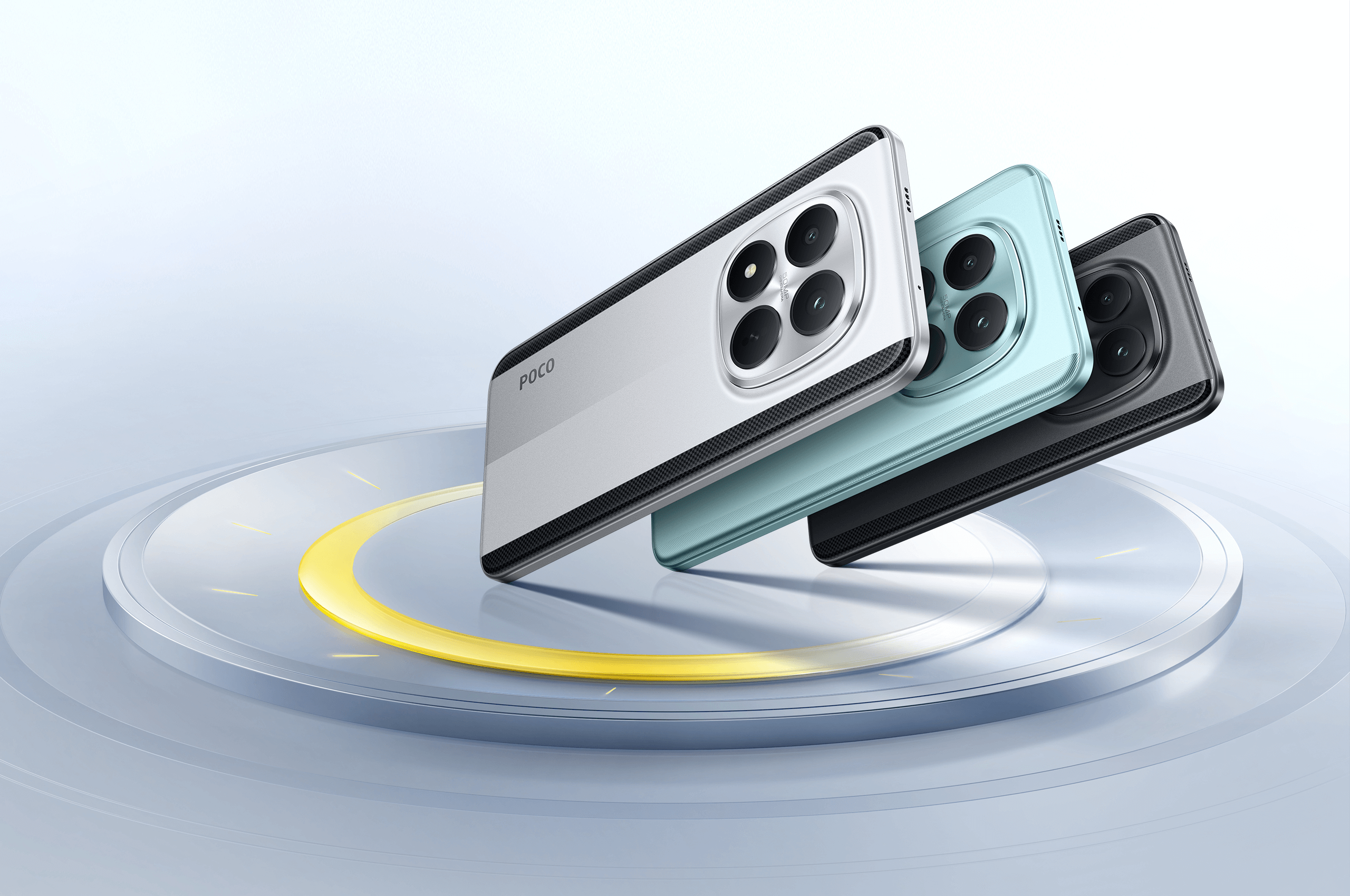
The Poco M8 Pro arrives in a crowded part of the market, and that is part of the problem. On its own, it is easy to understand: a large AMOLED display, a big 6,500mAh battery, very fast 100W charging, and a capable enough Snapdragon 7s Gen 4 chipset. The Poco M8 Pro clearly aims at buyers who want endurance, a sharp screen, and a phone that feels modern without moving into full flagship pricing.
It also comes with baggage. This is effectively a close cousin of the Redmi Note 15 Pro+, but with a different main camera and a lower asking price. That lower price helps a lot, because it makes the overall package feel more coherent. Even so, the software bloat and ads are hard to ignore, and they shape the experience more than they should.
Specifications Table
| Category | Details |
|---|---|
| Display | 6.83-inch AMOLED, 1280 x 2772, 120Hz, HDR10+, Dolby Vision |
| Chipset | Snapdragon 7s Gen 4 |
| RAM & Storage | 256GB/8GB, 256GB/12GB, 512GB/12GB, UFS 2.2 |
| Rear Camera | 50MP main, 8MP ultrawide |
| Front Camera | 32MP selfie |
| Battery | 6500mAh |
| Charging | 100W wired, 22.5W reverse wired |
| OS | Android 15, HyperOS 2 |
| Build | Gorilla Glass Victus 2 front, plastic back/frame, IP68 EU, IP69K elsewhere |
| Connectivity | 5G, Wi-Fi 6, Bluetooth 5.4, NFC, IR blaster |
Design and Build Quality
The Poco M8 Pro has more personality than some recent Redmi derivatives. The dual-tone finish and separate camera rings give it a fresher look, especially in silver. It does not feel cheap either. The body is slim for a phone with a 6,500mAh battery, and the internal reinforcement adds some confidence in hand.
Build quality is solid. You get Gorilla Glass Victus 2 at the front, good water resistance, and extra drop-resistance claims from Xiaomi. In Europe, the phone carries IP66 and IP68 ratings. In other regions, it also gets IP69 and IP69K. That is strong protection for this class.
Handling is mostly good, though not perfect. The phone feels balanced, but the glossy and matte mix on some color versions picks up fingerprints quickly. It is also slippery enough that the included case feels less like a bonus and more like a necessity. The optical fingerprint reader works reliably, but it is still an optical unit, not the faster ultrasonic type you find higher up the range.
Compared with the Poco M7 Pro, this is a clear step forward in design ambition and durability. It feels more substantial, better protected, and more premium in daily use. The missing microSD slot, however, is a step backward for users who still value expandable storage.
Poco M8 Pro Display Performance
The Poco M8 Pro display is one of its best features. The 6.83-inch AMOLED panel is sharp, bright, and well suited to media use. It supports both HDR10+ and Dolby Vision, and it is properly recognized by major apps including Netflix and YouTube. That matters more than spec-sheet brightness claims on their own.
In testing, the panel reached 1,435 nits in auto mode on a large white area and just over 3,000 nits on a small highlight. Those are strong results for a mid-ranger. Outdoor visibility is not an issue, and the display retains enough contrast and punch in bright light to stay comfortable. Manual brightness is less impressive, but that is common at this level.
Color reproduction is pleasing, and the high resolution helps the Poco M8 Pro feel a notch above cheaper AMOLED phones. Text looks crisp, and streaming content benefits from the extra density. The panel also supports 3840Hz PWM dimming, which may help users sensitive to flicker.
Refresh-rate behavior is straightforward rather than advanced. The phone switches between 60Hz and 120Hz dynamically, and the so-called custom 120Hz mode behaves almost the same in many situations. That is not a major flaw, but it means you do not get the sort of granular adaptation found on LTPO panels. Still, for this segment, the screen is a real strength.
Performance and Benchmarks
The Poco M8 Pro runs on Qualcomm’s Snapdragon 7s Gen 4, a mid-range 4nm chip with one Cortex-A720 prime core, three additional A720 performance cores, and four A520 efficiency cores. GPU duties are handled by the Adreno 810. This is not a gaming monster, but it is clearly stronger than entry-level silicon and comfortably ahead of lower Poco M-series devices.
Benchmark numbers place it near the top of its immediate price bracket, though not at the level of performance-focused devices like the Poco X7 Pro. The phone does enough to feel quick in normal use, but it is not positioned as a raw-speed bargain. That is an important distinction. Poco’s own F and X series still cater better to buyers who care most about gaming or benchmark wins.
Poco M8 Pro real-world performance
In day-to-day use, the phone behaves like a competent mid-ranger. App launches are quick enough, switching between common apps is smooth, and the high-resolution display does not seem to overwhelm the hardware. Multitasking is helped by the larger RAM option, though the use of UFS 2.2 storage means it does not feel quite as snappy as phones with faster storage.
Gaming stability is decent. Lighter games pose no problem, while heavier titles are playable with sensible settings. This is not the phone to buy for maximum frame rates, but it is stable enough to avoid frustration.
Poco M8 Pro thermal performance
Thermal behavior is one of the better parts of the package. The Poco M8 Pro does not throttle in the stress tests cited, and it also avoids getting uncomfortably warm. That suggests Xiaomi tuned the phone conservatively, and for this class that is the right choice. You lose some peak-performance bragging rights, but you gain consistency.
Camera Performance
The Poco M8 Pro camera setup is simple: a 50MP main camera, an 8MP ultrawide, and a 32MP front camera. There is no telephoto. This is not a flexible camera system, but the main sensor is better than the phone’s market position might suggest. It is borrowed from more expensive Poco models, and that gives it a stronger base than many direct rivals.
Poco M8 Pro main camera analysis
In daylight, the main camera performs well. Dynamic range is strong, exposure is dependable, and color is lively without looking unnatural. Detail is also very good for the class, especially at the native 1x view. This is one of the clearer positives of the phone. Human subjects look good too, with natural skin tones and acceptable portrait separation, though portrait mode softens detail a little.
The 50MP mode adds little. It narrows dynamic range and does not produce a meaningful gain in detail, so the default processing remains the better choice. The 2x crop is usable and often quite decent in daylight, though it does not have the crispness of a true telephoto solution. At 4x, quality drops off more sharply.
Poco M8 Pro low-light performance
At night, the main camera remains respectable. The phone keeps wide dynamic range, balanced exposure, and generally pleasing colors. Sharpness is only average, but still good enough for social use and casual photography. The 2x zoom remains usable after dark, though detail becomes more digital and less natural.
This is where the Poco M8 Pro feels honest. It does not try to impress with aggressive sharpening or unrealistic contrast. It just delivers competent low-light photos for the class, which is enough for most buyers.
Poco M8 Pro ultrawide and selfie cameras
The ultrawide is the weak point. In daylight it is soft, and at night it becomes softer still. Dynamic range is fine, and colors are not offensive, but the limited sensor and optics are obvious. It is there for convenience, not quality.
The selfie camera is also average. Dynamic range is good and skin tones are acceptable, but sharpness is underwhelming. This is one of those familiar 32MP units that looks better on paper than it does in practice. Buyers who care about front-camera quality will find stronger options elsewhere.
Poco M8 Pro video performance
Video is basic but mostly competent from the main camera. It records 4K at 30fps and produces good-looking clips at 1x in daylight, with solid detail, lively colors, and decent stabilization. Night video from the main camera also holds up reasonably well. The 2x crop is serviceable, but clearly weaker.
The ultrawide is nearly unusable for serious video work, especially in low light. There is also no HDR video recording. That keeps the Poco M8 Pro behind more rounded camera phones in the same broad price bracket.
Battery and Charging
Battery life is central to the Poco M8 Pro pitch, and mostly it delivers. The 6,500mAh battery produced an active-use score a little over 16 hours, which is comfortably strong. Web browsing and video playback are especially good, and overall endurance is better than many mainstream rivals with 5,000mAh batteries.
Charging is even more convincing. With the right Xiaomi 100W adapter and settings enabled, the phone reaches 83 percent in 30 minutes and fully charges in under 50 minutes. For a battery this large, that is impressive. Real-world usefulness is high because the charging curve stays strong for much of the session, rather than collapsing early.
Heat management during charging appears under control, and Xiaomi also includes battery-care options such as an 80 percent cap, smart charging, and the ability to disable fast charging. Reverse wired charging at 22.5W adds some practical value too. For users in regions with unreliable power, long battery life and fast top-ups make the Poco M8 Pro especially appealing.
Software and User Experience
This is where the Poco M8 Pro loses momentum. HyperOS 2 itself is familiar and functional enough, but the review source describes the phone as heavily affected by bloatware, ads, and persistent notifications. That is not a minor annoyance. It changes the character of the phone.
The bigger frustration is that not all ads can be disabled through the usual Xiaomi methods. If even core apps such as File Manager push long ads, the experience starts to feel hostile rather than merely cluttered. That hurts the phone’s longevity too, because intrusive software is often what pushes users to replace otherwise capable hardware earlier than expected.
Software support is decent on paper with four major Android upgrades, but the phone launches on Android 15 while newer Xiaomi models have already moved to Android 16 and HyperOS 3. That makes the support promise feel slightly less generous than it first appears.
UI fluidity is fine, and Gemini plus Circle to Search are present, but Xiaomi’s own AI tools are limited here. That is not a huge loss, since many of those tools are uneven in value anyway. The real issue is still the bloat.
Connectivity and Extras
Connectivity is solid for a mid-ranger. The Poco M8 Pro supports 5G, Wi-Fi 6, Bluetooth 5.4, NFC, and an IR blaster. That covers the essentials well, though the lack of microSD expansion is a meaningful omission in a segment where some users still expect it.
Other extras are more mixed. The phone uses an optical in-display fingerprint reader and virtual proximity sensing rather than a hardware proximity sensor. Those are normal compromises in this class, but they are still compromises. Repairability is not deeply detailed in the provided material, though the reinforced structure and common Xiaomi parts ecosystem could help with servicing in many markets.
Audio and Multimedia
The Poco M8 Pro is a strong media device. The stereo speakers can get very loud, and at normal listening levels they sound balanced enough, with better bass presence than many rivals. At maximum boosted output, quality drops, but that is not unusual. As long as you stay near standard volume ranges, the experience is good.
Combined with the large HDR-capable AMOLED display, this makes the Poco M8 Pro a good fit for streaming and casual gaming. It is not the most refined audio setup, but it is more enjoyable than what you usually get at this price.
Competition and Market Position
The Poco M8 Pro’s biggest strength is not that it is unique. It is that it brings higher-tier Redmi-class hardware into a lower price bracket. That makes it easier to justify than the Redmi Note 15 Pro+, which is harder to defend at its higher price.
Still, the competition is not abstract. The Samsung Galaxy A56 offers a cleaner software experience and a more versatile camera setup. The Motorola Edge 60 Pro looks especially dangerous, with better cameras, stronger overall value, and a lower street price in some markets. The Realme 16 Pro+ also competes well where available, especially for buyers who care about zoom and selfies. And then there is the Poco X7 Pro, which may be the bigger problem of all, because it offers far better performance while staying within the same family.
So the Poco M8 Pro sits in an awkward but understandable place. It is for buyers who want battery life, fast charging, a good display, and a solid main camera more than they want software polish or the best gaming value.
Verdict
The Poco M8 Pro gets a lot right. It has a durable build, a bright and sharp AMOLED display, very good battery life, and impressively fast charging. The main camera is better than expected, and the performance is stable even if not exciting. For many users, that is a strong foundation.
However, the software experience holds it back. The ads and bloat are not small issues. They are central flaws. The ultrawide and selfie cameras are also underwhelming, and the missing microSD slot removes a feature some buyers still value in this class.
The Poco M8 Pro is best viewed as a value-driven battery phone with a good main camera and a strong display. It makes sense for users who prioritize endurance, charging speed, and media use. It makes less sense for buyers who want clean software, versatile cameras, or the best performance per dollar.
Why This Phone Matters in Africa
The Poco M8 Pro makes practical sense in many African markets because battery life and charging speed matter more than they do in regions with more stable power access. A 6,500mAh battery combined with fast 100W charging can be a real quality-of-life advantage, not just a spec-sheet line.
Network support is modern enough for growing 5G rollouts, while Wi-Fi 6 and NFC help future-proof the device a bit. The strong display brightness is also useful outdoors, especially in bright equatorial conditions. That said, the lack of microSD support may matter more here than in Europe, since expandable storage is still valued by many buyers who keep media offline.
Repair and resale value should be decent rather than exceptional. Xiaomi and Poco devices are common in many African markets, which helps with familiarity and parts access. Still, resale strength may be weakened by the intrusive software reputation and by how quickly Xiaomi refreshes its lineups.
Final Thoughts
The Poco M8 Pro is for buyers who want a dependable all-rounder with a clear bias toward battery life, fast charging, and display quality. It also suits people who mostly shoot with the main camera and do not care much about ultrawide quality or polished selfies.
You should skip it if you are sensitive to ads, want expandable storage, or care more about raw gaming performance than endurance. In that case, the Poco X7 Pro or a cleaner rival may be the better long-term choice.
Its longevity outlook is mixed. The hardware should hold up well enough for several years, and the battery setup is strong. But software annoyance can age a phone faster than modest hardware ever does. That is the central trade-off here.
The Review
Poco M8 Pro
One thing became clear during the review of the Poco M8 Pro. It brings the Redmi Note 15 Pro+ level hardware into a lower price bracket, where it feels more coherent and considerably more competitive. It even raises the question of whether Xiaomi has deliberately priced the Redmi Note 15 Pro+ aggressively high to make the Poco M8 Pro appear like the better value by comparison.The phone offers a solid and durable build, a well-specced OLED display, impressive battery life, and very fast charging. The stereo speakers are notably loud, while chipset performance is adequate for the class, even if it does not stand out.Camera expectations were modest, yet the supposedly downgraded main camera proved more capable than anticipated, delivering reliable results in both daylight and low-light conditions. The ultrawide and selfie cameras, however, remain unremarkable.
PROS
- Durable design.
- Bright OLED, high-res, Dolby Vision.
- Very good battery life, fast to charge.
- Good speakers, which can get loud too.
- Very good photos and videos from the main camera.
- Decent performance.
CONS
- The microSD slot is gone.
- Plagued with ads.
- Mediocre ultrawide and selfie cameras.
- Doesn't launch with the latest Android 16/HyperOS 3.
 MI
MI


