


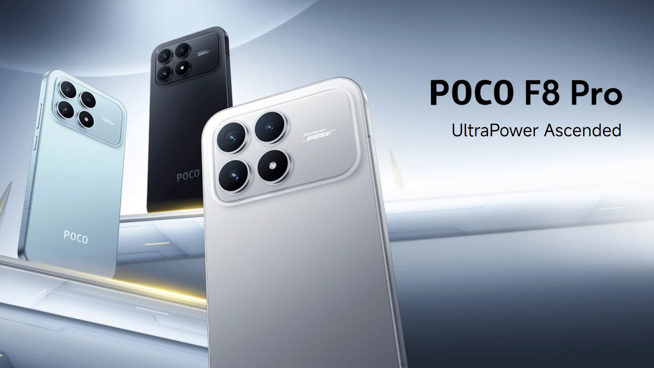
The Poco F8 Pro review reveals a phone that gets a lot of important things right. It delivers flagship-grade speed, a premium build, a sharp and bright OLED display, strong battery life, and very fast charging. On paper, that already makes it one of the more attractive performance-focused phones in its class. Add the Snapdragon 8 Elite chip and HyperOS 3 on top of Android 16, and it becomes clear that Poco is pushing this model as a serious value flagship.
Still, the Poco F8 Pro review also shows that raw power is not everything. The camera system is inconsistent, the ultrawide remains weak, and the phone can run hot under sustained heavy loads. Its launch price also makes the buying decision harder unless you catch it at a discount. So while the Poco F8 Pro is very easy to admire, it is a bit harder to recommend without context.
Poco F8 Pro at a glance
| Feature | Poco F8 Pro |
|---|---|
| Display | 6.59-inch AMOLED, 120Hz, Dolby Vision, HDR10+ |
| Chipset | Snapdragon 8 Elite |
| RAM and storage | 12GB RAM, 256GB/512GB UFS 4.1 |
| Rear cameras | 50MP main, 50MP 2.5x telephoto, 8MP ultrawide |
| Front camera | 20MP |
| Battery | 6210mAh |
| Charging | 100W wired, 22.5W reverse wired |
| Software | Android 16, HyperOS 3 |
| Protection | IP68 |
| Extras | eSIM, Wi-Fi 7, ultrasonic fingerprint reader, stereo speakers |
Design and build quality
The Poco F8 Pro looks more refined than many earlier Poco phones. It has a glass front and back, an aluminum frame, and IP68 water resistance, which helps it feel properly premium rather than merely powerful. The phone is also more compact than its predecessor because it now uses a 6.59-inch display instead of a 6.67-inch panel. That makes it easier to handle without making it feel small.
This more compact body is one of the F8 Pro’s biggest underrated strengths. Many performance phones become too big or too bulky, but Poco has kept this one at 199 grams with an 8mm profile. That balance helps daily usability. The downside is that the phone can get uncomfortably warm around the frame and camera island when pushed hard, so the polished design does not completely hide the thermal limits.
Display quality
The display is smaller this year, but it remains one of the better panels in the segment. It is a 6.59-inch AMOLED with 120Hz refresh rate, 12-bit color, Dolby Vision, and HDR10+ support. The resolution is lower than some rivals, but at this size it still looks sharp enough in daily use.
Brightness is another strong point. The panel reaches 821 nits manually, around 1094 nits in auto mode on a large white area, and up to 3497 nits on a small 10 percent patch. That means outdoor visibility is very good, and HDR highlights can look genuinely impressive. The refresh rate behavior is standard for a non-LTPO display, switching mainly between 60Hz and 120Hz depending on the app.
Battery life and charging
Battery life is one of the best reasons to buy the Poco F8 Pro. The 6210mAh battery is only a modest increase over the previous generation on paper, but actual endurance is much better. The phone scores an Active Use Score of 17 hours and 35 minutes, which is excellent for a phone in this performance tier.
Charging is also very fast. With the proper 100W HyperCharge adapter, the phone reaches 80 percent in 30 minutes and finishes in 39 minutes. Using a 100W USB Power Delivery charger is nearly as fast early on, though a full charge takes longer. Poco also offers helpful battery care features such as slower standard charging and an 80 percent charging cap.
Speaker quality
The Poco F8 Pro has stereo speakers and they are reasonably loud, but they do not fully live up to expectations. They earn a very good loudness score, yet the sound signature is not especially rich. Mids and highs dominate, vocals are clear, but bass is limited. That makes them fine for podcasts, YouTube, and casual watching, though less satisfying for music.
This is not a bad speaker system, but for a phone marketed as a premium all-rounder, it feels more functional than impressive.
Software experience
The phone ships with HyperOS 3 on Android 16, making it one of Xiaomi’s first global devices to launch on this newer software combo. Xiaomi promises four major OS upgrades and six years of security updates, which is a respectable commitment. The software itself is smooth, quick, and visually familiar, though with a few additions such as Hyper Island and broader cross-device connectivity.
HyperOS 3 also leans into AI features, including writing help, subtitles, translation, and smart wallpapers. In daily use, the key point is that the software feels fluid and fast, which suits the Snapdragon 8 Elite well. For buyers focused on responsiveness, Poco delivers here.
Performance
Performance is the Poco F8 Pro’s headline feature. The Snapdragon 8 Elite remains an extremely strong chipset, and Poco pairs it with 12GB of RAM and fast UFS 4.1 storage. In benchmarks, the phone comfortably outperforms many rivals around this price, including devices using the Dimensity 9400, Snapdragon 8 Gen 3, and Exynos 2400.
In normal use, the phone feels every bit as fast as the numbers suggest. Apps open quickly, multitasking is easy, and gaming performance is excellent. This is the kind of phone that still feels flagship-level in speed even if it sits below the very top model in the range. That makes it appealing for buyers who want near-maximum power without paying Ultra prices.
Sustained performance and gaming
This is where the story becomes more mixed. Under long CPU stress, the phone drops to around 50 percent of peak performance, and clock speeds begin dipping after roughly ten minutes. The phone also gets noticeably hot, especially around the camera island and frame.
That does not mean the Poco F8 Pro is bad for gaming. It is still a very capable gaming phone for most real-world sessions. But it does mean that extended heavy workloads are not handled as gracefully as the raw benchmark charts might suggest. Buyers who care about sustained performance should know that the F8 Pro is fast, but not endlessly stable.
Main camera performance
The 50MP main camera is the strongest part of the camera system. In daylight, it captures pleasing photos with solid detail, good dynamic range, and natural-looking processing. Xiaomi wisely avoids excessive sharpening, so the results feel cleaner and more realistic than some overprocessed rivals. Highlights can sometimes run a bit bright, but overall the main camera is dependable.
The 50MP full-resolution mode is harder to recommend because while it can show slightly more detail, it also looks softer. Standard photo mode is usually the better choice. Portrait photos are also pleasant, with good skin tones and decent subject separation in most scenes.
2x crop zoom and 2.5x telephoto
The 2x crop from the main camera is surprisingly good in daylight. In fact, it can look sharper and cleaner than the dedicated 2.5x telephoto in some scenes. That creates an awkward situation for the separate zoom camera because the main sensor often comes very close in quality.
The 2.5x telephoto is not useless, but it feels less valuable than it sounds on paper. In daylight it generally produces good images, but they are often too close to what the 2x crop can already do. This makes the telephoto feel more like an added convenience than a true leap in versatility. At 5x in good lighting, the phone can still capture decent results, though softness becomes more visible.
Ultrawide and selfie cameras
The 8MP ultrawide remains the weakest rear camera. Daylight shots show limited dynamic range, occasional pale colors, and visible overprocessing. It feels clearly below the standard set by the main camera and below what some competitors now offer in this price range.
The 20MP selfie camera is also merely fine. It produces soft-looking photos and dynamic range could be better, though skin tones and detail are acceptable enough for casual use. Neither camera is a disaster, but neither is likely to excite anyone.
Low-light photos
At night, the main camera still performs well. Images are sharp, clean, and detailed, with wide dynamic range. In some scenes the shadows can look a bit too lifted and processed, but overall the main shooter remains reliable after dark. This gives the F8 Pro at least one genuinely strong low-light camera.
The rest of the system is much less convincing. The 2x crop becomes too soft and grainy, the 2.5x telephoto is weak with inaccurate colors and low contrast, and 5x shots are predictably fuzzy. The ultrawide does slightly better than expected, but still lacks sharpness and accurate color. In low light, this is very much a one-camera phone.
Video quality
Video results follow a similar pattern. The main camera produces very good daylight 4K footage with pleasing sharpness, strong detail, and decent dynamic range. Low-light main-camera video is also fairly sharp and only moderately noisy, though dynamic range could be wider.
The 2x crop video is unimpressive, while the dedicated 2.5x telephoto records surprisingly nice video in both daylight and low light. That is one of the few areas where the telephoto feels meaningfully useful. The ultrawide is much weaker, partly because it is limited to 1080p. Overall, the Poco F8 Pro can record good video, but mainly through the main and telephoto cameras.
Competition and value
Value is where the Poco F8 Pro becomes complicated. At early bird pricing, it looks excellent. At full MSRP, it is harder to defend. Rivals like the Samsung Galaxy S25 FE, Xiaomi 15T, and Realme GT 7 all offer their own advantages, particularly in camera balance or overall polish. Poco’s own F8 Ultra is also close enough to tempt buyers who want to spend a bit more for better camera hardware, slightly better battery life, and faster charging.
That means the F8 Pro is most attractive when discounted. At that point, its combination of flagship power, premium materials, strong battery life, and fast charging becomes very difficult to beat.
Final verdict
The Poco F8 Pro is a powerful and mostly well-rounded phone. It offers a premium build, a compact and bright OLED display, excellent battery life, extremely fast charging, and flagship-grade performance. Those are not small strengths. For anyone who prioritizes speed and endurance, it is easy to see the appeal.
Its weak points are also clear. The camera system is inconsistent, the ultrawide is outdated, and the phone can get hot with prolonged heavy use. Most importantly, the launch price makes it less convincing than the hardware alone suggests.
So the verdict is simple: the Poco F8 Pro is easy to recommend at the right price, but much less easy to recommend at the wrong one.
The Review
Poco F8 Pro
The Poco F8 Pro is an excellent all-rounder with few missteps, and those being the overall camera experience as well as the MSRP price. It's a hard sell at its original price, sadly.
PROS
- Premium IP68-rated build
- Bright and sharp AMOLED with Dolby Vision and HDR10+
- Snapdragon 8 Elite delivers flagship performance
- Very good battery life
- Fast 100W charging
- HyperOS 3 feels smooth and modern
- Main camera is reliable
- Telephoto video is better than expected
CONS
- Cameras are not competitive enough for the price
- 8MP ultrawide feels outdated
- Sustained performance is weaker than peak performance suggests
- Phone gets hot under stress
- High MSRP hurts value
Review Breakdown
-
Our Rating
 POCO
POCO


