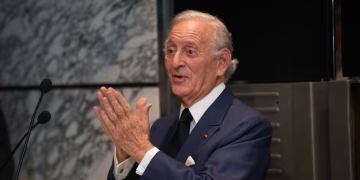
Peter Munga is one of Kenya’s most influential business figures, best known as the founder of Equity Bank, now Equity Group Holdings. His story is a testament to resilience, vision, and determination. From humble beginnings in a rural village in Murang’a County, Munga rose to build a billion-dollar financial empire that transformed banking in Africa.
His impact goes beyond banking. He democratized financial services, making banking accessible to millions who had been excluded from the formal financial system. Munga’s journey—full of struggles, triumphs, and innovation—proves that vision and perseverance can change the world.
Humble Beginnings: From Murang’a to the Boardroom
Peter Kahara Munga was born on December 2, 1946, in Gatura Village, Murang’a County. Raised in a farming family, life was challenging. His parents struggled to make ends meet, and opportunities were scarce.
However, Munga was determined to break free from poverty through education. He excelled academically, securing admission to Kagumo High School, one of Kenya’s top institutions. Later, he joined Kagumo Teachers College, training as a teacher.
For a time, he worked as a teacher, a highly respected profession in post-independence Kenya. But Munga had bigger dreams—he wanted to do something transformational.
From Teaching to Business: A Leap into the Corporate World
Munga’s time as a teacher exposed him to the struggles of ordinary Kenyans, particularly the lack of access to financial services. In rural Kenya, banks were seen as institutions for the wealthy—ordinary people had nowhere to save or borrow money.
Driven by the need to understand finance, Munga left teaching and took a clerical job at the Kenya Posts and Telecommunications Corporation (KPTC). This was his first step into the corporate world.
Later, he joined the Central Bank of Kenya (CBK), where he gained deeper insights into the banking sector. These experiences shaped his vision—to create a financial institution that served ordinary Kenyans.
Founding Equity Building Society (1984): The Struggle Begins
In 1984, Munga and a small group of partners founded Equity Building Society (EBS). The goal was to provide affordable housing loans to low-income Kenyans.
At the time, Kenya’s banking industry was controlled by a few elite banks that served the wealthy and middle class. Small-scale traders, farmers, and ordinary Kenyans had no access to credit or savings accounts.
Munga saw an opportunity to fill this gap—to build a bank that served the unbanked.
Early Challenges
- Low Capital – The institution had little money and struggled to meet customer demand.
- Skepticism – Many Kenyans distrusted banks, believing they were only for the rich.
- Mismanagement – The institution lacked banking expertise and faced operational difficulties.
By the mid-1990s, Equity Building Society was on the brink of collapse. It was losing money, and its future looked uncertain.
Turning Point: Bringing in James Mwangi (1993)
Faced with potential failure, Munga took a bold step—he brought in James Mwangi, a young and ambitious accountant, to turn things around.
Under Mwangi’s leadership, Equity shifted its focus from mortgage lending to microfinance, targeting small businesses, farmers, and low-income earners.
Key Reforms:
- Low-cost accounts – Equity removed high fees, making banking affordable.
- Mobile Banking – Introduced services like M-Pesa integration, making banking more accessible.
- Expansion to rural areas – Opened branches and partnered with agents to reach more people.
- Customer-Centric Approach – Focused on financial literacy and customer empowerment.
By 2006, Equity had grown from a struggling society to a full-fledged commercial bank—Equity Bank Kenya.
Equity’s Growth: From Kenya to Africa
With a strong foundation, Equity Bank expanded aggressively. In 2014, it rebranded to Equity Group Holdings, reflecting its pan-African ambitions.
Expansion into Other Countries:
- Uganda (2008)
- Tanzania (2009)
- South Sudan (2011)
- Rwanda (2011)
- Democratic Republic of Congo (DRC) (2015)
Today, Equity serves over 15 million customers across Africa, making it one of the continent’s largest banks.
Peter Munga’s Business Empire
Beyond Equity, Munga has invested in several sectors, including investment banking, real estate, agriculture, and manufacturing.
1. Equity Investment Bank (EIB)
- A subsidiary of Equity Group Holdings.
- Provides investment banking, wealth management, and advisory services.
2. Real Estate & Commercial Properties
- Owns major commercial properties, including Equity Centre in Nairobi.
- Has investments in residential and commercial real estate across Kenya.
3. Agriculture & Agribusiness
- Equatorial Nut Processors – A major processor of macadamia and cashew nuts.
- Kakuzi PLC – Investments in avocado, tea, and forestry production.
4. Manufacturing & Consumer Goods
- Holds stakes in packaging, consumer goods, and industrial manufacturing companies.
5. Stock Market & Public Investments
- Holds shares in major Kenyan companies, including Britam Holdings (insurance & asset management).
- Linked to investments in Safaricom, Kenya’s leading telecommunications company.
Munga’s business empire reflects his diversified investment approach, focusing on sectors that drive economic growth and create jobs.
Challenges & Controversies
Like any successful entrepreneur, Munga has faced challenges and controversies.
Insider Trading Allegations (2018)
- In 2018, Munga stepped down as Equity Bank chairman amid allegations of insider trading.
- Reports suggested that he facilitated the sale of Equity Investment Bank (EIB) shares to a private firm.
- Critics argued the deal favored private investors over minority shareholders.
Munga denied any wrongdoing, maintaining that the sale was transparent and legal. The controversy faded, but it was a significant moment in his career.
Equity’s Aggressive Expansion Strategy
- Some critics argue that Equity’s rapid expansion into multiple African countries was too ambitious.
- Others believe the bank should focus more on consolidating its market position rather than expanding further.
Despite these challenges, Munga remains one of Kenya’s most respected business figures.
Legacy: A Pioneer of Financial Inclusion
Peter Munga’s impact goes beyond business. He is a philanthropist passionate about education and youth empowerment.
His Contributions:
- Education Initiatives – Funded schools and scholarships in Murang’a County.
- Equity Group Foundation – A leading social impact organization providing education, healthcare, and entrepreneurship training.
- Mentorship Programs – Actively supports young entrepreneurs and business leaders.
Munga believes that wealth is not just about making money—it’s about making a difference.
Final Thoughts: The Man Who Changed Banking in Africa
Peter Munga’s story is a powerful lesson in vision, resilience, and impact. He saw a problem, created a solution, and refused to give up, even when faced with failure.
His bold leadership and innovative banking model have transformed millions of lives across Africa.
Today, Equity Group Holdings stands as a symbol of financial empowerment, proving that banking should serve everyone—not just the wealthy.
Munga’s journey from a rural village in Murang’a to the top of Kenya’s corporate world is an inspiration to entrepreneurs, business leaders, and future generations.
He is more than a banker—he is a trailblazer, a game-changer, and a true African success story.