By Bernard Mwinzi
The news of Wafula Wanyonyi Chebukati’s passing on February 19, 2025, at Nairobi Hospital hit me like a thunderbolt, pulling me back to a sweltering day in August 2022 when I faced him in a boardroom at the Bomas of Kenya. As the former chairman of the Independent Electoral and Boundaries Commission (IEBC) from 2017 to 2023, Chebukati was a towering figure in Kenya’s electoral history—a man whose quiet demeanor masked a steely resolve. His death marks the end of an era, but it’s that heated encounter, just days before the 2022 General Elections, that lingers in my mind as I mourn a public servant who shaped our nation’s democratic narrative.
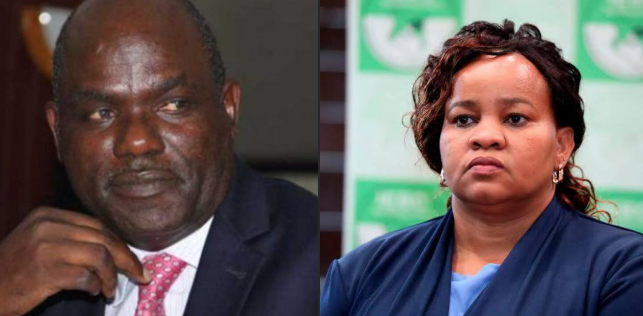
I had walked into Bomas expecting a reprimand. My articles in the Daily Nation, particularly a Page 1 headline screaming “The Making of an Opaque Election,” had ruffled feathers at the IEBC. I anticipated a stern lecture, perhaps a private dressing-down over coffee. Instead, I found myself in a lions’ den—Chebukati flanked by commissioners, including his deputy Juliana Whonge Cherera and CEO Marjan Hussein Marjan, all poised to dissect my journalistic audacity. What ensued wasn’t just a hiding; it was a brutal roasting that left me battered but oddly enlightened.
Chebukati entered the room with the gait of a man burdened yet unbroken, his slight stoop hinting at the weight of a thousand petitions and the quiet amusement of a seasoned arbiter. His piercing, watery eyes locked onto me with disdain as he took his seat. When he spoke, his voice was soft, almost detached, yet laced with an acerbic edge honed over two decades at his law firm, Cootow and Associates Advocates. He accused me of undermining Kenya’s electoral integrity, claiming my writings were a “great disservice” to the nation. The commission, he revealed, had even resolved to withhold advertising revenue from Nation Media Group until I “put the house in order”—a chilling threat to press freedom that still unsettles me.
The commissioners took turns dismantling me. Cherera’s moralistic tirade painted me as a villain, while Marjan and others piled on, leaving me figuratively sprawled on the Bomas floor. When my chance to speak finally came, I offered a subdued defense of journalism’s role—how it sometimes stings but isn’t personal, how punishing media financially sets a dangerous precedent. But my heart wasn’t in the past; it was on the future. I had a rare audience with the IEBC’s top brass, and I seized the moment to probe their thoughts on the looming election.
“Raila will not win this one by the backdoor!” Chebukati declared, his voice rising with conviction. When I pressed him on what he meant, he pointed to Raila Odinga’s legal challenges against the Kenya Integrated Election Management System (KIEMS) kits and his push for a manual voter register—moves Chebukati dismissed as futile attempts to sway the process. “Mark my words, it won’t happen,” he added, his tone a mix of defiance and certainty.
That exchange shifted my perspective. I’d been juggling two election scenarios: a Raila win and a Ruto win. Chebukati’s words, delivered with the weight of a man who’d navigated Kenya’s electoral chaos before, convinced me to pivot. I called the newsroom, urging editors to abandon the Raila scenario and focus all resources on a Ruto victory. “From what I’ve heard, we should all prepare for a Ruto presidency,” I told them. Days later, on August 15, 2022, William Ruto was declared president-elect with 50.49% of the vote, edging out Raila’s 48.85%. Chebukati’s prediction held true, his commission’s process—however controversial—standing firm against legal and political assaults.
Reflecting on that encounter, I see Chebukati as a paradox: a soft-spoken elder whose gentle demeanor belied a granite will. He wasn’t flawless—his tenure was marred by disputes, from the 2017 election annulment to the 2022 fallout with the “Cherera Four” who contested Ruto’s win. Yet, he carried the IEBC through storms with a stoic resolve that commanded respect, even from critics like me. His disdain for my journalism stung, but I admired his clarity, his refusal to bend under pressure. He saw the election not as a circus but as a duty, and in that Bomas boardroom, he made it clear whose word would prevail.
Chebukati’s death closes a chapter on a man who shaped Kenya’s electoral destiny. His legacy is complex—celebrated by some, questioned by others—but undeniable. He was no saint, but he was a servant who bore the nation’s democratic burden with a quiet, unyielding strength. As I bid him farewell, I recall his parting shot: “Raila will not win this by the backdoor!” It wasn’t just a prediction; it was a testament to his resolve. Rest in peace, Wafula Chebukati—a stooped figure who stood tall when it mattered most.