


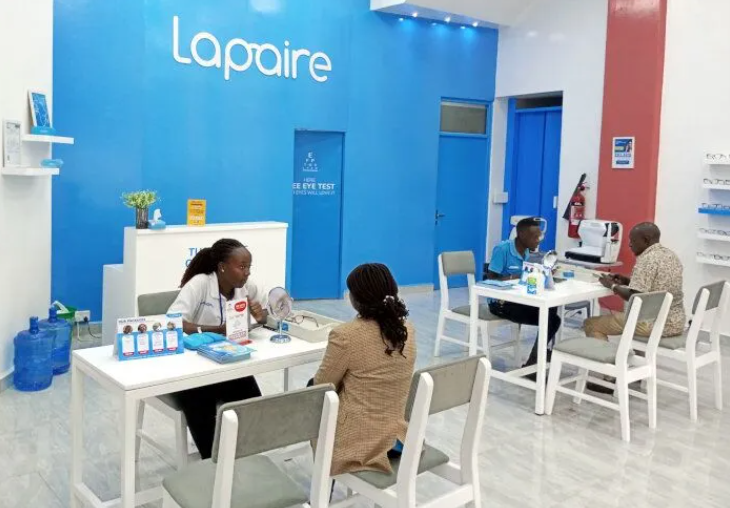
Lapaire funding shows how affordable eyecare has become an investable healthcare and retail opportunity across Africa. Founded in 2018, Lapaire is a pan-African eyecare company focused on making quality eyewear accessible without making customers pay premium private-clinic prices.
The company operates across retail, e-commerce, health, medical services, affordable eyewear, optical care and technology-enabled health access. Its model is built around a simple but powerful problem: millions of people in Africa need glasses, but many do not get tested, cannot afford frames and lenses, or do not have easy access to reliable optical services.
Lapaire’s business combines free eye tests, affordable glasses, physical branches, technology-enabled operations and a customer-centered optical retail model. The company says it is present in more than 50 locations across Uganda, Kenya, Côte d’Ivoire, Burkina Faso, Mali, Benin and Togo.
Its funding history includes seed investment, Series B equity, debt financing and later strategic equity activity. Known investors and funders include Saviu Ventures, Sayani Investment, EQ2 Ventures, Investisseurs & Partenaires, Asia Africa Investment & Consulting, FINCA Ventures, Beyond Capital Ventures, AfricInvest, Proparco and Creadev.
The company’s funding story matters because eyecare is often overlooked in healthcare investment. Poor vision can affect education, productivity, road safety, income and quality of life. Lapaire’s growth shows that affordable optical care can be both socially important and commercially scalable.
What Is Lapaire?
Lapaire is a technology-enabled eyecare and affordable eyewear company serving African markets. The company’s mission is to make eyecare accessible to everyone in Africa without breaking the bank.
Lapaire provides eye tests and sells prescription glasses at fair prices. Its model is built around a one-stop-shop customer experience where clients can walk into a branch, get tested and purchase eyewear suited to their needs and budget.
Unlike premium optical clinics that may be too expensive for low- and middle-income customers, Lapaire targets affordability and convenience. It uses physical branches, local teams and operational systems to make eyecare more accessible in underserved markets.
Lapaire’s business sits across several categories:
| Sector | Why It Matters to Lapaire |
|---|---|
| Retail | Lapaire sells eyeglasses through physical branches and customer-facing outlets. |
| E-commerce | Digital tools support customer acquisition, ordering and service operations. |
| Health / Medical | Eye tests and prescription eyewear are part of essential health access. |
| Affordable Eyewear | Lower pricing expands access for low- and middle-income customers. |
| Optical Care | Lapaire provides vision testing and eyecare services. |
| HealthTech | Technology supports branch operations, customer records and scaling. |
| Impact Business | Better vision can improve education, work and daily life. |
Lapaire is therefore best understood as both a healthcare access company and a retail platform. It sells glasses, but its deeper value lies in making vision correction easier to access.
Why Lapaire Funding Matters
Lapaire funding matters because vision care remains one of Africa’s underfunded health and productivity gaps. Many people live with poor eyesight because they have never had an eye test, cannot afford glasses, or do not know where to get reliable optical care.
This has everyday consequences. A child who cannot see clearly may struggle in school. A tailor, driver, farmer, shopkeeper or office worker may lose productivity. Older adults may become less independent. Small vision problems can become large economic and social barriers when eyecare is inaccessible.
Lapaire’s model addresses this problem by combining free eye tests with affordable glasses and branch-based access. That makes funding important because optical retail expansion requires capital. The company must open branches, train staff, manage inventory, source lenses and frames, build systems, market services and maintain quality.
The January 2024 Series B round helped Lapaire expand across Africa. The October 2024 financing from AfricInvest and Proparco supported further expansion into new markets such as Senegal, the Democratic Republic of Congo and Tanzania while strengthening coverage in existing countries. Creadev’s 2025 acquisition of Saviu Ventures’ stake added another strategic investor to the ownership story.
Full List of Lapaire Funding and Investor Activity
Lapaire has raised capital through seed funding, Series B equity, debt financing and strategic secondary investment activity. Some amounts are publicly disclosed, while others are undisclosed.
| Investor / Funding Partner | Announced Date | Amount | Main Category | Strategic Value |
| Saviu Ventures | Oct 2018 | Undisclosed | Seed / Equity Funding | Early investor that supported Lapaire’s expansion and later exited to Creadev. |
| Saviu Ventures | Dec 2019 | Undisclosed | Seed | Follow-on support for early growth. |
| Sayani Investment | Jan 2021 | Undisclosed | Seed | Supported early-stage expansion and market development. |
| EQ2 Ventures | Jan 2022 | Undisclosed | Seed | Added venture support for growth and operations. |
| Investisseurs & Partenaires | Jan 2024 | Part of $3M Series B | Series B / Impact Investment | Led the Series B round to support African expansion. |
| Asia Africa Investment & Consulting | Jan 2024 | Part of $3M Series B | Series B / Healthcare Investment | Supported expansion of affordable eyecare and retail operations. |
| FINCA Ventures | Jan 2024 | Part of $3M Series B | Series B / Impact Investment | Supported access to affordable eyewear for underserved customers. |
| Beyond Capital Ventures | Jan 2024 | Part of $3M Series B | Series B / Impact Capital | Supported accessible eyecare and essential services expansion. |
| AfricInvest | Oct 2024 | $2.5M financing | Debt Funding / Transform Health Fund | Supported expansion of optical care coverage across Africa. |
| Proparco | Oct 2024 | €450K financing | Debt Funding / Bridge by Digital Africa | Supported expansion of Lapaire’s eyecare network. |
| Creadev | Jan–Feb 2025 | Undisclosed | Equity Funding / Secondary Stake Acquisition | Acquired Saviu Ventures’ 22% stake and became a strategic investor. |
This funding history shows Lapaire’s move from venture-backed startup to a growth-stage healthcare retail platform with impact and development finance support.
Lapaire Funding Timeline
2018: Founded to Make Eyewear Affordable
Lapaire was founded in 2018 with a mission to make eyecare and glasses more accessible across Africa. Its early model focused on affordable eyewear, free eye tests and a retail experience designed for customers who may not have used formal optical services before.
The company’s entry point was practical. Glasses are a simple intervention, but access remains limited. Lapaire saw an opportunity to reduce cost, improve convenience and build trust.
2018–2019: Early Seed Support From Saviu Ventures
Saviu Ventures invested in Lapaire in 2018 and later participated in follow-on rounds. That early support helped the company build its branch model and expand into more markets.
Saviu’s later exit is also important because it showed that early-stage African health retail businesses can generate investor returns when they scale effectively.
2021–2022: Additional Seed Investors Support Growth
In 2021 and 2022, Lapaire attracted additional seed-stage support from investors including Sayani Investment and EQ2 Ventures. This period helped the company expand its operating footprint and strengthen the retail model.
At this stage, Lapaire was proving that affordable eyecare could work across multiple African markets, not just one country.
January 2024: $3 Million Series B Round
In January 2024, Lapaire raised $3 million in Series B funding. The round was led by Investisseurs & Partenaires, with participation from Asia Africa Investment & Consulting, FINCA Ventures and Beyond Capital Ventures.
This round helped Lapaire accelerate expansion across the continent. It also positioned the company as a serious impact-driven optical care platform, not only a small eyewear retailer.
The investor mix was significant. I&P brought impact investment experience, AAIC added healthcare and Africa-Asia investment relevance, FINCA Ventures aligned with financial inclusion and essential services, and Beyond Capital Ventures added support for businesses serving low-income consumers.
October 2024: AfricInvest and Proparco Approve Debt Financing
In October 2024, AfricInvest and Proparco approved close to $3 million in financing for Lapaire. AfricInvest provided $2.5 million, while Proparco provided €450,000 through its Bridge by Digital Africa facility.
This financing was designed to improve optical care coverage in Lapaire’s existing markets and support expansion into new countries, including Senegal, the Democratic Republic of Congo and Tanzania.
The debt financing is strategically important because it shows Lapaire moving beyond equity fundraising. Growth-stage retail and healthcare companies often use debt to expand outlets, manage working capital and support inventory.
2025: Creadev Acquires Saviu Ventures’ Stake
In early 2025, Saviu Ventures exited its investment in Lapaire by selling its 22% stake to Creadev. This was a secondary transaction, meaning it involved a shareholder change rather than necessarily new operating capital for the company.
Even so, the transaction matters. Creadev is a long-term investment company, and its entry as a strategic investor suggests continued confidence in Lapaire’s growth model. The exit also showed that early investors in African health access businesses can achieve liquidity when companies scale.
Biggest Lapaire Funding Rounds by Deal Value
Lapaire’s largest disclosed capital events show a company raising both equity and debt for regional expansion.
| Rank | Funding Event | Announced Date | Deal Value | Strategic Area |
| 1 | Series B led by Investisseurs & Partenaires | Jan 2024 | $3M | African expansion, branch growth and affordable eyewear |
| 2 | AfricInvest financing | Oct 2024 | $2.5M | Optical care coverage and market expansion |
| 3 | Proparco financing | Oct 2024 | €450K | Bridge financing for digital and retail expansion |
| 4 | Creadev acquisition of Saviu stake | Jan–Feb 2025 | Undisclosed | Strategic shareholder transition |
| 5 | Saviu Ventures early investment and follow-ons | 2018–2019 | Undisclosed | Early branch model development and expansion |
| 6 | EQ2 Ventures seed support | Jan 2022 | Undisclosed | Growth-stage seed support |
| 7 | Sayani Investment seed support | Jan 2021 | Undisclosed | Early expansion support |
The $3 million Series B and the AfricInvest-Proparco financing are the most important disclosed growth events because they directly support expansion of Lapaire’s eyecare network.
Most Common Funding Categories
Lapaire’s funding profile reflects a hybrid retail-healthcare business.
| Funding Category | Examples of Investors | Strategic Role |
| Series B Equity | I&P, AAIC, FINCA Ventures, Beyond Capital Ventures | Supports regional expansion and branch network growth. |
| Debt Funding | AfricInvest, Proparco | Supports optical care expansion, working capital and new market entry. |
| Seed Funding | Saviu Ventures, Sayani Investment, EQ2 Ventures | Supports early business model validation and branch rollout. |
| Strategic Equity | Creadev | Adds long-term shareholder support through secondary acquisition. |
| Impact Capital | I&P, FINCA Ventures, Beyond Capital Ventures | Supports affordable eyecare access for underserved customers. |
| Healthcare Investment | AAIC, AfricInvest Transform Health Fund | Supports health access and scalable care delivery. |
This mix makes sense because Lapaire needs both growth equity and operational financing. Branch expansion, staff training, inventory and customer acquisition all require capital.
Strategic Lessons From Lapaire Funding
Affordable Eyecare Can Be a Scalable Business
Lapaire funding shows that eyecare can be both an impact opportunity and a commercial market. Glasses are not complex medical devices, but they can dramatically improve daily life.
The business case is strong when a company can combine affordable pricing with reliable testing, attractive frames and efficient distribution.
Physical Branches Still Matter
Even though Lapaire is technology-enabled, eyecare remains a physical service. Customers need eye tests, frame fitting and product support.
This makes Lapaire different from a pure e-commerce startup. Its branch network is central to trust, service quality and sales.
Impact Investors Like Essential Services
Lapaire’s investor base shows that essential services businesses can attract impact capital. Eyecare improves education, work and quality of life, especially for low- and middle-income customers.
Debt Can Support Growth-Stage Expansion
The AfricInvest and Proparco financing shows how debt can support expansion once a company has a proven model. For a retailer with branch operations and inventory needs, debt can be useful if cash flows are predictable.
How Lapaire Funding Fits Its Business Model
Lapaire’s business model depends on delivering affordable eyewear through a branch-based and technology-supported platform.
Funding supports this model in several ways.
First, it helps open new locations. Each branch requires staff, equipment, inventory, rental space, branding and customer outreach.
Second, it supports inventory. Eyewear companies must manage frames, lenses, accessories and prescription fulfillment.
Third, capital supports technology systems. Lapaire needs tools for customer records, prescriptions, stock management, sales tracking and branch operations.
Fourth, funding helps expand into new markets. Each new country requires regulatory compliance, hiring, supplier relationships and local marketing.
Fifth, it supports affordability. A well-capitalized company can invest in efficient sourcing and operations, helping keep prices accessible.
The funding therefore fits a retail-healthcare platform model: grow the branch network, maintain affordability, improve operations and build trust.
Financial and Ownership Context
Lapaire is a private company, so full financial statements are not publicly available. However, its funding history shows a company that has moved from early venture funding to a more mature mix of impact equity, debt and strategic investment.
Saviu Ventures’ 2025 exit is a useful ownership milestone. Saviu had invested early and built a 22% stake before selling to Creadev. That transaction showed that Lapaire had reached a stage where later-stage strategic investors were interested in ownership exposure.
The Series B and debt financing also show that investors see Lapaire as more than a small retailer. It is being financed as a pan-African eyecare platform.
For analysts, the key financial questions are branch-level profitability, customer acquisition costs, inventory turnover, gross margins, repeat customer behavior, lens fulfillment efficiency and expansion discipline.
Competitive Impact of Lapaire Funding
Lapaire funding improves the company’s competitive position in several ways.
First, it supports branch expansion. More locations make Lapaire easier to access and improve brand visibility.
Second, it supports market entry. Expansion into Senegal, the Democratic Republic of Congo and Tanzania can broaden the company’s footprint beyond its existing countries.
Third, funding strengthens procurement and operations. Larger scale can improve supplier terms, inventory management and pricing flexibility.
Fourth, investor backing improves credibility. Customers, landlords, suppliers and regulators may trust a better-capitalized healthcare retailer.
Fifth, Lapaire’s affordability positioning differentiates it from premium optical clinics and informal eyewear sellers.
The competitive landscape includes traditional opticians, hospitals, pharmacies, informal frame sellers, e-commerce platforms and local eyewear retailers. Lapaire’s advantage depends on combining trust, price, convenience and service quality.
Advantages of the Funding Strategy
Strong Impact Alignment
Lapaire’s investors are aligned with healthcare access, affordability and essential services.
Expansion Across Multiple Countries
The company has built a footprint across East and West Africa, reducing dependence on one market.
Hybrid Health and Retail Model
Lapaire combines healthcare service delivery with retail economics, creating both impact and revenue potential.
Strategic Debt Use
Debt financing from AfricInvest and Proparco can support expansion without relying only on equity dilution.
Investor Exit Validation
Saviu Ventures’ exit to Creadev shows that early investors can achieve liquidity in African health retail businesses.
Disadvantages of the Funding Strategy
Branch Expansion Risk
Opening many branches can strain operations if staff training, quality control and inventory systems do not keep pace.
Affordability Pressure
Lapaire must keep prices low while covering branch costs, staff salaries, inventory and expansion expenses.
Healthcare Quality Risk
Eye tests must be reliable. Poor prescriptions or weak service quality can damage trust.
Working Capital Needs
Eyewear retail requires inventory. Frames and lenses must be stocked or sourced efficiently to avoid delays and cash pressure.
Multi-Country Complexity
Operating across several countries creates regulatory, currency, logistics and management challenges.
Case Studies of Major Lapaire Funding Events
$3 Million Series B Round
Lapaire’s January 2024 Series B round was a major milestone. Led by Investisseurs & Partenaires, with participation from AAIC, FINCA Ventures and Beyond Capital Ventures, the round supported expansion across Africa.
The round confirmed that affordable eyecare can attract investors looking for both impact and scale. It also helped Lapaire strengthen its branch network and growth strategy.
AfricInvest and Proparco Financing
The October 2024 financing from AfricInvest and Proparco added close to $3 million in debt support. AfricInvest’s $2.5 million commitment and Proparco’s €450,000 Bridge by Digital Africa facility were designed to improve optical care coverage and support new market entry.
This funding is important because it supports expansion without depending entirely on new equity. It also brings development finance credibility to Lapaire’s model.
Creadev Acquisition of Saviu Ventures’ Stake
Creadev’s acquisition of Saviu Ventures’ 22% stake in Lapaire was a major ownership event. It gave Saviu a successful exit and brought in a strategic long-term investor.
For Lapaire, the transaction reinforced market confidence in its growth potential. For African venture capital, it showed that health access and retail businesses can create exit opportunities.
Saviu Ventures’ Early Investment
Saviu Ventures’ early investment in 2018 helped Lapaire develop its model and expand in its first years. Early-stage capital is often decisive in retail healthcare because companies need time to test pricing, branch operations and customer demand.
Common Mistakes When Analyzing Lapaire Funding
Treating Lapaire as Only a Glasses Retailer
Lapaire sells eyewear, but it is also an eyecare access platform. The free eye test and affordability model are central to its value.
Ignoring Branch Economics
The success of Lapaire depends on branch-level performance, not only the number of branches opened.
Looking Only at Funding Amounts
Investor quality matters. Lapaire’s backers bring impact, healthcare, development finance and retail growth relevance.
Underestimating Working Capital
Eyewear businesses need inventory. Poor stock management can hurt margins and customer satisfaction.
Assuming Every Market Is the Same
Eyecare demand, pricing, regulation and customer behavior can differ across Kenya, Uganda, Côte d’Ivoire, Mali, Togo, Benin and other markets.
Lessons for Business Owners and Investors
Lapaire offers several lessons.
First, essential health services can be delivered through retail models when pricing and operations are disciplined.
Second, affordability can be a competitive advantage, not just a social mission.
Third, physical access still matters. Branches build trust and allow customers to receive tests and fittings.
Fourth, impact capital and debt can work together. Equity can fund growth, while debt can support proven expansion.
Finally, investor exits can happen in African health access businesses when companies build scale and strong unit economics.
Key Takeaways
- Lapaire is a technology-enabled eyecare and affordable eyewear company founded in 2018.
- The company is linked to Nairobi in the supplied profile and operates as a pan-African eyecare platform.
- Lapaire provides free eye tests and affordable glasses.
- Lapaire says it is present in more than 50 locations across Africa.
- Its markets include Uganda, Kenya, Côte d’Ivoire, Burkina Faso, Mali, Benin and Togo.
- Lapaire funding includes seed, Series B, debt financing and strategic equity activity.
- The company raised $3 million in Series B funding in January 2024.
- Investisseurs & Partenaires led the Series B round.
- AAIC, FINCA Ventures and Beyond Capital Ventures participated in the Series B.
- AfricInvest and Proparco approved close to $3 million in debt financing in October 2024.
- Creadev acquired Saviu Ventures’ 22% stake in Lapaire in early 2025.
- Lapaire’s growth depends on branch economics, affordability, service quality, inventory management and multi-country execution.
Frequently Asked Questions
What is Lapaire?
Lapaire is a pan-African eyecare company that provides free eye tests and affordable prescription glasses.
When was Lapaire founded?
Lapaire was founded in 2018.
Where is Lapaire based?
The supplied company profile lists Lapaire in Nairobi, Kenya. The company operates across several African markets.
What does Lapaire do?
Lapaire offers eye tests, prescription glasses and affordable eyewear through a technology-enabled retail and healthcare model.
What is Lapaire funding?
Lapaire funding refers to the capital raised by the company through seed investment, Series B equity, debt financing and strategic shareholder transactions to expand eyecare access in Africa.
How much did Lapaire raise in Series B funding?
Lapaire raised $3 million in Series B funding in January 2024.
Who led Lapaire’s Series B round?
Investisseurs & Partenaires led Lapaire’s Series B round.
Who participated in Lapaire’s Series B?
Participants included Asia Africa Investment & Consulting, FINCA Ventures and Beyond Capital Ventures.
How much financing did AfricInvest and Proparco provide?
AfricInvest provided $2.5 million and Proparco provided €450,000 through its Bridge by Digital Africa facility in October 2024.
What did Creadev do in Lapaire’s funding story?
Creadev acquired Saviu Ventures’ 22% stake in Lapaire in early 2025, becoming a strategic investor.
Where does Lapaire operate?
Lapaire says it operates in Uganda, Kenya, Côte d’Ivoire, Burkina Faso, Mali, Benin and Togo.
What are Lapaire’s main risks?
Lapaire’s main risks include branch expansion risk, affordability pressure, working capital needs, healthcare service quality, competition and multi-country operating complexity.
Conclusion
Lapaire funding shows how affordable eyecare can become a serious healthcare and retail investment opportunity in Africa. Founded in 2018, Lapaire has built a pan-African model around free eye tests, affordable glasses and branch-based access for customers who may otherwise go without vision correction.
The company’s $3 million Series B round in January 2024, led by Investisseurs & Partenaires with participation from AAIC, FINCA Ventures and Beyond Capital Ventures, helped support African expansion. The later financing from AfricInvest and Proparco added close to $3 million in debt support, while Creadev’s acquisition of Saviu Ventures’ stake showed growing strategic investor interest in Lapaire’s model.
The opportunity is large. Better vision can improve education, productivity, safety and quality of life. Yet many people across Africa still lack access to affordable eye tests and glasses. Lapaire is trying to close that gap through a model that combines health access, retail efficiency and technology-enabled operations.
For business owners, investors and healthcare analysts, Lapaire funding offers a clear lesson. The future of essential health services in Africa will be shaped not only by hospitals and clinics, but also by focused companies that make basic care affordable, convenient and trusted at scale.
Disclaimer: This article is for informational and educational purposes only. It is not investment advice, financial advice, or a recommendation to buy or sell any security. Always conduct your own research and consider speaking with a qualified financial adviser before making investment decisions.
Read Also: Farm Works Funding: How Farm Works Built Its Agribusiness Platform


