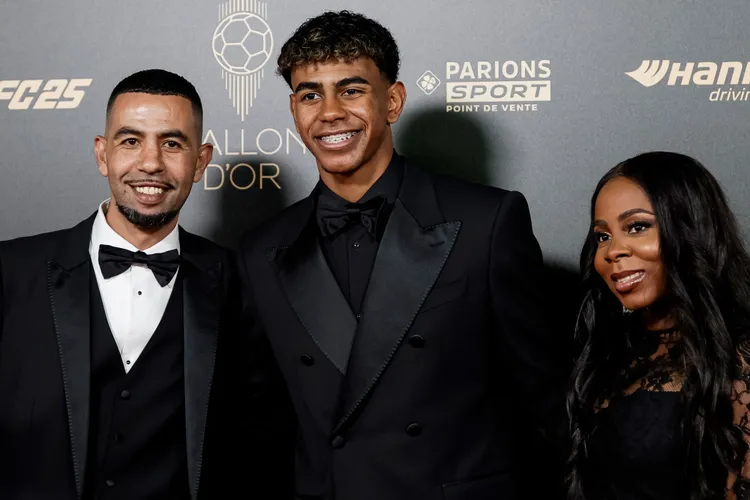
Lamine Yamal’s parents, Mounir Nasraoui and Sheila Ebana, supported one of football’s most remarkable young careers through financial pressure, family separation and the challenges of raising a gifted child in working-class communities near Barcelona.
Nasraoui is originally from Morocco, while Ebana comes from Equatorial Guinea. Their son was born in Catalonia on July 13, 2007, making his family story a reflection of three countries and several cultural identities. FC Barcelona identifies his birthplace as Esplugues de Llobregat, while earlier club reporting has also associated his childhood with Mataró, the city where he spent significant parts of his early life.
The couple separated when Yamal was about three years old. He subsequently divided his childhood between his mother’s home in Granollers and the Rocafonda area of Mataró, where his father and paternal relatives lived. Despite no longer being together, both parents remained involved in their son’s life and became visible supporters as he rose through Barcelona’s academy and the Spanish national-team system.
Ebana worked long hours while raising her son and helped connect him with organised youth football. Nasraoui remained closely linked to the community where Yamal developed his identity and repeatedly expressed confidence in his son’s ability.
Their sacrifices formed the foundation of a career that progressed at extraordinary speed. Barcelona says Yamal joined its youth system in 2014 at seven years old. He later became the youngest player to represent the club’s senior team and developed into a leading attacker for Barcelona and Spain.
His official Spanish federation profile records his continuing senior international career, while the federation described him before the 2026 World Cup as one of the outstanding young figures in the national squad.
Who Are Lamine Yamal’s Parents?
Lamine Yamal’s father is Mounir Nasraoui, a Moroccan-born member of the immigrant community in Catalonia.
His mother is Sheila Ebana, who comes from Equatorial Guinea and also settled in the Barcelona area with her family.
The pair met in Catalonia and welcomed Yamal in July 2007. Their relationship ended while he was still a young child, but both continued supporting him.
Their backgrounds gave Yamal eligibility and cultural connections to Morocco, Equatorial Guinea and Spain.
Morocco represented his father’s country of origin.
Equatorial Guinea represented his mother’s heritage.
Spain was his birthplace, home and the country whose football system developed him.
He eventually selected Spain for international football and stated that his commitment had been clear from his early appearances in the country’s youth teams.
Yamal has continued recognising the African sides of his family identity. He has worn boots displaying Moroccan and Equatorial Guinean flags while representing Spain, presenting his heritage as complementary rather than conflicting.
Mounir Nasraoui Comes From Morocco
Nasraoui’s family origins are in Morocco.
Yamal has discussed how members of his paternal family reached Spain during a period of financial difficulty and demanding immigrant labour.
According to the account attributed to Yamal in the source material, his grandmother arrived first and worked several shifts before helping other family members join her.
The story reflects the economic reality faced by many immigrant families moving to European cities.
Relocation does not immediately guarantee stability.
Families may begin with temporary employment, shared accommodation and limited financial resources. Their first priority is often creating a secure foundation for children and relatives rather than accumulating personal wealth.
Nasraoui’s experience appears to have included periods of temporary employment and movement between Morocco and Spain before the family became more established.
He later settled in the Mataró area, particularly Rocafonda, the neighbourhood that became closely associated with his son.
Sheila Ebana Is From Equatorial Guinea
Ebana originates from Equatorial Guinea, a Central African country with strong historical and linguistic links to Spain.
She moved to Catalonia with members of her family and eventually met Nasraoui in the Barcelona area.
After separating from Yamal’s father, she lived with her son in Granollers.
Published accounts describe her working in food service while supporting the household. Those years became an important part of Yamal’s public account of his childhood because they illustrated the financial pressure under which his mother raised him.
Ebana generally maintains a lower public profile than Nasraoui.
She attends matches, award ceremonies and family celebrations but does not seek the same level of social-media visibility.
Her appearances after major victories have nevertheless made her familiar to supporters.
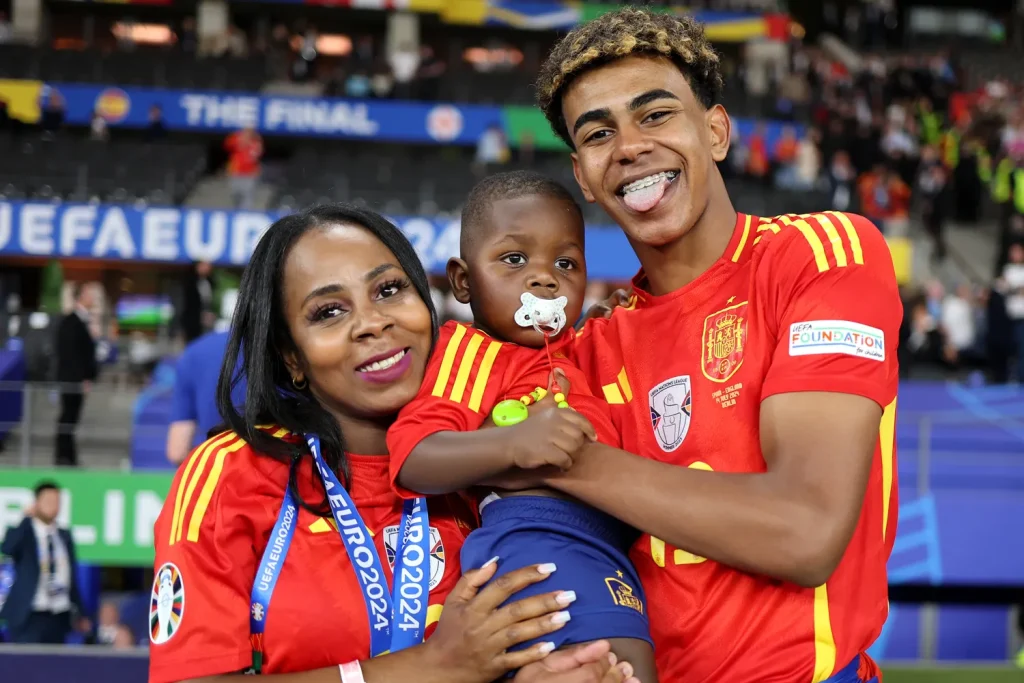
Images of Yamal embracing his mother after Spain’s Euro 2024 matches became symbols of the family’s journey from modest circumstances to international success.
His Parents Met in Catalonia
Nasraoui and Ebana came to Spain through different family migration stories.
They met after their families settled in Catalonia and lived for a period in accommodation intended for young parents, according to Yamal’s account cited in the source material.
The relationship produced one son, Lamine Yamal Nasraoui Ebana.
His full name reflects both sides of the family.
Nasraoui comes from his father.
Ebana comes from his mother.
This naming structure is common in Spain, where children generally receive surnames representing both parents.
Yamal’s family identity therefore remains publicly visible every time his complete name is used.
Although his parents later separated, the connection between the Moroccan, Equatoguinean and Catalan parts of his background remained central to his upbringing.
Mounir and Sheila Separated During Yamal’s Childhood
Nasraoui and Ebana separated when Yamal was approximately three years old.
Following the split, Yamal lived primarily with his mother in Granollers but maintained strong connections with his father and paternal grandmother in Mataró.
This arrangement required movement between two communities.
Granollers was associated with his mother’s household and some of his earliest organised football experiences.
Rocafonda became connected to his father, relatives, friends and the neighbourhood identity he later celebrated on the field.
The separation did not remove either parent from his life.
Both were involved as he progressed through local football and later Barcelona’s academy.
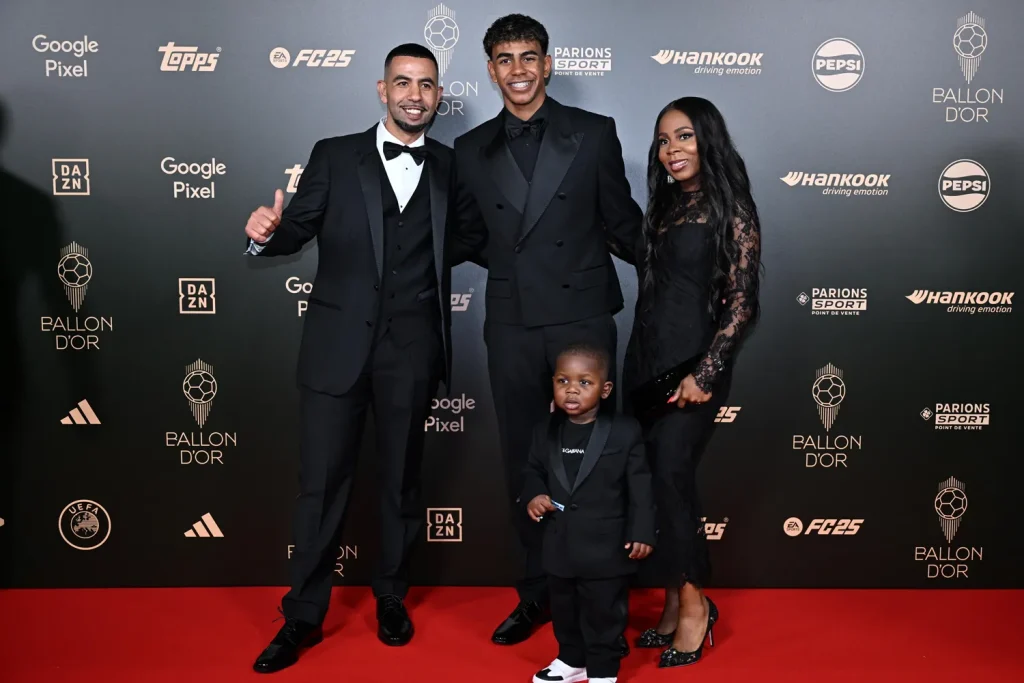
They have also appeared together at important ceremonies, including the 2024 Ballon d’Or event in Paris.
Their ability to support their son despite the end of their relationship became an important part of the family story.
Growing Up Between Granollers and Mataró
Yamal’s childhood was divided between different parts of the Barcelona metropolitan region.
Granollers lies farther from central Barcelona and has its own local identity and sporting institutions.
Mataró is a coastal city northeast of Barcelona. Rocafonda, where Yamal spent significant time, is a diverse neighbourhood with a large immigrant population.
Yamal has remained closely connected to Rocafonda even after becoming internationally famous.
His goal celebration forms the number 304 with his fingers, referring to the final digits of the neighbourhood’s postal code, 08304.
The gesture is more than personal branding.
It publicly associates his success with the community in which he grew up.
Young supporters in the area can see someone from familiar streets playing for Barcelona and Spain.
For Yamal, the celebration also recognises the relatives, coaches, friends and neighbours who formed part of his life before professional football.
His Mother Helped Him Enter Organised Football
Ebana played an important role in turning her son’s enthusiasm for football into participation at a local club.
While working in Granollers, she reportedly met a relative of Inocente Díez, who was involved in youth football at CF La Torreta.
The family was concerned about the cost of organised football, but the club offered to help ensure that Yamal could participate.
That support became an important early intervention.
Many talented children do not lack enthusiasm or ability. They lack access.
Registration costs, equipment, travel and training schedules can become significant barriers for families with limited incomes.
Community clubs often bridge that gap through reduced fees, volunteer coaching and informal support.
Yamal’s opportunity at La Torreta gave him structured training and competitive matches before Barcelona recruited him.
His mother’s willingness to pursue that opportunity helped move him from informal childhood football into an organised development pathway.
CF La Torreta Provided an Early Opportunity
Before entering Barcelona’s academy, Yamal played youth football with CF La Torreta.
The local club gave him a place to demonstrate his natural ability against other young players.
At that stage, football development was not about fame, sponsorships or major contracts.
It was about learning how to train, follow instructions, play within a team and respond to competition.
Youth coordinators quickly recognised that Yamal possessed unusual technical ability.
His close control, balance and confidence with the ball distinguished him from players of a similar age.
Barcelona eventually identified him and brought him into La Masia, its famous youth-development system.
The journey shows the importance of football’s local foundation.
Barcelona may have refined Yamal’s ability, but community football gave him his first organised platform.
Barcelona Recruited Yamal at Seven
Barcelona says Yamal joined its youth structure in 2014, when he was seven years old.
Entering La Masia represented a major opportunity but also introduced new expectations.
Barcelona’s academy contains many of the best young players in Catalonia and recruits talent from farther afield.
Being selected at seven does not guarantee a professional career.
Players must continue improving as new prospects arrive and physical development changes the competitive balance.
Yamal moved rapidly through the age groups.
His ability to receive the ball under pressure, defeat opponents and create chances made him one of the academy’s outstanding prospects.
He eventually began training with older players and reached Barcelona’s senior side while still attending school.
The speed of his progress created new responsibilities for his parents.
They had to support a child who was becoming publicly famous before reaching adulthood.
Sheila Ebana Initially Wanted Academic Security
Like many parents, Ebana reportedly hoped her son would obtain a university education.
That preference was understandable.
Professional football offers extraordinary rewards to a small number of players, but most academy prospects do not build long senior careers.
Education provides a form of protection against injury, rejection or career instability.
Yamal, however, appears to have maintained unusual confidence that football would become his profession.
In the interview described in the source material, he recalled telling his parents that conventional academic employment might not suit him but that he believed strongly in his ability to become a footballer.
His confidence could easily have appeared unrealistic in another child.
The difference was that Barcelona’s continued interest provided growing evidence that his ambition had a genuine foundation.
His mother’s initial desire for educational security should not be interpreted as a lack of belief.
It reflected the responsibility of a parent who understood that talent alone did not guarantee financial stability.
Mounir Nasraoui Publicly Believed in His Son
Nasraoui became one of his son’s most vocal supporters.
He repeatedly expressed confidence that Yamal could reach the highest level and attended major matches throughout his rise.
His public enthusiasm contrasts with Ebana’s quieter approach.
Nasraoui is active on social media and has frequently shared photographs, reactions and messages concerning his son.
He has also made ambitious comparisons about Yamal’s potential.
Such statements attract headlines, particularly when they involve Lionel Messi, the player against whom almost every highly talented Barcelona attacker is eventually measured.
For a father, those comments may reflect pride and personal belief.
For Yamal, however, comparisons with Messi add to the pressure already created by becoming a Barcelona star as a teenager.
The challenge for the family is supporting ambition without allowing outside expectations to define his development.
Both Parents Attend His Major Matches
Although Nasraoui and Ebana are no longer a couple, both have regularly appeared at important events in their son’s career.
They attended Barcelona matches, Spain internationals and award ceremonies.
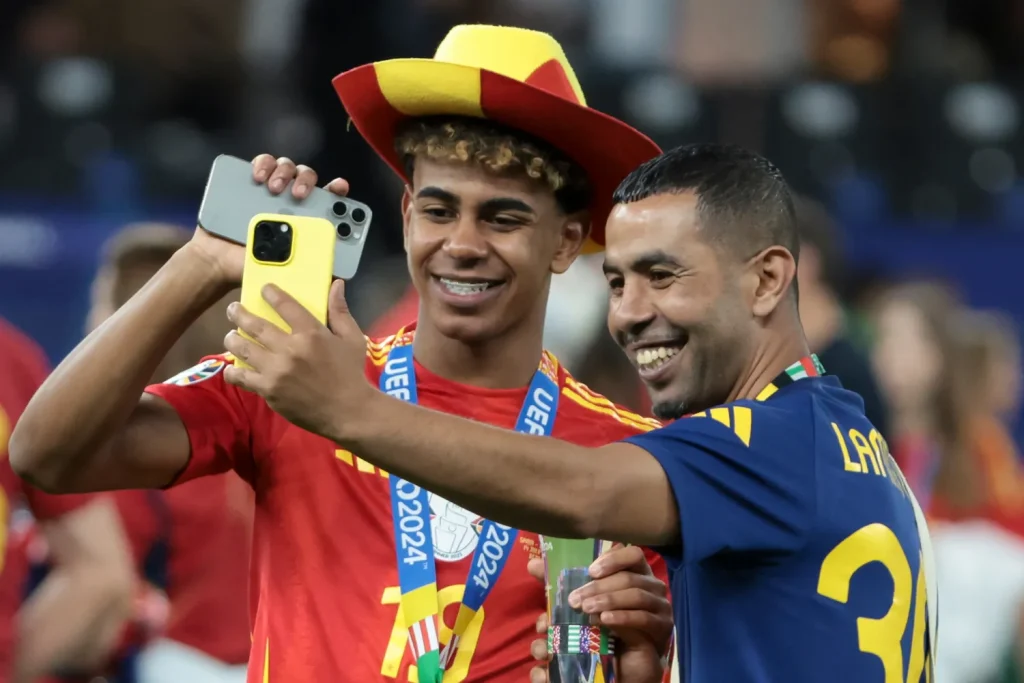
Ebana celebrated on the field after Spain won Euro 2024.
Nasraoui also appeared during the tournament and expressed pride in his son’s achievements.
Their joint attendance sends a clear message that their parental roles continued after separation.
It also allows Yamal to celebrate success with both sides of his family.
For a player whose heritage spans several communities, these public moments reinforce the family unity surrounding his career.
Yamal Chose Spain Over Morocco and Equatorial Guinea
Yamal’s background made him eligible to represent Spain, Morocco or Equatorial Guinea.
He was born and developed in Spain, while his parents connected him to the two African nations.
International eligibility can create intense pressure for young players.
Football federations may contact the player and family before the athlete is old enough to understand the full significance of the decision.
Supporters from each country may also treat the choice as a statement about identity or loyalty.
Yamal said he had been clear about representing Spain after playing for its youth teams.
His decision reflected the country where he was born, educated and developed as a footballer.
Choosing Spain did not require rejecting his parents’ heritage.
His boots and public comments have continued acknowledging Morocco and Equatorial Guinea.
His Boots Represent All Sides of the Family
Yamal has used his footwear to display the flags connected to his family.
While representing Spain, he has worn the Moroccan flag for his father and the Equatoguinean flag for his mother.
The tribute provides a visible expression of multiple identity.
International football often encourages simple national categories: one player, one team and one flag.
Families such as Yamal’s are more complex.
A person may belong legally and culturally to one country while maintaining deep family connections to others.
Yamal’s choice of Spain reflects his sporting nationality.
The flags on his boots recognise the migration stories that made his life in Spain possible.
His Parents’ Sacrifices Shaped His Perspective
Yamal has spoken about growing up in a small home and watching his mother work to support the family.
Those experiences appear to have influenced how he understands his success.
For young athletes who become wealthy quickly, the transition can be dramatic.
A family may move from worrying about routine expenses to managing major contracts, sponsorships and international attention within only a few years.
Yamal has said that seeing his mother happy and knowing his younger brother can enjoy a more comfortable childhood gives him particular satisfaction.
That response shows how financial success can change not only the athlete’s life but also the circumstances of the wider family.
His parents’ earlier difficulties remain part of the motivation behind those improvements.
Sheila Ebana Has Another Son, Keyne
Ebana later remarried and welcomed another son, Keyne.
Keyne is Yamal’s younger half-brother and has become a familiar figure at football matches and family events.
He appeared during Spain’s Euro 2024 celebrations and attended the Ballon d’Or ceremony with Yamal and his parents.
Yamal has spoken warmly about their relationship and expressed happiness that Keyne can experience a childhood with greater financial comfort and security.
Keyne was born in September 2022, according to a later family profile.
His age means the brothers’ experiences are very different.
Yamal remembers the family’s more difficult years.
Keyne is growing up after his older brother became one of football’s biggest stars.
Yamal appears to view that contrast positively rather than with resentment.
Yamal Describes His Mother as His Queen
Yamal has spoken with particular affection about Ebana.
He has described her as the person he loves most and used the expression “my queen” when discussing their relationship.
The words reflect the central role she played during his childhood.
She worked, managed the household and ensured he could attend football training after separating from his father.
For many players, public success produces images with coaches, teammates and club executives.
Yamal’s emotional celebrations with his mother provide a reminder that the private sacrifices behind a career often begin years before professional recognition.
Her lower media profile may also have helped provide him with a degree of stability away from public attention.
Mounir Nasraoui Remains Closely Linked to Rocafonda
Nasraoui is strongly associated with Rocafonda and the community surrounding Mataró.
His presence helped maintain Yamal’s connection with the neighbourhood after the player moved into Barcelona’s elite academy.
Elite development can separate young footballers from their original environments.
Training schedules, travel and public attention may create distance from childhood friends and local communities.
Yamal’s relationship with his father and paternal grandmother allowed him to retain that connection.
The 304 celebration later transformed Rocafonda into part of his global identity.
Supporters watching in different countries learned the meaning of a postal code that previously had little international recognition.
The Family Faced Intense Public Scrutiny
Yamal’s rapid emergence brought considerable attention to both parents.
Nasraoui’s statements and social-media activity frequently generated headlines.
Ebana’s appearances at major events also attracted growing interest, despite her relatively private approach.
This scrutiny can be difficult for families who were not previously public figures.
A player signs a professional contract, but parents and siblings do not necessarily choose celebrity.
Their personal relationships, employment histories and social-media posts may suddenly become news.
Responsible reporting should distinguish between information relevant to the player’s career and private details that add little public value.
The family’s support and heritage are relevant to understanding Yamal’s development.
Rumours and unnecessary intrusion are not.
Nasraoui Survived a Serious 2024 Attack
In August 2024, Nasraoui was seriously injured during an attack in Mataró.
The incident drew international coverage because of his connection to Yamal.
He recovered, but the episode demonstrated the security pressures that can accompany sudden fame.
Relatives of famous athletes may become recognisable even when they have no formal role in football.
That visibility can expose them to unwanted attention and personal risk.
The incident should not define Nasraoui’s relationship with his son, but it forms part of the intense public environment surrounding the family after Yamal became internationally known.
Yamal Became a Barcelona First-Team Star
Barcelona gave Yamal his senior debut in April 2023, when he was 15.
The club described him at the time as its youngest first-team player, marking the beginning of an extraordinary sequence of age-related records.
He quickly moved from being an academy curiosity to a regular senior attacker.
His performances were characterised by close control, creativity, speed and the confidence to challenge experienced defenders.
The rise placed him among the most important young players in European football.
It also increased the responsibility facing his parents and professional advisers.
Decisions regarding playing time, contracts, endorsements, media access and physical workload can shape the long-term career of a teenager.
The family’s role shifted from helping a child attend football practice to protecting the development of a major international asset.
Spain’s National Team Accelerated His Fame
Yamal’s international career developed nearly as quickly as his Barcelona progress.
He became Spain’s youngest senior international and later played a central role in its Euro 2024 triumph.
His goal against France in the semifinal made him the youngest scorer in European Championship history.
Those performances moved his fame beyond Barcelona supporters.
He became a national figure and one of the most recognisable teenage athletes in the world.
By July 2026, the Spanish federation’s official profile recorded 30 senior appearances and seven goals.
His parents’ appearances in stadiums consequently became part of the tournament coverage.
Cameras frequently turned toward them after goals and victories, showing the emotional connection between his performances and the family journey.
His Parents Must Help Manage Extraordinary Expectations
Yamal’s development has generated expectations rarely placed on a player his age.
He is asked to influence major matches for Barcelona and Spain while still moving through late adolescence.
His father’s confidence and his mother’s support can provide emotional protection, but family encouragement must also be balanced with professional guidance.
Young players require rest, medical management and space to make mistakes.
They should not be expected to decide every match or reproduce the career of a previous legend.
Barcelona and Spain also carry responsibility for managing his workload.
The most successful outcome would not be a few spectacular seasons followed by physical decline.
It would be a long career in which his body, motivation and private life remain protected.
What Lamine Yamal’s Story Says About Migration
The Yamal family story is also an immigration story.
His paternal grandmother worked to help relatives leave Morocco.
His maternal family moved from Equatorial Guinea to Catalonia.
His parents found employment, formed a household and raised a child in Spain.
That child later represented Spain at the highest level while continuing to acknowledge the countries from which his family came.
This pattern is familiar across European sport.
Immigrant families often provide players with multiple cultural identities and strong motivation, while local clubs and public institutions provide sporting opportunity.
Yamal’s career illustrates what can happen when talent encounters accessible community football and an elite development system.
It also shows why debates about national identity are rarely simple.
The Role of Community Football
The first important institutions in Yamal’s career were not global brands.
They were local clubs, neighbourhood pitches and the people who helped his family manage participation costs.
CF La Torreta provided an early structured environment.
Barcelona later delivered elite coaching and competition.
Without the first stage, the second may never have occurred.
Community football acts as the entry point through which children from different economic backgrounds can be discovered.
When costs become too high, the talent pool narrows.
Yamal’s story demonstrates the potential return from helping one child participate.
Most young players will not become international stars, but football can still provide health, discipline, friendship and education.
His Parents Have Different Public Personalities
Nasraoui and Ebana present contrasting public images.
Nasraoui is expressive, vocal and active in public discussions about his son.
Ebana is generally quieter and appears mainly during significant family or football occasions.
Neither approach alone determines parental commitment.
Some parents support children through public advocacy.
Others prefer private stability.
Yamal appears to value both.
His father represents confidence, neighbourhood identity and visible pride.
His mother represents sacrifice, emotional security and the household in which he spent much of his childhood.
The combination may have helped him manage the conflicting demands of extraordinary fame.
What Comes Next for the Family
Yamal’s career remains at an early stage despite the scale of his achievements.
His parents will likely continue attending major matches and supporting decisions around his professional life.
However, the family’s responsibilities will change as he becomes older and gains more control over his own affairs.
Contract management, investments, commercial partnerships and personal security will require qualified professionals.
Family trust remains valuable, but modern elite football cannot be managed through family relationships alone.
Legal advisers, financial experts, medical staff and experienced agents or managers all play important roles.
The healthiest structure will preserve the emotional support of his parents while giving specialist professionals responsibility for complex decisions.
Expert Analysis
Mounir Nasraoui and Sheila Ebana did not follow the conventional image of parents preparing a child for elite football through wealth and private academies.
Their son emerged from a family managing work, separation and limited resources.
Ebana’s contribution was practical and sustained.
She supported the household, helped secure access to organised football and provided emotional stability.
Nasraoui maintained his son’s connection to Rocafonda and openly reinforced the belief that Yamal could achieve something exceptional.
Neither parent could guarantee his success.
Barcelona recruits many talented children, and most do not become first-team stars.
Yamal’s technical ability, confidence and willingness to compete ultimately distinguished him.
Yet talent required an environment in which it could survive.
His parents ensured he continued reaching training, remained connected to family and believed that his background did not limit his ambition.
Their separation could have disrupted that development. Instead, both remained present.
The multicultural nature of the family also became a strength.
Yamal did not need to choose between respecting Morocco, Equatorial Guinea and Spain as cultural identities.
He chose Spain as his football nation while carrying symbols of his parents’ countries.
That balance gives his story resonance across Europe and Africa.
The greatest challenge now is no longer gaining opportunity.
It is managing success.
Yamal has reached a level at which every match, statement and personal appearance generates attention.
His parents’ most valuable future role may be helping him retain the emotional stability and sense of identity formed before fame arrived.
Frequently Asked Questions
Who are Lamine Yamal’s parents?
Lamine Yamal’s parents are Mounir Nasraoui and Sheila Ebana. His father is originally from Morocco, while his mother comes from Equatorial Guinea.
When was Lamine Yamal born?
Yamal was born on July 13, 2007, in Catalonia. Barcelona’s current player profile lists Esplugues de Llobregat as his birthplace.
Are Lamine Yamal’s parents still together?
No. Nasraoui and Ebana separated when Yamal was about three years old, but both remained involved in his upbringing and football career.
Where did Lamine Yamal grow up?
He grew up between Granollers and Mataró in Catalonia. He remains particularly connected to Rocafonda, represented by his 304 goal celebration.
What nationality are Lamine Yamal’s parents?
His father is Moroccan, while his mother is Equatoguinean. Yamal was born in Spain and chose to represent the Spanish national team.
Does Lamine Yamal have a brother?
Yes. His mother later welcomed another son, Keyne, who is Yamal’s younger half-brother. Keyne was born in September 2022.
Why does Yamal show 304 with his hands?
The number represents the final digits of the 08304 postal code for Rocafonda, the Mataró neighbourhood closely connected to his childhood.
Conclusion
Lamine Yamal’s rise from local football in Catalonia to Barcelona and Spain was built on exceptional ability, but his parents provided the support that allowed that ability to develop.
Mounir Nasraoui brought Moroccan heritage, visible confidence and a strong connection to Rocafonda.
Sheila Ebana brought Equatoguinean heritage, financial sacrifice and the daily stability required to raise a young player after the couple separated.
Both remained present even after forming separate households.
His mother helped create the opportunity for organised football.
His father reinforced the belief that a child from their neighbourhood could reach the highest level.
Community coaches then recognised the talent, and Barcelona gave it an elite platform.
Yamal now represents Spain while publicly honouring the African roots of both parents.
His story belongs to all three parts of that identity: the country where he was born, the Moroccan family that helped establish a future in Catalonia and the Equatoguinean family that supported his mother’s journey.
The next phase will require the same combination of confidence and protection that shaped his childhood.
He is no longer a child trying to gain access to football.
He is a global athlete managing expectations that would challenge a far more experienced player.
For Nasraoui and Ebana, the task has changed, but their importance remains.
They are no longer helping their son reach the beginning of a career. They are helping him preserve the values, relationships and perspective that existed before the world learned his name.
Read Also: Inside Kylian Mbappé’s Sporting Family