


A significant drop in Treasury bill yields has affected Kenya’s Money Market Funds, raising concerns among investors relying on stable short-term returns. In June 2025, for the first time in months, all Treasury bill tenures reported rates below 10%, signaling a shift in market dynamics that could reshape how local funds perform in the near term.
Money Market Funds have become the go-to investment option for many Kenyans. With over 64% of all collective investment schemes held in MMFs, these funds remain attractive due to their low-risk profile and daily income payouts. According to the Capital Markets Authority, MMFs now manage assets worth more than KSh 319.7 billion, reflecting their growing relevance in a market driven by caution and liquidity.
The auction conducted by the Central Bank of Kenya on June 6, 2025, raised KSh 57.4 billion, surpassing the target of KSh 24 billion. However, the success in subscription did not translate into higher yields. Instead, returns for all three T-bill tenures dropped:
- 91-day: 8.2816%
- 182-day: 8.5433%
- 364-day: 9.9985%
This is a slight dip compared to the previous auction where the 364-day bill just managed to hold at 10%. These figures are especially critical for MMFs since their portfolios largely comprise Treasury securities. As noted by financial expert Alfred Methu, the correlation is straightforward: when T-bill rates go down, MMF yields follow suit. Since MMFs distribute their returns based on the interest accrued from these instruments, lower yields directly translate into reduced payouts for investors.
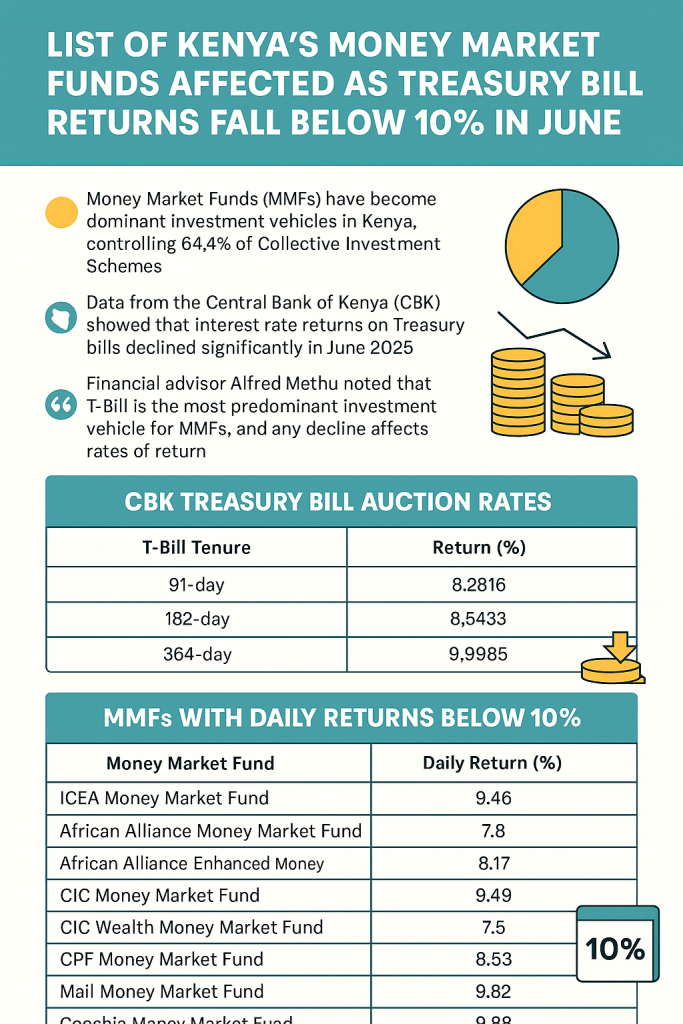
Recent data shows that several major MMFs have already started reflecting the impact of falling Treasury returns. On June 9, 2025, the following MMFs were all posting daily returns under the 10% mark:
- ICEA Money Market Fund – 9.46%
- CIC Money Market Fund – 9.49%
- CPF Money Market Fund – 8.53%
- African Alliance Money Market Fund – 7.6%
- Equity Money Market Fund – 5.3%
- Ziidi MMF by Safaricom – 7.13%
- Genghis MMF – 9.88%
- CIC Wealth MMF – 7.5%
- Mali MMF – 9.62%
- Co-op Bank MMF – 9.49%
- African Alliance Enhanced MMF – 8.17%
While this represents a broad sector trend, some funds have shown resilience. Sanlam MMF and CIC MMF, for example, remain among the strongest performers, continuing to post returns near 10% despite the yield squeeze. Safaricom’s Ziidi MMF, launched only six months ago, has already grown to a KSh 7.4 billion portfolio, representing 2.3% of the MMF market.
For Kenyan investors, this shift may be unsettling, but panic selling is not recommended. MMFs still offer more stability compared to stocks, crypto, or offshore instruments. Experts advise reviewing fund manager performance, comparing management fees, and considering diversification. Instruments such as infrastructure bonds or fixed savings accounts can complement MMFs for better risk balancing.
Ultimately, the drop in Treasury bill yields is a reality check for Kenya’s Money Market Funds and their investors. While the compression in returns may reduce income in the short term, MMFs remain a critical pillar in Kenya’s investment ecosystem. For now, patience and strategy will be essential to navigating this yield downturn.


