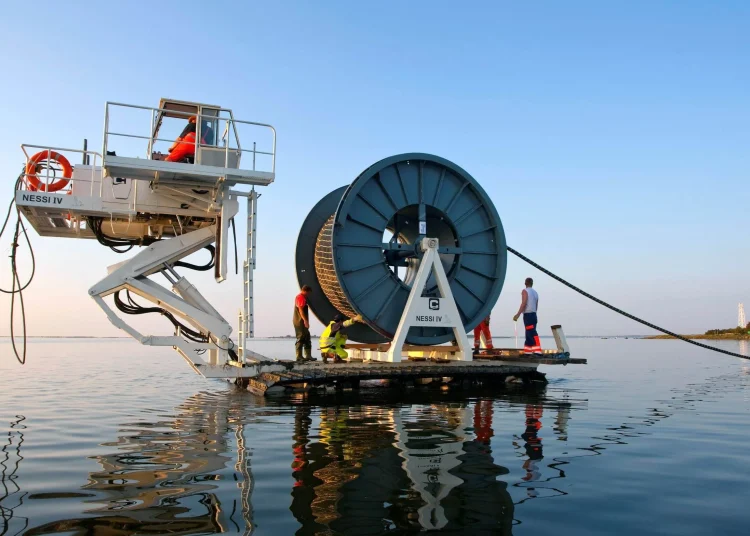
Kenya internet capacity rose sharply in the third quarter of the 2025/2026 financial year, giving the country more international bandwidth to support faster connectivity, growing data consumption and expanding digital services.
According to the latest sector statistics from the Communications Authority of Kenya, total available international internet bandwidth increased by 16.4% to 28,130.332 Gbps between January and March 2026. That is a major quarterly jump for a market where internet demand continues to rise across homes, businesses, schools, government services, cloud platforms and mobile networks.
SEACOM was the biggest driver of the increase. The undersea cable operator expanded its active capacity by 53.3%, rising from 6,850 Gbps in the previous quarter to 10,500 Gbps. That made SEACOM the largest single contributor to the quarter’s bandwidth growth.
Other submarine cable systems also recorded smaller increases. EASSY grew from 6,310 Gbps to 6,500 Gbps. PEACE rose from 3,638 Gbps to 3,738 Gbps. Lion 2 moved from 1,100 Gbps to 1,119 Gbps. DARE 1 increased slightly from 2,200 Gbps to 2,210 Gbps. TEAMS remained unchanged at 4,063 Gbps.
The data shows Kenya’s international connectivity layer is becoming larger and more resilient. More capacity does not automatically mean every consumer immediately gets cheaper or faster internet, but it gives internet service providers and network operators more room to serve rising demand.
SEACOM Drives the Biggest Quarterly Increase
SEACOM’s 53.3% capacity increase is the standout figure in the latest bandwidth data.
The company raised its active international bandwidth capacity to 10,500 Gbps, up from 6,850 Gbps in the previous quarter. That increase alone added 3,650 Gbps to Kenya’s available international bandwidth.
This matters because international bandwidth is one of the foundations of internet performance. Kenya’s users access global platforms for streaming, cloud storage, online learning, gaming, video calls, enterprise software, social media and business communication. The more capacity the country has, the easier it becomes for operators to handle demand without congestion.
SEACOM’s expansion also comes alongside its investment in regional terrestrial infrastructure. The company recently launched a high-capacity Nairobi–Kampala route connecting Nairobi, Kisumu and Kampala. That route strengthens the inland corridor that carries traffic from Mombasa’s submarine cable landing points into Kenya’s interior and onward to Uganda and other regional markets.
The combination of undersea capacity and inland fibre routes is important. Submarine cables bring global internet capacity to the coast, but inland fibre determines how efficiently that capacity reaches businesses, data centres, telecom networks and end users.
Kenya’s International Bandwidth by Cable
The latest Communications Authority data shows that Kenya’s international capacity is spread across several submarine cable systems and a small satellite component.
Subsea Cable | Oct-Dec 2025 Capacity | Jan-Mar 2026 Capacity | Quarterly Growth
SEACOM | 6,850 Gbps | 10,500 Gbps | 53.3%
EASSY | 6,310 Gbps | 6,500 Gbps | 3.0%
TEAMS | 4,063 Gbps | 4,063 Gbps | 0.0%
PEACE | 3,638 Gbps | 3,738 Gbps | 2.7%
DARE 1 | 2,200 Gbps | 2,210 Gbps | 0.5%
Lion 2 | 1,100 Gbps | 1,119 Gbps | 1.7%
Satellite Capacity | 0.332 Gbps | 0.332 Gbps | 0.0%
The table shows that SEACOM’s jump was the main reason Kenya’s total available bandwidth increased. Without SEACOM’s expansion, the overall quarterly growth would have been much smaller.
EASSY remains another major contributor with 6,500 Gbps, while TEAMS remains important at 4,063 Gbps despite recording no quarterly growth. PEACE, DARE 1 and Lion 2 provide additional diversity.
This diversity matters because internet resilience depends on having multiple routes. When one cable system experiences disruption, traffic can be rerouted through other systems. Kenya has experienced the effects of submarine cable faults before, and each additional route helps reduce the risk of widespread outages.
Utilized Bandwidth Grows More Slowly
While available international bandwidth increased by 16.4%, utilized bandwidth grew more slowly.
Total utilized international bandwidth rose by 3.0%, from 17,233.813 Gbps in the previous quarter to 17,758.824 Gbps between January and March 2026.
That means Kenya is not using all the capacity now available. Utilization is around 63% of available international bandwidth. In simple terms, the country has headroom for future demand.
That is not a weakness. It is a positive signal for a growing digital market. Internet capacity should not always run close to full usage. If it does, users are more likely to experience congestion, slower speeds and weaker performance during peak hours.
Extra capacity gives operators room to serve more customers, handle streaming traffic, support enterprise workloads and prepare for new demand from cloud computing, AI services, remote work, e-commerce and digital public services.
The gap between available and utilized bandwidth also shows that Kenya is investing ahead of demand. That is important because digital infrastructure takes time to build. If operators wait until demand overwhelms existing capacity, users suffer before upgrades arrive.
Why More International Bandwidth Matters
International bandwidth is the amount of data capacity available between Kenya and the rest of the world.
When a user streams a video, joins a cloud meeting, accesses a global website, uses an online game, downloads software or opens a foreign-hosted application, that traffic may depend on international connectivity.
More bandwidth helps reduce congestion. It also gives operators more flexibility to route traffic efficiently. This can improve the quality of experience for users, especially during peak hours when many people are online at the same time.
For businesses, international bandwidth supports cloud applications, cross-border payments, customer support platforms, cybersecurity tools, software updates and digital collaboration. For banks, it supports real-time systems and secure connectivity. For schools and universities, it supports online learning and research. For media firms, it supports video uploads, content distribution and live streaming.
Kenya’s digital economy cannot grow without strong international connectivity. Fibre to homes and offices matters, but that local access must connect to enough international capacity to deliver reliable service.
What It Means for Internet Service Providers
The increase in bandwidth gives internet service providers more room to improve service quality.
ISPs need wholesale capacity to serve homes, offices and public institutions. If wholesale capacity is constrained, retail users may experience slower speeds, buffering and unstable performance. If more capacity is available, ISPs can design better packages and handle more traffic.
This does not mean prices will fall immediately. Consumer internet prices depend on many factors, including last-mile infrastructure, competition, taxes, exchange rates, equipment costs, customer density and power costs.
However, more international capacity can improve the economics of internet service delivery over time. When wholesale bandwidth becomes more available and competition increases, ISPs may have more room to offer higher speeds or better value.
Kenya has already seen stronger competition in fixed internet. Providers such as Safaricom, Jamii Telecommunications, Wananchi Group, Poa Internet, Mawingu and others are competing across fibre, wireless and satellite-connected services. More international bandwidth strengthens the foundation on which these providers operate.
Why the Nairobi–Kampala Route Matters
SEACOM’s Nairobi–Kampala route is important because Kenya is not only serving its own internet market. It is also a regional connectivity gateway.
Mombasa is one of East Africa’s key submarine cable landing points. Traffic arriving through Mombasa does not stop at the coast. It moves inland through Nairobi, Kisumu and other hubs before reaching Uganda, Rwanda, Burundi, South Sudan and parts of the wider region.
A stronger Nairobi–Kampala route improves that inland movement. It creates a more resilient and scalable digital corridor between Kenya and Uganda, while also supporting cross-border data traffic.
This matters for banks, cloud providers, telecom operators, e-commerce platforms, logistics companies, content providers and regional enterprises. These organizations need stable, low-latency and high-capacity connectivity across borders.
The route also strengthens regional integration. East Africa’s digital economy depends on cross-border systems, from payments and trade platforms to enterprise cloud services and shared infrastructure.
When Kenya improves both international submarine capacity and inland fibre corridors, the benefits can extend beyond the country.
Kenya’s Bandwidth Growth Since 2023
Kenya’s international internet capacity has grown rapidly over the past few years.
At the end of March 2023, total available international internet bandwidth stood at about 14,413 Gbps. By March 2024, it had grown to about 20,744 Gbps. By March 2025, it had reached about 22,154 Gbps. The latest figure of 28,130.332 Gbps shows another major step upward.
This growth reflects rising demand for internet services across the country. More Kenyans are using smartphones, home fibre, fixed wireless broadband, satellite internet, cloud services and streaming platforms. Businesses are also moving more operations online.
The country’s digital infrastructure must keep expanding because internet traffic rarely moves backward. Once households and businesses adopt digital services, they usually use more data over time.
The growth also reflects competition among submarine cable providers. More international cable capacity gives Kenya better resilience and stronger bargaining power in the regional connectivity market.
The Role of Submarine Cables in Kenya’s Digital Economy
Submarine cables are the hidden foundation of Kenya’s internet economy.
They carry enormous volumes of data across oceans, connecting Kenya to global networks in Europe, Asia, the Middle East and beyond. Without these cables, modern internet services would be slower, more expensive and less reliable.
Kenya is served by several submarine cable systems, including SEACOM, EASSY, TEAMS, PEACE, DARE 1 and Lion 2. Each cable adds capacity and route diversity.
Route diversity is critical because cable faults can happen. Ships, anchors, undersea landslides, equipment faults and other incidents can disrupt subsea infrastructure. When multiple cables are available, operators can reroute traffic and reduce the impact on users.
The latest data shows that Kenya’s international connectivity is not dependent on one cable alone. SEACOM now leads in active capacity, but EASSY, TEAMS, PEACE, DARE 1 and Lion 2 all remain part of the national bandwidth mix.
That diversity makes Kenya better positioned as a regional internet hub.
Why Capacity Growth Does Not Always Mean Immediate Price Cuts
Many users expect that when bandwidth increases, internet prices should fall quickly. In practice, the link is not always immediate.
International bandwidth is only one part of the cost of delivering internet. ISPs must also pay for local fibre networks, towers, routers, customer equipment, maintenance, electricity, customer support, licensing, taxes and financing.
Last-mile connectivity is often the most expensive part. Delivering internet from a national backbone to a home, office or rural community requires physical infrastructure and maintenance. In low-density areas, the cost per customer can be high.
Still, international bandwidth growth can help reduce pressure over time. If wholesale capacity becomes cheaper and more abundant, ISPs can offer better speeds, larger packages or more competitive pricing.
Kenya’s fixed internet market has already become more competitive, with home fibre and wireless providers fighting for users through cheaper packages, speed upgrades and promotional offers.
The latest bandwidth growth strengthens the foundation for that competition.
What It Means for Streaming, Cloud and AI
The new bandwidth headroom matters because Kenya’s internet usage is shifting toward heavier applications.
Streaming video consumes large amounts of data. Cloud backups, online gaming, video conferencing and software updates also require stable bandwidth. Businesses increasingly rely on cloud-based accounting, customer management, cybersecurity and collaboration tools.
Artificial intelligence services could add another layer of demand. AI tools depend on cloud infrastructure, data movement and reliable connectivity. As more companies and users adopt AI applications, bandwidth demand could grow further.
Kenya’s digital economy will therefore need both capacity and reliability. It is not enough to have more bandwidth on paper. Networks must also deliver stable performance to end users.
That requires investment across the full chain: submarine cables, landing stations, national fibre backbones, metropolitan networks, data centres, internet exchange points and last-mile access.
SEACOM’s capacity expansion and inland route investment fit into that broader picture.
Kenya Still Needs Stronger Last-Mile Access
International bandwidth growth is important, but it does not solve every internet problem.
Many users still judge internet quality by what happens at home, in school, at work or on mobile networks. If last-mile infrastructure is weak, extra international capacity may not be felt immediately by the end user.
Kenya still needs more affordable fibre, better rural broadband, stronger 4G and 5G coverage, reliable public Wi-Fi, better school connectivity and more local content hosting.
Last-mile networks determine whether the benefits of international bandwidth reach ordinary users. A country can have huge international capacity, but users may still suffer if local distribution is congested, expensive or unavailable.
That is why internet development must happen at every layer. Submarine cables bring capacity into the country. National backbones move it across regions. ISPs deliver it to homes and businesses. Mobile networks bring it to phones. Data centres and local exchanges keep more traffic closer to users.
Kenya is improving, but the last-mile challenge remains one of the biggest barriers to universal digital access.
Why Internet Headroom Is Good for Kenya’s Future
Having unused capacity may look inefficient, but in internet infrastructure it is often necessary.
Digital demand can grow quickly. A new streaming habit, a major cloud service, a popular app, a school connectivity programme or a shift to remote work can increase traffic fast. Networks need enough headroom to absorb that growth without breaking.
Kenya’s current utilization of about 63% suggests the market has room to grow. That gives ISPs and enterprises confidence that the country has enough upstream capacity to support expansion.
It also strengthens Kenya’s position as a regional digital hub. A country with strong international capacity can attract data centres, cloud providers, content delivery networks and digital businesses.
For investors, bandwidth growth signals that the connectivity market is expanding. For consumers, it creates the possibility of better packages over time. For government, it supports digital public services and technology-led development.
Conclusion
Kenya’s total available international internet bandwidth rose by 16.4% to 28,130.332 Gbps in the third quarter of the 2025/2026 financial year, according to the Communications Authority of Kenya.
SEACOM drove most of the growth, increasing its active capacity by 53.3% from 6,850 Gbps to 10,500 Gbps. EASSY, PEACE, Lion 2 and DARE 1 also recorded smaller gains, while TEAMS remained unchanged.
Utilized bandwidth rose more slowly, growing 3.0% to 17,758.824 Gbps. That means Kenya is using about 63% of its available international capacity, leaving significant headroom for future demand.
The increase is important for internet service providers, businesses, streaming platforms, cloud services, schools, government systems and regional connectivity. It also comes as SEACOM strengthens the Nairobi–Kampala route through Kisumu, improving inland connectivity between Kenya and Uganda.
More international bandwidth will not automatically make internet cheaper overnight. Last-mile infrastructure, competition, equipment costs and taxes still matter. But the latest growth gives Kenya a stronger digital foundation.
As data consumption rises and more services move online, Kenya’s expanding bandwidth capacity will play a central role in supporting the next phase of the country’s digital economy.
Read Also: Kenya Mobile Money Agents Hit 600,000