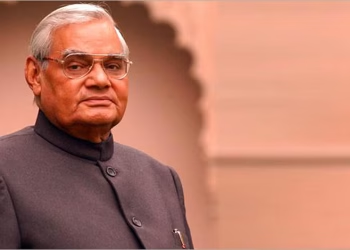
Ilham Aliyev net worth is estimated at $900 million, a staggering sum for the President of Azerbaijan. Despite an official annual salary of just $230,000, Aliyev and his family control vast assets, allegedly accumulated through tight state control over the nation’s oil and gas industry. His wealth reflects the intersection of dynastic politics, energy monopolies, and opaque governance in the post-Soviet space.
Early Life and Rise to Power
Born on December 24, 1961, in Baku, Azerbaijan SSR, Ilham Aliyev was groomed for power from an early age. He studied at the prestigious Moscow State Institute of International Relations (MGIMO), earning both a Master’s degree and later a PhD in History.
In 1994, he began his climb through Azerbaijan’s political and business elite by becoming Vice-President of SOCAR, the state oil company. This position placed him at the heart of Azerbaijan’s most valuable economic sector.
Throughout the late 1990s and early 2000s, Aliyev expanded his influence:
- Elected to the National Assembly
- Appointed head of Azerbaijan’s delegation to the Council of Europe
- Named President of the National Olympic Committee
- Appointed Prime Minister in 2003
Just months later, his father and long-serving President Heydar Aliyev stepped down due to ill health and positioned Ilham as his successor. Despite widespread allegations of election fraud, Ilham Aliyev was elected president in October 2003.
Consolidating Power and Wealth
Aliyev’s presidency has been marked by authoritarian consolidation. Azerbaijan ranks among the lowest globally in terms of press freedom, political transparency, and judicial independence. However, during his tenure, the country has experienced substantial economic growth, largely due to oil and gas exports.
Critics argue that Aliyev’s family has benefited disproportionately from this growth. Independent investigations and leaked financial documents have revealed extensive holdings linked to the Aliyev family.
Some key facts:
- Presidential salary: Officially $230,000 per year
- Real estate: His son owns nine luxury villas in Dubai worth $45 million
- Daughters’ holdings: Combined $30 million in Dubai properties
- Daughter Arzu reportedly holds shares in major enterprises, including Silk Way Bank and SW Holding
- SW Holding controls Silk Way Airlines, Azerbaijan’s state contractor, and dozens of subsidiaries
Although Azerbaijani law bars public officials from holding private business interests, it does not apply to family members, a loophole that critics say enables enormous offshore accumulation of wealth.
The Role of Oil and State Assets
Much of Ilham Aliyev’s net worth stems from his control over Azerbaijan’s oil reserves and infrastructure. Through SOCAR and related state-run firms, the Aliyev administration has overseen multi-billion-dollar contracts, energy deals, and infrastructure projects with minimal public scrutiny.
State-owned companies have frequently been privatized into the hands of politically connected elites, often traced back to the president’s inner circle. The Panama Papers and OCCRP investigations have documented offshore shell companies and proxy ownership structures used by the Aliyev family.
Criticism and Global Scrutiny
Ilham Aliyev’s rule has drawn sharp criticism from:
- Human rights organizations, for jailing journalists and opposition figures
- Western governments, for flawed elections and lack of transparency
- International watchdogs, for suspicious public tenders and monopolistic business environments
Yet Azerbaijan’s geopolitical importance—particularly in energy and security cooperation—has often shielded the regime from meaningful sanctions or pressure.
Despite repeated exposés, including those from the Organized Crime and Corruption Reporting Project (OCCRP) and BBC’s investigations, the wealth attributed to the Aliyev family has remained largely untouched.
Conclusion
With an estimated net worth of $900 million, Ilham Aliyev is among the richest heads of state in the world. His fortune, amassed under the guise of a fragile democracy, underscores the power of energy wealth in authoritarian regimes. While official disclosures paint a modest picture, offshore real estate, luxury holdings, and state-linked business ventures tell a different story.
The story of Ilham Aliyev’s net worth is not just about personal wealth—it’s a window into how modern kleptocracy functions through dynastic politics, state capture, and resource monopolization.