The UK seized Hong Kong in 1841, and China formally ceded it the following year at the end of the First Opium War. The Kowloon Peninsula was added in 1860 at the end of the Second Opium War, and the UK obtained a 99-year lease of the New Territories in 1898. Pursuant to a UK-China agreement in 1984, Hong Kong became the Hong Kong Special Administrative Region (HKSAR) of the People’s Republic of China as of 1 July 1997. In this agreement, China promised that, under its “one country, two systems” formula, China’s socialist economic and strict political system would not be imposed on Hong Kong and that Hong Kong would enjoy a “high degree of autonomy” in all matters except foreign and defense affairs for the next 50 years.
After the handover, Hong Kong continued to enjoy success as an international financial center. However, growing Chinese political influence and dissatisfaction with the Hong Kong Government in the 2010s became central issues and led to considerable civil unrest, including large-scale pro-democracy demonstrations in 2019 after the HKSAR attempted to revise a local ordinance to allow extraditions to mainland China. In response to the protests, the governments of the HKSAR and China reduced the city’s autonomy and placed new restrictions on the rights of Hong Kong residents, moves that were widely criticized as contravening obligations under the Hong Kong Basic Law and the Sino-British Joint Declaration. Democratic lawmakers and political figures were arrested in a widespread crackdown, while others fled abroad. At the same time, dozens of civil society groups and several independent media outlets were closed or disbanded. In 2021, Beijing imposed a more restrictive electoral system, restructuring the Legislative Council (LegCo) and allowing only government-approved candidates to run for office. The changes ensured that virtually all seats in the 2021 LegCo election went to pro-establishment candidates and effectively ended political opposition to Beijing. In 2024, the LegCo passed a new national security law (Article 23 of the Basic Law) further expanding the Hong Kong Government’s power to curb dissent.
Geography
Location
Eastern Asia, bordering the South China Sea and China
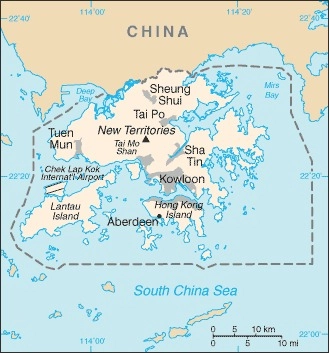
Geographic coordinates
22 15 N, 114 10 E
Map references
Southeast Asia
Area
total : 1,108 sq km
land: 1,073 sq km
water: 35 sq km
comparison ranking: total 183
Area – comparative
six times the size of Washington, D.C.
Land boundaries
total: 33 km
regional borders (1): China 33 km
Coastline
733 km
Maritime claims
territorial sea: 12 nm
Climate
subtropical monsoon; cool and humid in winter, hot and rainy from spring through summer, warm and sunny in fall
Terrain
hilly to mountainous with steep slopes; lowlands in north
Elevation
highest point: Tai Mo Shan 958 m
lowest point: South China Sea 0 m
Natural resources
outstanding deepwater harbor, feldspar
Land use
agricultural land: 3.8% (2022 est.)
arable land: 1.9% (2022 est.)
permanent crops: 1% (2022 est.)
permanent pasture: 1% (2022 est.)
forest: 0% (2022 est.)
other: 96.2% (2022 est.)
Irrigated land
10 sq km (2012)
Population distribution
population fairly evenly distributed
Natural hazards
occasional typhoons
Geography – note
consists of a mainland area (the New Territories) and over 200 islands
People and Society
Population
total: 7,297,821 (2024 est.)
male: 3,367,812
female: 3,930,009
comparison rankings: total 106; female 103; male 106
Nationality
noun: Chinese/Hong Konger
adjective: Chinese/Hong Kong
Ethnic groups
Chinese 91.6%, Filipino 2.7%, Indonesian 1.9%, other 3.7% (2021 est.)
Languages
Cantonese (official) 85.4%, English (official) 4.5%, Putonghua (official) 2.2%, other Chinese dialects 2.8%, other 2%, persons under 5 or mute 3.2% (2021 est.)
major-language sample(s):
世界概况, 必須擁有的基本資料参考书 (Cantonese)
The World Factbook, the indispensable source for basic information.
note: data represent population by usual spoken language
Cantonese audio sample:
Religions
Buddhist or Taoist 27.9%, Protestant 6.7%, Roman Catholic 5.3%, Muslim 4.2%, Hindu 1.4%, Sikh 0.2%, other or none 54.3% (2016 est.)
note: many people practice Confucianism, regardless of their religion or not having a religious affiliation
Age structure
0-14 years: 13.2% (male 505,718/female 459,956)
15-64 years: 64.8% (male 2,123,216/female 2,609,102)
65 years and over: 21.9% (2024 est.) (male 738,878/female 860,951)
2024 population pyramid:

Dependency ratios
total dependency ratio: 54.2 (2024 est.)
youth dependency ratio: 20.4 (2024 est.)
elderly dependency ratio: 33.8 (2024 est.)
potential support ratio: 3 (2024 est.)
Median age
total: 47.2 years (2024 est.)
male: 45.3 years
female: 48.6 years
comparison ranking: total 7
Population growth rate
0.12% (2024 est.)
comparison ranking: 183
Birth rate
7.6 births/1,000 population (2024 est.)
comparison ranking: 218
Death rate
8.1 deaths/1,000 population (2024 est.)
comparison ranking: 89
Net migration rate
1.6 migrant(s)/1,000 population (2024 est.)
comparison ranking: 54
Population distribution
population fairly evenly distributed
Urbanization
urban population: 100% of total population (2023)
rate of urbanization: 0.58% annual rate of change (2020-25 est.)
Major urban areas – population
7.685 million Hong Kong (2023)
Sex ratio
at birth: 1.06 male(s)/female
0-14 years: 1.1 male(s)/female
15-64 years: 0.81 male(s)/female
65 years and over: 0.86 male(s)/female
total population: 0.86 male(s)/female (2024 est.)
Mother’s mean age at first birth
29.8 years (2008 est.)
Infant mortality rate
total: 2.5 deaths/1,000 live births (2024 est.)
male: 2.8 deaths/1,000 live births
female: 2.2 deaths/1,000 live births
comparison ranking: total 215
Life expectancy at birth
total population: 84 years (2024 est.)
male: 81.3 years
female: 86.8 years
comparison ranking: total population 7
Total fertility rate
1.24 children born/woman (2024 est.)
comparison ranking: 223
Gross reproduction rate
0.6 (2024 est.)
Contraceptive prevalence rate
66.7% (2017)
Drinking water source
improved:
urban: 100% of population
rural: NA
total: 100% of population
unimproved:
urban: 0% of population
rural: NA
total: 0% of population (2020)
Physician density
2.04 physicians/1,000 population (2020)
Hospital bed density
4.9 beds/1,000 population (2020 est.)
Sanitation facility access
improved:
urban: 96.4% of population
rural: NA
total: 96.4% of population
unimproved:
urban: 3.6% of population
rural: NA
total: 3.6% of population (2017)
Currently married women (ages 15-49)
47.7% (2023 est.)
Education expenditure
3.8% of GDP (2023 est.)
12.7% national budget (2022 est.)
comparison ranking: Education expenditure (% GDP) 120
Literacy
total population: NA
male: NA
female: NA
School life expectancy (primary to tertiary education)
total: 17 years
male: 17 years
female: 17 years (2021)
Environment
Environment – current issues
air and water pollution from rapid urbanization; urban waste pollution; industrial pollution
Climate
subtropical monsoon; cool and humid in winter, hot and rainy from spring through summer, warm and sunny in fall
Land use
agricultural land: 3.8% (2022 est.)
arable land: 1.9% (2022 est.)
permanent crops: 1% (2022 est.)
permanent pasture: 1% (2022 est.)
forest: 0% (2022 est.)
other: 96.2% (2022 est.)
Urbanization
urban population: 100% of total population (2023)
rate of urbanization: 0.58% annual rate of change (2020-25 est.)
Air pollutants
carbon dioxide emissions: 43.64 megatons (2016 est.)
Waste and recycling
municipal solid waste generated annually: 5,679,816 tons (2015 est.)
municipal solid waste recycled annually: 1,931,138 tons (2016 est.)
percent of municipal solid waste recycled: 34% (2016 est.)
Government
Country name
conventional long form: Hong Kong Special Administrative Region
conventional short form: Hong Kong
local long form: Heung Kong Takpit Hangching Ku (Eitel/Dyer-Ball)
local short form: Heung Kong (Eitel/Dyer-Ball)
abbreviation: HK
etymology: probably an imprecise phonetic rendering of the Cantonese name meaning “fragrant harbor”
Government type
presidential limited democracy; a special administrative region of the People’s Republic of China
Dependency status
special administrative region of the People’s Republic of China
Administrative divisions
none (special administrative region of the People’s Republic of China)
Legal system
mixed system of common law based on the English model and Chinese customary law (in matters of family and land tenure); China’s imposition of National Security Law incorporates elements of Chinese civil law
Constitution
history: several previous (governance documents while under British authority); latest drafted April 1988 to February 1989, approved March 1990, effective 1 July 1997 (Basic Law of the Hong Kong Special Administrative Region of the People’s Republic of China serves as the constitution)
amendment process: proposed by the Standing Committee of the National People’s Congress (NPC), the People’s Republic of China State Council, or the Special Administrative Region of Hong Kong; submittal of proposals to the NPC requires two-thirds majority vote by the Legislative Council of Hong Kong, approval by two thirds of Hong Kong’s deputies to the NPC, and approval by the Hong Kong chief executive; final passage requires approval by the NPC
note: since 1990, China’s National People’s Congress has interpreted specific articles of the Basic Law
Citizenship
see China
Suffrage
18 years of age in direct elections for 20 of the 90 Legislative Council seats and all of the seats in 18 district councils; universal for permanent residents living in the territory of Hong Kong for the past 7 years; note – in indirect elections, suffrage is limited to about 220,000 members of functional constituencies for the other 70 legislature seats and a 1,500-member election committee for the chief executive drawn from broad sectoral groupings, central government bodies, municipal organizations, and elected Hong Kong officials
Executive branch
chief of state: President of China XI Jinping (since 14 March 2013)
head of government: Chief Executive John LEE Ka-chiu (since 1 July 2022)
cabinet: Executive Council or ExCo appointed by the chief executive
elections/appointments: president indirectly elected by National People’s Congress for a 5-year term (eligible for a second term); election last held on 10 March 2023 (next to be held in March 2028); chief executive indirectly elected by the Election Committee and appointed by the PRC Government for a 5-year term (eligible for a second term); election last held on 8 May 2022 (next to be held in 2027)
election results:
2022: John LEE was the only candidate and won with over 99% of the vote by the Election Committee
2017: Carrie LAM elected; Election Committee vote – Carrie LAM (non-partisan) 777, John TSANG (non-partisan) 365, WOO Kwok-hing (non-partisan) 21, 23 ballots rejected (1,186 votes cast)
note: electoral changes that Beijing imposed in March 2021 expanded the Election Committee to 1,500 members
Legislative branch
legislature name: Legislative Council or LegCo
legislative structure: unicameral
number of seats: 90
electoral system: 20 members directly elected; 70 members indirectly elected
scope of elections: full
most recent election date: 19 December 2021
parties elected and seats per party: Democratic Alliance for the Betterment and Progress of Hong Kong (DAB) 19, Federation of Hong Kong and Kowloon Labour Unions (HKFTU) 8, Business and Professionals Alliance for Hong Kong (BPA) 7, NPP 5, Liberal (LP) 4, New Territories Association of Societies (NTAS) 4, Hong Kong Federation of Education Workers (HKFEW) 2, Federation of Hong Kong and Kowloon Labour Unions (HKFLU) 2, Civil Force (CF) 2, Roundtable (RT) 1, Professional Power (PP) 1, Kowloon West New Dynamic (KWND) 1, New Prospect for Hong Kong (NPHK) 1, New Century Forum (NCF-1); other/independent 41
expected date of next election: December 2025
note 1: all political candidates are evaluated by the Candidate Eligibility Review Committee (CERC), which was established in April 2022; CERC members are all appointed by the chief executive
note 2: Hong Kong’s leading pro-democracy political parties boycotted the 2021 election
Judicial branch
highest court(s): Court of Final Appeal (consists of the chief justice, 3 permanent judges, and 20 non-permanent judges)
judge selection and term of office: all judges appointed by the Hong Kong Chief Executive on the recommendation of the Judicial Officers Recommendation Commission, an independent body consisting of the Secretary for Justice, other judges, and judicial and legal professionals; permanent judges serve until normal retirement at age 65, but term can be extended; non-permanent judges appointed for renewable 3-year terms without age limit
subordinate courts: High Court (consists of the Court of Appeal and Court of First Instance); District Courts (includes Family and Land Courts); magistrates’ courts; specialized tribunals
Political parties
Business and Professionals Alliance for Hong Kong or BPA
Civil Force or CF
Democratic Alliance for the Betterment and Progress of Hong Kong or DAB
Federation of Hong Kong and Kowloon Labour Unions or HKFLU
Hong Kong Federation of Education Workers or HKFEW
Hong Kong Federation of Trade Unions or HKFTU
Kowloon West New Dynamic or KWND
Liberal Party or LP
New Century Forum or NCF
New People’s Party or NPP
New Prospect for Hong Kong or NPHK
New Territories Association of Societies or NTAS
Professional Power or PP
Roundtable or RT
Third Side or TS
note 1: there is no political party ordinance, so there are no registered political parties; politically active groups register as societies or companies
note 2: by the end of 2021, the leading pro-democracy figures in Hong Kong had been effectively removed from the political arena under the provisions of Beijing’s 2021 electoral changes or via charges under the 2020 national security law; in addition, dozens of pro-democracy organizations, including political parties, unions, churches, civil rights groups, and media organizations have disbanded or closed; as of 2023, nearly all politically active groups were pro-Beijing
Diplomatic representation in the US
chief of mission: none (Special Administrative Region of China)
HKETO offices: New York, San Francisco, Washington DC
Note: Hong Kong is a Special Administrative Region of China and does not have a diplomatic presence; the Hong Kong Economic and Trade Office (HKETO) carries out normal liaison activities and communication with the US Government and other US entities; the position of the Hong Kong Commissioner to the US Government of the Hong Kong Special Administrative Region is vacant; address: 1520 18th Street NW, Washington, DC 20036; telephone: [1] (202) 331-8947; FAX: [1] (202) 331-8958; email: [email protected]; website: https://www.hketowashington.gov.hk/
Diplomatic representation from the US
chief of mission: Consul General Gregory MAY (since September 2022); note – also accredited to Macau
embassy: 26 Garden Road, Central, Hong Kong
mailing address: 8000 Hong Kong Place, Washington DC 20521-8000
telephone: [852] 2523-9011
FAX: [852] 2845-1598
email address and website:
[email protected]
https://hk.usconsulate.gov/
International organization participation
ADB, APEC, BIS, FATF, ICC (national committees), IHO, IMF, IMO (associate), Interpol (subbureau), IOC, ISO (correspondent), ITUC (NGOs), UNWTO (associate), UPU, WCO, WMO, WTO
Independence
none (special administrative region of China)
National holiday
National Day (Anniversary of the Founding of the People’s Republic of China), 1 October (1949); note – 1 July (1997) is celebrated as Hong Kong Special Administrative Region Establishment Day
Flag description
red with a stylized, five-petal, white Bauhinia flower in the center; each petal has a small, five-pointed red star; the red color is the same as the Chinese flag and represents the motherland, and the five stars also echo the Chinese flag; the Bauhinia flower was developed in Hong Kong the late 19th century and has come to symbolize the region
National symbol(s)
bauhinia flower
National colors
red, white
National anthem
note: as a Special Administrative Region of China, “Yiyongjun Jinxingqu” is the official anthem (see China)
Economy
Economic overview
high-income tourism- and services-based economy; global financial hub; COVID-19 and political protests fueled recent recession; ongoing recovery but lower-skilled unemployment remains high; investing in job-reskilling programs
Real GDP (purchasing power parity)
$485.834 billion (2023 est.)
$470.421 billion (2022 est.)
$488.412 billion (2021 est.)
note: data in 2021 dollars
comparison ranking: 50
Real GDP growth rate
3.28% (2023 est.)
-3.68% (2022 est.)
6.45% (2021 est.)
note: annual GDP % growth based on constant local currency
comparison ranking: 101
Real GDP per capita
$64,500 (2023 est.)
$64,000 (2022 est.)
$65,900 (2021 est.)
note: data in 2021 dollars
comparison ranking: 24
GDP (official exchange rate)
$380.812 billion (2023 est.)
note: data in current dollars at official exchange rate
Inflation rate (consumer prices)
1.7% (2024 est.)
2.1% (2023 est.)
1.9% (2022 est.)
note: annual % change based on consumer prices
comparison ranking: 49
GDP – composition, by sector of origin
agriculture: 0% (2023 est.)
industry: 6.3% (2023 est.)
services: 91.5% (2023 est.)
note: figures may not total 100% due to non-allocated consumption not captured in sector-reported data
comparison rankings: services 3; industry 209; agriculture 210
GDP – composition, by end use
household consumption: 70.6% (2023 est.)
government consumption: 13.3% (2023 est.)
investment in fixed capital: 16.8% (2023 est.)
investment in inventories: -1.3% (2023 est.)
exports of goods and services: 176.8% (2023 est.)
imports of goods and services: -176% (2023 est.)
note: figures may not total 100% due to rounding or gaps in data collection
Agricultural products
pork, chicken, spinach, vegetables, pork offal, game meat, beef, fruits, onions, pork fat (2023)
note: top ten agricultural products based on tonnage
Industries
trading and logistics, financial services, professional services, tourism, cultural and creative, clothing and textiles, shipping, electronics, toys, clocks and watches
Industrial production growth rate
4.59% (2023 est.)
note: annual % change in industrial value added based on constant local currency
comparison ranking: 58
Labor force
3.823 million (2024 est.)
note: number of people ages 15 or older who are employed or seeking work
comparison ranking: 97
Unemployment rate
2.8% (2024 est.)
2.9% (2023 est.)
4.3% (2022 est.)
note: % of labor force seeking employment
comparison ranking: 37
Youth unemployment rate (ages 15-24)
total: 8.4% (2024 est.)
male: 10.5% (2024 est.)
female: 6.3% (2024 est.)
note: % of labor force ages 15-24 seeking employment
comparison ranking: total 144
Population below poverty line
19.9% (2016 est.)
Gini Index coefficient – distribution of family income
53.9 (2016 est.)
comparison ranking: 5
Average household expenditures
on food: 11.5% of household expenditures (2023 est.)
on alcohol and tobacco: 0.7% of household expenditures (2023 est.)
Household income or consumption by percentage share
lowest 10%: 1.8%
highest 10%: 38.1% (2016)
Remittances
0.11% of GDP (2023 est.)
0.12% of GDP (2022 est.)
0.12% of GDP (2021 est.)
note: personal transfers and compensation between resident and non-resident individuals/households/entities
Budget
revenues: $70.124 billion (2020 est.)
expenditures: $105.849 billion (2020 est.)
Public debt
0.1% of GDP (2017 est.)
comparison ranking: 205
Taxes and other revenues
23.2% (of GDP) (2017 est.)
comparison ranking: 59
Current account balance
$32.338 billion (2023 est.)
$36.525 billion (2022 est.)
$43.659 billion (2021 est.)
note: balance of payments – net trade and primary/secondary income in current dollars
comparison ranking: 18
Exports
$673.738 billion (2023 est.)
$697.583 billion (2022 est.)
$752.621 billion (2021 est.)
note: balance of payments – exports of goods and services in current dollars
comparison ranking: 14
Exports – partners
China 22%, Vietnam 12%, S. Korea 8%, Netherlands 5%, Switzerland 4% (2023)
note: top five export partners based on percentage share of exports
Exports – commodities
gold, integrated circuits, gas turbines, broadcasting equipment, jewelry (2023)
note: top five export commodities based on value in dollars
Imports
$671.492 billion (2023 est.)
$682.881 billion (2022 est.)
$732.087 billion (2021 est.)
note: balance of payments – imports of goods and services in current dollars
comparison ranking: 14
Imports – partners
China 40%, Taiwan 10%, Singapore 7%, Japan 5%, S. Korea 4% (2023)
note: top five import partners based on percentage share of imports
Imports – commodities
integrated circuits, broadcasting equipment, gold, machine parts, jewelry (2023)
note: top five import commodities based on value in dollars
Reserves of foreign exchange and gold
$425.554 billion (2023 est.)
$424.03 billion (2022 est.)
$496.867 billion (2021 est.)
note: holdings of gold (year-end prices)/foreign exchange/special drawing rights in current dollars
comparison ranking: 8
Exchange rates
Hong Kong dollars (HKD) per US dollar –
Exchange rates:
7.804 (2024 est.)
7.83 (2023 est.)
7.831 (2022 est.)
7.773 (2021 est.)
7.757 (2020 est.)
Energy
Electricity access
electrification – total population: 100% (2022 est.)
Electricity
installed generating capacity: 13.3 million kW (2023 est.)
consumption: 45.54 billion kWh (2023 est.)
imports: 11.593 billion kWh (2023 est.)
transmission/distribution losses: 3.684 billion kWh (2023 est.)
comparison rankings: transmission/distribution losses 152; imports 19; consumption 56; installed generating capacity 57
Electricity generation sources
fossil fuels: 99.1% of total installed capacity (2023 est.)
solar: 0.5% of total installed capacity (2023 est.)
biomass and waste: 0.4% of total installed capacity (2023 est.)
Coal
consumption: 5.567 million metric tons (2023 est.)
exports: 16,000 metric tons (2023 est.)
imports: 5.884 million metric tons (2023 est.)
Petroleum
total petroleum production: 96 bbl/day (2023 est.)
refined petroleum consumption: 233,000 bbl/day (2023 est.)
Natural gas
consumption: 5.12 billion cubic meters (2023 est.)
imports: 5.12 billion cubic meters (2023 est.)
Carbon dioxide emissions
58.433 million metric tonnes of CO2 (2023 est.)
from coal and metallurgical coke: 12.935 million metric tonnes of CO2 (2023 est.)
from petroleum and other liquids: 35.453 million metric tonnes of CO2 (2023 est.)
from consumed natural gas: 10.045 million metric tonnes of CO2 (2023 est.)
comparison ranking: total emissions 54
Energy consumption per capita
116.811 million Btu/person (2023 est.)
comparison ranking: 36
Communications
Telephones – fixed lines
total subscriptions: 3.487 million (2023 est.)
subscriptions per 100 inhabitants: 47 (2023 est.)
comparison ranking: total subscriptions 35
Telephones – mobile cellular
total subscriptions: 23.8 million (2023 est.)
subscriptions per 100 inhabitants: 292 (2022 est.)
comparison ranking: total subscriptions 57
Broadcast media
34 commercial terrestrial TV networks, each with multiple stations; multi-channel satellite and cable TV systems available; 3 licensed broadcasters, one of which is government-funded, operate about 12 radio stations (2019)
Internet country code
.hk
Internet users
percent of population: 96% (2023 est.)
Broadband – fixed subscriptions
total: 2.97 million (2023 est.)
subscriptions per 100 inhabitants: 40 (2023 est.)
comparison ranking: total 49
Transportation
Civil aircraft registration country code prefix
B-H
Airports
2 (2025)
comparison ranking: 209
Heliports
142 (2025)
comparison ranking: 19
Merchant marine
total: 2,537 (2023)
by type: bulk carrier 1,047, container ship 560, general cargo 144, oil tanker 394, other 392
comparison ranking: total 10
Ports
total ports: 1 (2024)
large: 1
medium: 0
small: 0
very small: 0
ports with oil terminals: 1
key ports: Hong Kong
Military and Security
Military and security forces
no regular indigenous military forces; Hong Kong Police Force (specialized units include the Police Counterterrorism Response Unit, the Explosive Ordnance Disposal Bureau, the Special Duties Unit, the Airport Security Unit, and the VIP Protection Unit)
China’s People’s Liberation Army (PLA) Hong Kong Garrison is responsible for defense duties; the garrison includes elements of the PLA Army, PLA Navy, and PLA Air Force and are under the direct leadership of the Central Military Commission in Beijing and under administrative control of the adjacent Southern Theater Command (2025)
Military – note
defense is the responsibility of China
Transnational Issues
Trafficking in persons
tier rating: Tier 2 Watch List — the government did not demonstrate overall increasing efforts to eliminate trafficking compared with the previous reporting period, therefore Hong Kong was downgraded to Tier 2 Watch List; for more details, go to: https://www.state.gov/reports/2024-trafficking-in-persons-report/hong-kong/
Illicit drugs
modern banking system provides conduit for money laundering; groups involved in money laundering range from local street organizations to sophisticated international syndicates involved in assorted criminal activities, including drug trafficking; major source of precursor chemicals used in the production of illicit narcotics