Forex market hours are one of the first things every currency trader must understand. The forex market runs 24 hours a day during the trading week, but that does not mean every hour offers the same opportunity.
Some hours are active, liquid, and full of movement. Other hours are slow, quiet, and difficult to trade. A trader who understands the difference can choose better times to analyse charts, manage risk, and avoid poor entries.
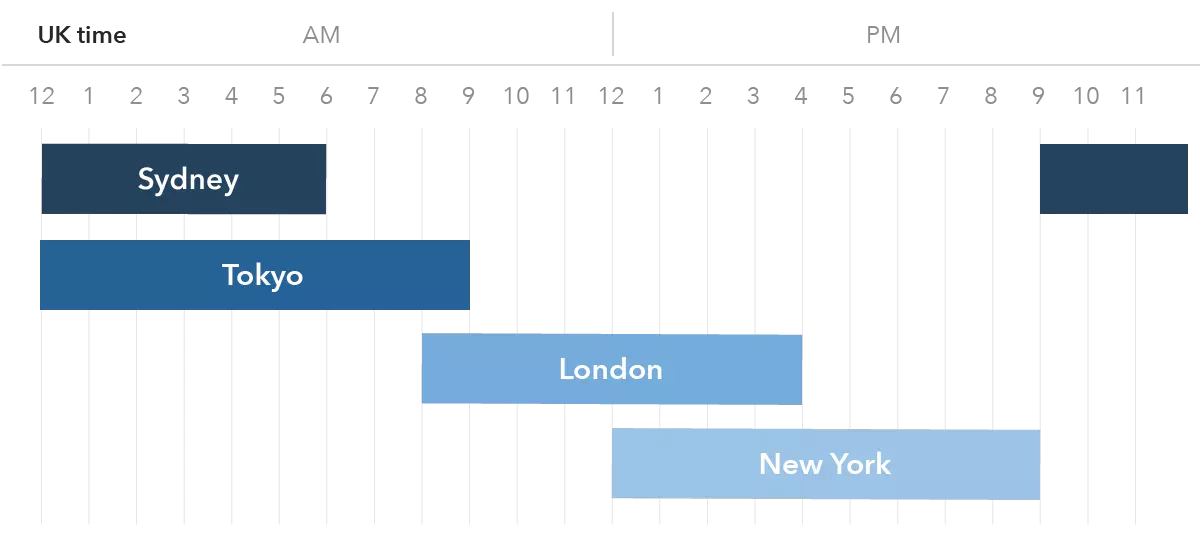
The forex market opens on Sunday evening and closes on Friday evening in global time. It stays active because trading moves across major financial centres, including Sydney, Tokyo, London, and New York. As one session closes, another session opens.
This global structure makes forex different from stock markets. A stock exchange usually has fixed local opening and closing times. Forex is decentralised, so banks, brokers, institutions, hedge funds, businesses, and retail traders participate across different regions throughout the week.
However, more trading hours do not automatically mean better trading. The best time to trade forex usually depends on liquidity, volatility, currency pair, trading strategy, news events, and personal schedule.
What Are Forex Market Hours?
Forex market hours refer to the periods when participants can buy and sell currencies during the global trading week.
The forex market is usually open 24 hours a day from Sunday evening to Friday evening in Coordinated Universal Time. It closes over the weekend because major institutional trading centres are not operating normally.
The 24-hour structure exists because forex trading happens across the world. When trading slows in one region, another financial centre becomes active.
The four major forex trading sessions are:
| Forex Session | Main Region | Main Role |
|---|---|---|
| Sydney session | Australia and Pacific region | Opens the trading week |
| Tokyo session | Asia | Drives Asian currency activity |
| London session | Europe | Often the most active session |
| New York session | North America | Major USD-driven session |
These sessions create a rolling market. Sydney starts first, followed by Tokyo, London, and New York. Then the cycle repeats until the market closes for the weekend.
Why Forex Market Hours Matter
Forex market hours matter because market behaviour changes throughout the day.
Liquidity, spreads, volatility, and price movement are not equal across all sessions. A currency pair can be active during one session and quiet during another.
For example, GBP/USD often moves more during the London and New York sessions because both the British pound and U.S. dollar are actively traded during those periods. AUD/JPY may see more activity during the Sydney and Tokyo sessions because Australia and Japan are active.
Understanding market hours helps traders answer important questions:
- When is my currency pair most active?
- When are spreads likely to be tighter?
- When is volatility likely to increase?
- When should I avoid trading?
- Which session matches my strategy?
- When do major news releases occur?
A scalper may prefer active hours with tight spreads. A swing trader may care more about daily closes and major news events. A beginner may prefer sessions with enough movement but not extreme volatility.
How the Forex Market Stays Open 24 Hours
Forex stays open during the week because it is not controlled by one central exchange.
Instead, forex is traded through a global network of banks, brokers, liquidity providers, electronic platforms, institutions, and market participants.
This decentralised structure allows trading to move across time zones.
The usual sequence is:
- Sydney opens.
- Tokyo opens.
- London opens.
- New York opens.
- New York closes.
- Sydney opens again.
This cycle continues from Sunday evening to Friday evening.
There are quiet periods, especially after New York closes and before Sydney gains full activity. There are also very active periods when two major sessions overlap.
The Four Major Forex Trading Sessions
Sydney Forex Market Hours
The Sydney session opens the global forex trading week.
It is not usually the most volatile session, but it matters because it sets the tone after the weekend. If major news breaks on Saturday or Sunday, the first price reaction may appear when Sydney opens.
Sydney Session Characteristics
The Sydney session often has:
- Lower liquidity than London and New York
- More activity in AUD and NZD pairs
- Wider spreads in some pairs
- More cautious price action after the weekend
- Occasional gaps after major weekend news
Currency pairs linked to the Australian dollar and New Zealand dollar may be more active during this session.
Examples include:
- AUD/USD
- NZD/USD
- AUD/JPY
- NZD/JPY
- AUD/NZD
Who Should Watch the Sydney Session?
The Sydney session may suit traders who focus on Pacific-region currencies. It can also help traders observe how the market reacts after weekend developments.
However, short-term traders should be careful. Liquidity may be thinner, especially at the start of the week.
Tokyo Forex Market Hours
The Tokyo session is the main Asian trading session. It brings more liquidity after Sydney and is important for yen pairs and Asian market sentiment.
Although it is called the Tokyo session, activity across Asia also matters. Traders watch financial centres such as Singapore, Hong Kong, and other regional hubs.
Tokyo Session Characteristics
The Tokyo session often has:
- More activity in JPY pairs
- Moderate volatility compared with London
- Stronger focus on Asian economic news
- Potential movement in AUD and NZD pairs
- Lower activity in some European pairs
Popular pairs during the Tokyo session include:
- USD/JPY
- EUR/JPY
- GBP/JPY
- AUD/JPY
- AUD/USD
- NZD/USD
Why the Tokyo Session Matters
The Tokyo session can set early market direction. If Asian equities are strong, risk-sensitive currencies may gain. If risk sentiment weakens, safe-haven currencies such as the Japanese yen may strengthen.
Traders may also watch data from Japan, China, Australia, and New Zealand during this period.
London Forex Market Hours
The London session is often considered the most important forex trading session.
London is a major global financial centre, and the session overlaps with both Asian and North American trading periods. This makes it a key part of global forex liquidity.
London Session Characteristics
The London session often has:
- High liquidity
- Strong volatility
- Tight spreads on major pairs
- Important European economic releases
- Breakouts from Asian session ranges
- Major activity in GBP and EUR pairs
Popular pairs during the London session include:
- EUR/USD
- GBP/USD
- EUR/GBP
- EUR/JPY
- GBP/JPY
- USD/CHF
- EUR/CHF
Why Traders Like the London Session
Many traders prefer the London session because it often provides strong movement. If the Asian session was quiet, London may create the first major breakout of the day.
The session is also important because many European economic reports are released during this period. These reports can affect the euro, British pound, Swiss franc, and other related currencies.
London Session Risk
High activity can create opportunity, but it can also create false breakouts. Price may break above or below the Asian range, trigger entries, and then reverse.
Traders need confirmation, stop-losses, and a clear risk plan.
New York Forex Market Hours
The New York session is another major forex trading period. It is especially important because the U.S. dollar is the world’s most traded currency.
Many important economic reports from the United States are released before or during the New York session. These reports can move the dollar, gold, oil, indices, and major currency pairs.
New York Session Characteristics
The New York session often has:
- High liquidity
- Strong USD activity
- Important economic news
- Sharp price movement after data releases
- Strong overlap with London
- Reduced activity later in the day
Popular pairs during the New York session include:
- EUR/USD
- GBP/USD
- USD/JPY
- USD/CAD
- USD/CHF
- AUD/USD
- NZD/USD
Why the New York Session Matters
The New York session is important because U.S. data can influence global markets.
Traders often watch:
- Inflation reports
- Employment data
- GDP releases
- Retail sales
- Federal Reserve speeches
- Interest rate decisions
- Manufacturing and services data
- Consumer confidence reports
When the data surprises the market, the U.S. dollar can move sharply.
Forex Market Hours Table
Forex session times can vary because of daylight saving changes. Different countries adjust clocks at different times of the year. This can temporarily shift session overlaps.
The table below gives a general guide using Coordinated Universal Time.
| Forex Session | General UTC Open | General UTC Close |
| Sydney | 10:00 PM | 7:00 AM |
| Tokyo | 12:00 AM | 9:00 AM |
| London | 8:00 AM | 4:00 PM |
| New York | 1:00 PM | 10:00 PM |
Traders should always confirm current market hours with their broker, especially around March, April, October, and November when daylight saving changes may affect session timing.
Best Time to Trade Forex
The best time to trade forex is usually when the market has strong liquidity and enough volatility to create tradeable movement.
This often happens during session overlaps.
A session overlap occurs when two major trading centres are open at the same time. More traders are active, more orders enter the market, and spreads often become tighter on major currency pairs.
Main Forex Session Overlaps
The most important forex market overlaps are:
| Overlap | Why It Matters |
| London and New York | Often the most active period of the day |
| Tokyo and London | Short but important transition period |
| Sydney and Tokyo | Important for AUD, NZD, and JPY pairs |
London and New York Overlap
The London-New York overlap is often the best time to trade forex for many traders.
This period combines European and U.S. liquidity. It is especially important for major pairs such as EUR/USD, GBP/USD, USD/JPY, USD/CAD, and USD/CHF.
Why This Overlap Is Important
The London-New York overlap often has:
- High liquidity
- Tight spreads
- Strong price movement
- Major U.S. economic data
- Active institutional participation
- Strong movement in USD pairs
For many traders, this is the most attractive part of the trading day.
Example
Suppose EUR/USD has been ranging during the London morning. A U.S. inflation report is released during the New York session. If inflation comes in higher than expected, traders may expect the Federal Reserve to keep rates higher for longer.
That can strengthen the U.S. dollar and push EUR/USD lower.
A trader may wait for a confirmed break below support rather than entering immediately during the first volatile spike.
Tokyo and London Overlap
The Tokyo-London overlap is shorter. It occurs as Asian trading slows and European trading begins.
This period may create movement when London traders react to the Asian session range.
What Traders Watch
During this overlap, traders may watch:
- Breaks of Asian session highs and lows
- JPY pairs
- EUR/JPY and GBP/JPY movement
- European market open reaction
- Early London volatility
This period can create fast moves, but false breakouts are also common.
Sydney and Tokyo Overlap
The Sydney-Tokyo overlap is important for traders who focus on Asian and Pacific currencies.
It can provide activity in:
- AUD/USD
- NZD/USD
- USD/JPY
- AUD/JPY
- NZD/JPY
- AUD/NZD
This overlap is usually quieter than London-New York, but it can still offer opportunities for traders who understand these pairs.
Best Time to Trade Major Currency Pairs
The best time to trade a currency pair often depends on the currencies involved.
EUR/USD
EUR/USD is usually most active during the London session and the London-New York overlap. This is when both the euro and U.S. dollar have strong institutional activity.
GBP/USD
GBP/USD often moves strongly during London and New York hours. It can be volatile around U.K. and U.S. economic releases.
USD/JPY
USD/JPY may be active during Tokyo and New York sessions. It can also react strongly to U.S. yields, Bank of Japan policy, and risk sentiment.
AUD/USD
AUD/USD often sees activity during Sydney, Tokyo, and New York sessions. Australian data, Chinese economic news, and U.S. dollar movement can all affect it.
USD/CAD
USD/CAD is usually active during the New York session. It can react to U.S. data, Canadian data, crude oil prices, and Bank of Canada expectations.
EUR/GBP
EUR/GBP is often more active during European trading hours because both currencies are linked to European financial activity.
Best Forex Market Hours by Trading Style
Different traders need different market conditions.
Scalping
Scalpers usually prefer active sessions with tight spreads. They often focus on London, New York, and the London-New York overlap.
Best Conditions for Scalping
Scalpers usually want:
- Tight spreads
- Fast execution
- Clear short-term movement
- Strong liquidity
- Low slippage
Scalping during quiet hours can be difficult because spreads may be wider and movement may be too small.
Day Trading
Day traders often prefer the London session, New York session, or their overlap.
They usually open and close trades within the same day. Therefore, they need enough movement to reach targets before the session ends.
Best Conditions for Day Trading
Day traders usually want:
- Clear intraday trends
- Breakouts from ranges
- Strong session momentum
- Scheduled news awareness
- Defined risk-reward setups
Swing Trading
Swing traders hold trades for several days or weeks. They do not need to enter during the most active minute of the day.
However, they still need to understand forex market hours because entries during illiquid periods can lead to poor prices.
Best Conditions for Swing Trading
Swing traders usually want:
- Higher-timeframe confirmation
- Good entry zones
- Clear stop-loss placement
- Awareness of major news
- Patience during quiet sessions
Position Trading
Position traders focus on large macro trends. They may hold trades for weeks or months.
For them, market hours matter less than central bank policy, interest rates, inflation, economic growth, and long-term sentiment.
Still, position traders should avoid entering during extremely thin liquidity unless they have a reason.
How News Affects Forex Market Hours
News can change market conditions quickly. A quiet session can become volatile when important data is released.
Important forex news includes:
- Interest rate decisions
- Inflation reports
- Employment data
- GDP figures
- Retail sales
- Central bank speeches
- Manufacturing and services data
- Political developments
News releases can create sharp price movement, wider spreads, slippage, and false breakouts.
Beginners should be careful around major news. It is often safer to wait until the first reaction settles before entering.
Why Spreads Change During Forex Market Hours
A spread is the difference between the bid price and the ask price.
Spreads often become tighter when liquidity is high. They may widen when liquidity is low or volatility is extreme.
Spreads May Be Tighter During:
- London session
- New York session
- London-New York overlap
- Active periods for major currency pairs
Spreads May Be Wider During:
- Market open after weekend
- Late New York session
- Holidays
- Major news events
- Thin liquidity periods
- Exotic pair trading
A trader using short-term strategies must pay close attention to spreads. A wide spread can turn a good setup into a poor trade.
Weekend Forex Market Closure
The forex market is closed during the weekend for normal retail trading.
However, economic and political events can still happen while the market is closed. When the market opens again, prices may gap higher or lower.
A weekend gap happens when the opening price is different from the previous closing price.
Weekend Gap Example
Suppose GBP/USD closes on Friday at 1.2700. Over the weekend, major political news affects the British pound. When the market opens on Sunday, GBP/USD starts at 1.2630.
That is a 70-pip gap.
This is why traders should be careful about holding positions over the weekend, especially when major events are expected.
Common Mistakes Traders Make With Forex Market Hours
Trading Every Hour
The market is open 24 hours, but you do not need to trade 24 hours. Overtrading often leads to poor decisions.
Ignoring Session Behaviour
Each session behaves differently. A strategy that works during London may fail during late New York.
Trading Illiquid Periods
Thin liquidity can create wider spreads and poor execution. Beginners should avoid very quiet periods.
Entering Before Major News
Entering right before a major release can be risky. Price may spike in both directions and trigger stop-losses.
Using the Same Strategy for Every Pair
Currency pairs have different active times. AUD/JPY does not behave exactly like EUR/USD.
Forgetting Daylight Saving Changes
Session times can shift when countries change clocks. Traders should check current broker times during daylight saving transition months.
Risk Management During Forex Market Hours
Risk management is important in every session.
Active sessions can create opportunity, but they can also produce sharp losses. Quiet sessions can look safe, but wider spreads and sudden moves can still hurt traders.
Practical Risk Rules
Use these rules:
- Risk only a small percentage per trade.
- Always define your stop-loss before entry.
- Avoid oversized positions.
- Check the economic calendar.
- Do not trade only because the market is open.
- Avoid revenge trading after a loss.
- Reduce risk during major news.
- Keep a trading journal.
Position Sizing Example
Assume a trader has a $1,000 account and risks 1% per trade.
That means the trader risks $10.
If the stop-loss is 20 pips, the trader needs a position size where 20 pips equals $10. That means each pip should be worth about $0.50.
This simple calculation helps prevent oversized trades.
Best Practices for Trading Forex Market Hours
Focus on the sessions that match your pair and strategy.
If you trade EUR/USD or GBP/USD, study London and New York. If you trade AUD/JPY, study Sydney and Tokyo. If you trade USD/CAD, watch New York and crude oil-related sentiment.
Build a routine. Do not sit at the chart all day. Choose your session, prepare your levels, check the news calendar, and wait for your setup.
Avoid trading during random quiet hours unless your strategy is built for low-volatility conditions.
Most importantly, protect your capital. The best trading time is not useful if you use poor risk management.
Key Takeaways
- Forex market hours run 24 hours a day during the trading week.
- The market usually opens on Sunday evening and closes on Friday evening in UTC.
- The four major sessions are Sydney, Tokyo, London, and New York.
- The London session is often one of the most active forex sessions.
- The London-New York overlap is usually the most liquid trading window.
- Sydney and Tokyo are important for AUD, NZD, and JPY pairs.
- The best time to trade depends on the currency pair and strategy.
- Spreads are often tighter during liquid sessions.
- Spreads may widen during quiet periods and major news.
- Forex closes over the weekend, but price gaps can occur after major events.
- Daylight saving changes can affect session times.
- Risk management matters more than trading at the perfect hour.
Frequently Asked Questions
What are forex market hours?
Forex market hours are the periods when traders can buy and sell currencies. The forex market is usually open 24 hours a day from Sunday evening to Friday evening in global time.
What time does the forex market open?
The forex market usually opens when the Sydney session begins on Sunday evening in UTC. Exact broker times may vary.
What time does the forex market close?
The forex market usually closes on Friday evening in UTC after the New York session ends. Retail trading normally remains closed over the weekend.
Is forex open 24 hours?
Yes, forex is open 24 hours a day during the trading week. It is not normally open for retail trading on weekends.
What are the main forex trading sessions?
The main forex trading sessions are Sydney, Tokyo, London, and New York.
What is the best time to trade forex?
The best time to trade forex is usually when liquidity and volatility are strong. Many traders prefer the London session and the London-New York overlap.
Why is the London-New York overlap important?
The London-New York overlap is important because both major financial centres are active. This often creates high liquidity, tight spreads, and strong movement in major currency pairs.
Which forex session is best for beginners?
Beginners may prefer liquid sessions such as London or New York because spreads are often tighter. However, they should avoid major news until they understand volatility.
Which pairs move most during the Tokyo session?
JPY pairs, AUD pairs, and NZD pairs often see more activity during the Tokyo session. Examples include USD/JPY, AUD/JPY, NZD/JPY, and AUD/USD.
Can I trade forex on weekends?
Most retail forex trading is closed on weekends. Some brokers may offer limited weekend products, but normal forex liquidity is not available.
Why do forex spreads widen?
Spreads widen when liquidity is low or volatility is high. This can happen during quiet hours, major news, holidays, and market open after the weekend.
Do daylight saving changes affect forex hours?
Yes. Daylight saving changes can shift session times. Traders should check current market hours with their broker during transition months.
Conclusion
Forex market hours help traders understand when the currency market is active, quiet, liquid, or volatile. The market runs 24 hours a day during the week because trading moves across Sydney, Tokyo, London, and New York.
The best time to trade forex depends on your pair, strategy, risk tolerance, and schedule. Many traders prefer the London session and the London-New York overlap because these periods often offer strong liquidity and movement. However, active markets also carry risk.
Do not trade simply because the market is open. Trade when your strategy has a clear setup, your pair is active, and your risk is controlled.
Forex market hours can help you plan better trades, but they cannot protect you from poor discipline. Use stop-losses, manage position size, check the news calendar, and avoid overtrading.
Forex trading involves significant risk and may not be suitable for all investors. Past performance does not guarantee future results. Always conduct your own research and consider seeking independent financial advice.
Read Also: Forex Trading in Kenya: What Drives Interest and What Traders Should Understand