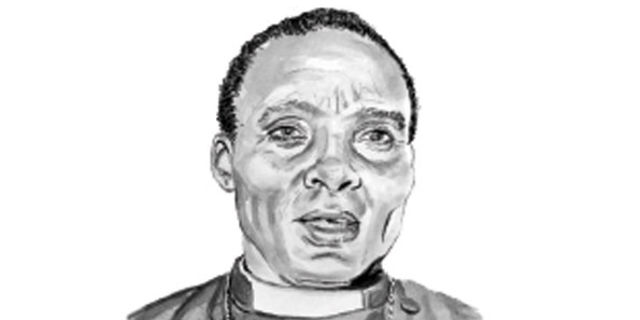
Festo Habakkuk Olang’ was a trailblazer in Kenya’s religious history, becoming the first African Archbishop of the Anglican Church of Kenya (ACK) from 1970 to 1980. His life journey—from humble beginnings in Bunyore to leading the Church—was marked by dedication, humility, and an unwavering commitment to faith.
Early Life and Education
Born in 1914 in Ebusakami Esabalu village, Maseno, in what was then Kakamega District, Olang’ was raised in a deeply traditional setting. His mother, Emisiko Sambaya, was the senior wife in his father’s polygamous family. As one of only two surviving sons of his mother, he spent much of his youth herding cattle, a common activity for boys in his community.
A significant turning point in his childhood came when his family moved to Nyamasaria in Kano, near Kisumu. The relocation exposed him to new cultures and enabled him to learn Dholuo, in addition to his native Luhya language, a skill that would later prove invaluable in his ministry.
In 1925, Olang’ enrolled at Kisumu Primary School (then Komulo School) before moving to Maseno School in 1927, where he sat for his Common Entrance Examination. He was admitted in 1928, marking the beginning of his formal education. It was at Maseno School that he first encountered Carey Francis, a renowned British mathematician and educator, who became a key mentor in shaping Olang’s faith and career.
In 1931, he proceeded to Alliance High School, where his mentorship under Carey Francis continued. At Alliance, he studied alongside some of Kenya’s future leaders, including James Gichuru, Kenya’s first Minister of Finance.
A Calling to Teach
After completing his teacher training, Olang’ returned to Maseno School as a teacher, where he taught for four years. His dedication to education saw him inspire young minds, reinforcing his passion for serving people.
In 1937, Olang’ entered into an arranged marriage with Eseri Twera. Together, they built a family, raising 12 children.
A Higher Calling: Journey to Priesthood
Despite his success as a teacher, Olang’ felt a deeper calling to serve God. Encouraged by Rev. Martyn Capon, he left teaching after 13 years and joined St. Paul’s Divinity School in Limuru to study theology.
On December 9, 1945, Bishop Crabbe ordained Olang’ as a deacon at St. Stephen’s Church in Nairobi. His passion for theological studies saw him earn a British Council Scholarship to Wycliffe Hall, Oxford, England, in 1948, where he specialized in the Holy Spirit and Church Administration.
Returning Home: Leadership in the Church
Olang’ returned to Kenya in 1950 and was ordained as a priest at St. Paul’s, Maseno. He soon took up leadership roles, becoming principal of Maseno Bible School and later, the first Rural Dean of Central Kenya.
By 1954, Olang’ was appointed Vicar of Bunyore, solidifying his influence in church leadership. His historic moment came in 1955, when he was consecrated as an Assistant Bishop alongside Obadiah Kariuki. The consecration—conducted by the Archbishop of Canterbury, Geoffrey Fisher—took place at Namirembe Cathedral in Kampala, Uganda. This event marked the first time Kenyan clergy were elevated to the position of bishop.
In 1960, Olang’ was named Bishop of Maseno Diocese, overseeing the Church’s expansion and spiritual growth in Western Kenya.
Archbishop of the Anglican Church of Kenya
A decade later, in 1970, Olang’ achieved another historic milestone. When the Anglican churches in Kenya and Tanzania split into separate provinces, he was elected the first Archbishop of the Church of the Province of Kenya (CPK).
His election was not without competition—he won against Bishop Obadiah Kariuki, known for his outspoken nature, due to Olang’s humble and unifying leadership style. The outgoing Archbishop, Leonard Beecher, presided over the installation ceremony at All Saints’ Cathedral on August 3, 1970.
As Archbishop and Bishop of Nairobi, Olang’ led the Church through a transformative decade, overseeing:
- The expansion of parishes across Kenya.
- The construction of schools and hospitals.
- The translation of the Bible, Prayer Book, and hymn books into Luhya and Dholuo, making Christian teachings more accessible to Kenyan communities.
- The creation of a new Anglican Church constitution, ensuring greater autonomy and governance for the church in Kenya.
Olang’ also served as Bishop-in-Ordinary for Kenya’s Military and presided over State functions, reinforcing the Church’s role in national affairs.
A Legacy of Humility and Service
Festo Olang’s legacy goes beyond his administrative achievements. He was a pillar of humility, integrity, and faith. His leadership was characterized by:
- A deep respect for human dignity.
- A commitment to unity within the Church.
- An emphasis on spiritual growth and service to the community.
Even after his retirement in 1980, he continued to mentor church leaders and advocate for Christian values.
Final Years and Passing
Festo Olang’ lived a long and fulfilling life, surrounded by his 45 grandchildren and 24 great-grandchildren.
On February 3, 2004, he passed away in Nairobi at the age of 90, due to a heart attack. His impact on the Anglican Church of Kenya remains immeasurable, and his contributions continue to influence Christian leadership in Kenya to this day.
Conclusion: A Pioneer of Faith
Festo Habakkuk Olang’ was more than just the first African Archbishop of the Anglican Church of Kenya—he was a visionary leader, a spiritual mentor, and a servant of the people. From grazing cattle in Bunyore to leading Kenya’s largest Christian denomination, his life story serves as an inspiration for generations to come.
His dedication to faith, education, and leadership left an indelible mark on Kenya’s spiritual and social landscape, making him one of the most revered figures in Kenya’s Christian history.