After centuries of Danish, Swedish, German, and Russian rule, Estonia attained independence in 1918. Forcibly incorporated into the USSR in 1940 — an action never recognized by the US and many other countries — it regained its freedom in 1991 with the collapse of the Soviet Union. Since the last Russian troops left in 1994, Estonia has been free to promote economic and political ties with the West. It joined both NATO and the EU in 2004, formally joined the OECD in 2010, and adopted the euro as its official currency in 2011.
Geography
Location
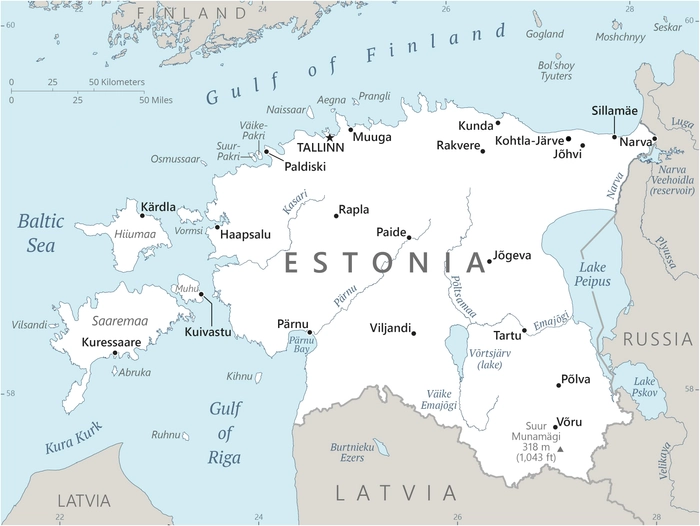
Eastern Europe, bordering the Baltic Sea and Gulf of Finland, between Latvia and Russia
Geographic coordinates
59 00 N, 26 00 E
Map references
Europe
Area
total : 45,228 sq km
land: 42,388 sq km
water: 2,840 sq km
note: includes 1,520 islands in the Baltic Sea
comparison ranking: total 132
Area – comparative
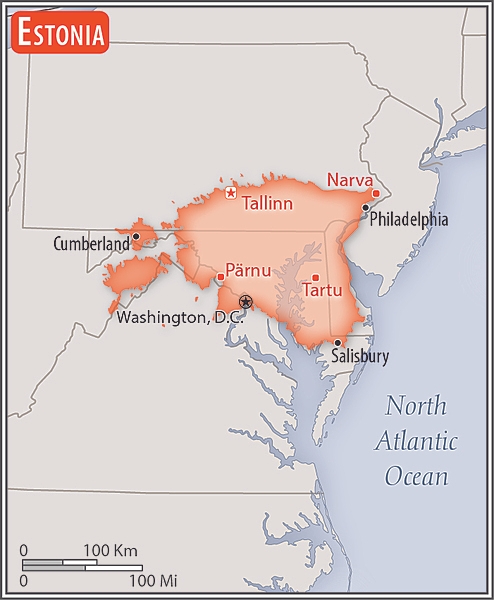
about twice the size of New Jersey
Area comparison map:
Land boundaries
total: 657 km
border countries (2): Latvia 333 km; Russia 324 km
Coastline
3,794 km
Maritime claims
territorial sea: 12 nm
exclusive economic zone: limits as agreed to by Estonia, Finland, Latvia, Sweden, and Russia
Climate
maritime; wet, moderate winters, cool summers
Terrain
marshy, lowlands; flat in the north, hilly in the south
Elevation
highest point: Suur Munamagi 318 m
lowest point: Baltic Sea 0 m
mean elevation: 61 m
Natural resources
oil shale, peat, rare earth elements, phosphorite, clay, limestone, sand, dolomite, arable land, sea mud
Land use
agricultural land: 23.1% (2022 est.)
arable land: 16.5% (2022 est.)
permanent crops: 0.1% (2022 est.)
permanent pasture: 6.4% (2022 est.)
forest: 57.1% (2022 est.)
other: 19.9% (2022 est.)
Irrigated land
20 sq km (2016)
Major lakes (area sq km)
fresh water lake(s): Lake Peipus – 4,300 sq km (shared with Russia); Lake Võrtsjärv – 270 sq km
Population distribution
a fairly even distribution throughout most of the country, with urban areas attracting larger and denser populations
Natural hazards
sometimes flooding occurs in the spring
Geography – note
the mainland terrain is flat, boggy, and partly wooded; over 1,500 islands lie offshore
People and Society
Population
total: 1,193,791 (2024 est.)
male: 563,079
female: 630,712
comparison rankings: total 160; female 158; male 160
Nationality
noun: Estonian(s)
adjective: Estonian
Ethnic groups
Estonian 69.1%, Russian 23.7%, Ukrainian 2.1%, other 4.6%, unspecified 0.5% (2021 est.)
Languages
Estonian (official) 67.2%, Russian 28.5%, other 3.7%, unspecified 0.6% (2021est.)
Religions
Orthodox 16.5%, Protestant 9.2% (Lutheran 7.7%, other Protestant 1.5%), other 3% (includes Roman Catholic, Muslim, Jehovah’s Witness, Pentecostal, Buddhist, and Taara Believer), none 58.4%, unspecified 12.9% (2021 est.)
Age structure
0-14 years: 15.2% (male 92,980/female 88,753)
15-64 years: 62.2% (male 373,989/female 368,113)
65 years and over: 22.6% (2024 est.) (male 96,110/female 173,846)
2024 population pyramid:

Dependency ratios
total dependency ratio: 57.6 (2024 est.)
youth dependency ratio: 25.4 (2024 est.)
elderly dependency ratio: 32.2 (2024 est.)
potential support ratio: 3.1 (2024 est.)
Median age
total: 45 years (2024 est.)
male: 41.9 years
female: 48.2 years
comparison ranking: total 22
Population growth rate
-0.76% (2024 est.)
comparison ranking: 228
Birth rate
8.2 births/1,000 population (2024 est.)
comparison ranking: 212
Death rate
13.2 deaths/1,000 population (2024 est.)
comparison ranking: 12
Net migration rate
-2.7 migrant(s)/1,000 population (2024 est.)
comparison ranking: 174
Population distribution
a fairly even distribution throughout most of the country, with urban areas attracting larger and denser populations
Urbanization
urban population: 69.8% of total population (2023)
rate of urbanization: -0.03% annual rate of change (2020-25 est.)
Major urban areas – population
454,000 TALLINN (capital) (2023)
Sex ratio
at birth: 1.05 male(s)/female
0-14 years: 1.05 male(s)/female
15-64 years: 1.02 male(s)/female
65 years and over: 0.55 male(s)/female
total population: 0.89 male(s)/female (2024 est.)
Mother’s mean age at first birth
28.2 years (2020 est.)
Maternal mortality ratio
5 deaths/100,000 live births (2020 est.)
comparison ranking: 164
Infant mortality rate
total: 3.3 deaths/1,000 live births (2024 est.)
male: 3.2 deaths/1,000 live births
female: 3.4 deaths/1,000 live births
comparison ranking: total 196
Life expectancy at birth
total population: 78.4 years (2024 est.)
male: 73.8 years
female: 83.2 years
comparison ranking: total population 79
Total fertility rate
1.62 children born/woman (2024 est.)
comparison ranking: 178
Gross reproduction rate
0.79 (2024 est.)
Contraceptive prevalence rate
NA
Drinking water source
improved:
urban: 100% of population
rural: NA
total: 99.6% of population
unimproved:
urban: 0% of population
rural: NA
total: 0.4% of population (2020 est.)
Health expenditure
6.9% of GDP (2022)
13.2% of national budget (2022 est.)
Physician density
3.47 physicians/1,000 population (2022)
Hospital bed density
4.5 beds/1,000 population (2020 est.)
Sanitation facility access
improved:
urban: 99.8% of population
rural: 100% of population
total: 99.8% of population
unimproved:
urban: 0.2% of population
rural: 0% of population
total: 0.2% of population (2020 est.)
Obesity – adult prevalence rate
21.2% (2016)
comparison ranking: 93
Alcohol consumption per capita
total: 11.65 liters of pure alcohol (2019 est.)
beer: 4 liters of pure alcohol (2019 est.)
wine: 1.92 liters of pure alcohol (2019 est.)
spirits: 4.6 liters of pure alcohol (2019 est.)
other alcohols: 1.13 liters of pure alcohol (2019 est.)
comparison ranking: total 7
Tobacco use
total: 23.7% (2025 est.)
male: 29.9% (2025 est.)
female: 18.3% (2025 est.)
comparison ranking: total 46
Currently married women (ages 15-49)
52.3% (2023 est.)
Education expenditure
5.7% of GDP (2022 est.)
14.6% national budget (2022 est.)
comparison ranking: Education expenditure (% GDP) 37
Literacy
total population: 99.9%
male: 99.9%
female: 99.9% (2021)
School life expectancy (primary to tertiary education)
total: 16 years
male: 15 years
female: 17 years (2020)
Environment
Environment – current issues
air pollution from sulfur dioxide from oil-shale-burning power plants; coastal seawater pollution
Environment – international agreements
party to: Air Pollution, Air Pollution-Heavy Metals, Air Pollution-Nitrogen Oxides, Air Pollution-Persistent Organic Pollutants, Air Pollution-Sulphur 85, Air Pollution-Volatile Organic Compounds, Antarctic Treaty, Biodiversity, Climate Change, Climate Change-Kyoto Protocol, Climate Change-Paris Agreement, Comprehensive Nuclear Test Ban, Desertification, Endangered Species, Environmental Modification, Hazardous Wastes, Law of the Sea, Marine Dumping-London Protocol, Ozone Layer Protection, Ship Pollution, Tropical Timber 2006, Wetlands, Whaling
signed, but not ratified: none of the selected agreements
Climate
maritime; wet, moderate winters, cool summers
Land use
agricultural land: 23.1% (2022 est.)
arable land: 16.5% (2022 est.)
permanent crops: 0.1% (2022 est.)
permanent pasture: 6.4% (2022 est.)
forest: 57.1% (2022 est.)
other: 19.9% (2022 est.)
Urbanization
urban population: 69.8% of total population (2023)
rate of urbanization: -0.03% annual rate of change (2020-25 est.)
Air pollutants
particulate matter emissions: 6.35 micrograms per cubic meter (2019 est.)
carbon dioxide emissions: 16.59 megatons (2016 est.)
methane emissions: 0.99 megatons (2020 est.)
Waste and recycling
municipal solid waste generated annually: 473,000 tons (2015 est.)
municipal solid waste recycled annually: 117,020 tons (2015 est.)
percent of municipal solid waste recycled: 24.7% (2015 est.)
Major lakes (area sq km)
fresh water lake(s): Lake Peipus – 4,300 sq km (shared with Russia); Lake Võrtsjärv – 270 sq km
Total water withdrawal
municipal: 60 million cubic meters (2020 est.)
industrial: 790 million cubic meters (2020 est.)
agricultural: 4.5 million cubic meters (2017 est.)
Total renewable water resources
12.81 billion cubic meters (2020 est.)
Government
Country name
conventional long form: Republic of Estonia
conventional short form: Estonia
local long form: Eesti Vabariik
local short form: Eesti
former: Estonian Soviet Socialist Republic (while occupied by the USSR)
etymology: derives from the name of the people who lived along the eastern Baltic Sea in the first centuries A.D., which came from the Baltic word aueist, meaning “waterside dwellers”
Government type
parliamentary republic
Capital
name: Tallinn
geographic coordinates: 59 26 N, 24 43 E
time difference: UTC+2 (7 hours ahead of Washington, DC, during Standard Time)
daylight saving time: +1hr, begins last Sunday in March; ends last Sunday in October
etymology: the name derives from the Old Estonian term tan-linn, meaning “Danish fort,” a reference to Danish King VALDEMAR II founding the city in 1219
Administrative divisions
15 urban municipalities (linnad, singular – linn), 64 rural municipalities (vallad, singular – vald)
urban municipalities: Haapsalu, Keila, Kohtla-Jarve, Loksa, Maardu, Narva, Narva-Joesuu, Paide, Parnu, Rakvere, Sillamae, Tallinn, Tartu, Viljandi, Voru
rural municipalities: Alutaguse, Anija, Antsla, Elva, Haademeeste, Haljala, Harku, Hiiumaa, Jarva, Joelahtme, Jogeva, Johvi, Kadrina, Kambja, Kanepi, Kastre, Kehtna, Kihnu, Kiili, Kohila, Kose, Kuusalu, Laane-Harju, Laane-Nigula, Laaneranna, Luganuse, Luunja, Marjamaa, Muhu, Mulgi, Mustvee, Noo, Otepaa, Peipsiaare, Pohja-Parnumaa, Pohja-Sakala, Poltsamaa, Polva, Raasiku, Rae, Rakvere, Räpina, Rapla, Rouge, Ruhnu, Saarde, Saaremaa, Saku, Saue, Setomaa, Tapa, Tartu, Toila, Tori, Torva, Turi, Vaike-Maarja, Valga, Viimsi, Viljandi, Vinni, Viru-Nigula, Vormsi, Voru
Legal system
civil law system
Constitution
history: several previous; latest adopted 28 June 1992, entered into force 3 July 1992
amendment process: proposed by at least one-fifth of Parliament members or by the president of the republic; passage requires three readings of the proposed amendment and a simple majority vote in two successive memberships of Parliament; passage of amendments to the “General Provisions” and “Amendment of the Constitution” chapters requires at least three-fifths majority vote by Parliament to conduct a referendum and majority vote in a referendum
International law organization participation
accepts compulsory ICJ jurisdiction with reservations; accepts ICCt jurisdiction
Citizenship
citizenship by birth: no
citizenship by descent only: at least one parent must be a citizen of Estonia
dual citizenship recognized: no
residency requirement for naturalization: 5 years
Suffrage
18 years of age; universal; age 16 for local elections
Executive branch
chief of state: President Alar KARIS (since 11 October 2021)
head of government: Prime Minister Kristen MICHAL (since 23 July 2024)
cabinet: Cabinet appointed by the prime minister, approved by Parliament
elections/appointments: president indirectly elected by Parliament for a 5-year term (eligible for a second term); if a candidate does not secure two thirds of the votes after 3 rounds of balloting, then an electoral college consisting of Parliament members and local council members elects the president, choosing between the 2 candidates with the highest number of votes; if a president is still not elected, the process begins again; election last held on 30 to 31 August 2021 (next to be held in 2026); prime minister nominated by the president and approved by Parliament
election results:
2021: Alar KARIS (independent) elected president; won second round of voting in parliament with 72 of 101 votes
2016: Kersti KALJULAID elected president; won sixth round of voting in parliament with 81 of 98 votes (17 ballots blank); KALJULAID sworn in on 10 October 2016 – first female head of state of Estonia
Legislative branch
legislature name: The Estonian Parliament (Riigikogu)
legislative structure: unicameral
number of seats: 101 (all directly elected)
electoral system: proportional representation
scope of elections: full renewal
term in office: 4 years
most recent election date: 3/5/2023
parties elected and seats per party: Reform Party (37); Conservative People’s Party (EKRE) (17); Centre Party (16); Estonia 200 (Eesti 200) (14); Social Democratic Party (9); Pro Patria (Isamaa) (8)
percentage of women in chamber: 28.7%
expected date of next election: March 2027
Judicial branch
highest court(s): Supreme Court (consists of 19 justices, including the chief justice, and organized into civil, criminal, administrative, and constitutional review chambers)
judge selection and term of office: the chief justice is proposed by the president of the republic and appointed by the Riigikogu; other justices proposed by the chief justice and appointed by the Riigikogu; justices appointed for life
subordinate courts: circuit (appellate) courts; administrative, county, city, and specialized courts
Political parties
Conservative People’s Party (Konservatiivne Rahvaerakond) or EKRE
Estonia 200 or E200
Estonia Centre Party of (Keskerakond) or KE
Estonian Free Party or VAP
Estonian Greens or EER
Estonian Nationalists and Conservatives or ERK
Estonian Reform Party (Reformierakond) or RE
Estonian United Left Party or EÜVP
Fatherland or I
Pro Patria (Isamaa)
The Right or PP
Social Democratic Party or SDE
Diplomatic representation in the US
chief of mission: Ambassador Kristjan PRIKK (since 7 July 2021)
chancery: 2131 Massachusetts Ave, NW
Washington, DC, 20008
telephone: [1] (202) 588-0101
FAX: [1] (202) 588-0108
email address and website:
[email protected]
https://washington.mfa.ee/
consulate(s) general: New York, San Francisco
Diplomatic representation from the US
chief of mission: Ambassador (vacant); Chargé d’Affaires Matthew E. WALL (since January 2025)
embassy: Kentmanni 20, 15099 Tallinn
mailing address: 4530 Tallinn Place, Washington DC 20521-4530
telephone: [372] 668-8100
FAX: [372] 668-8265
email address and website:
[email protected]
https://ee.usembassy.gov/
International organization participation
Australia Group, BA, BIS, CBSS, CD, CE, EAPC, EBRD, ECB, EIB, EMU, ESA (cooperating state), EU, FAO, IAEA, IBRD, ICAO, ICC (national committees), ICCt, ICRM, IDA, IEA, IFAD, IFC, IFRCS, IHO, ILO, IMF, IMO, Interpol, IOC, IOM, IPU, ISO, ITSO, ITU, ITUC (NGOs), MIGA, NATO, NIB, NSG, OAS (observer), OECD, OIF (observer), OPCW, OSCE, PCA, Schengen Convention, UN, UNCTAD, UNESCO, UNHCR, UNTSO, UPU, Wassenaar Arrangement, WCO, WHO, WIPO, WMO, WTO
Independence
24 February 1918 (from Soviet Russia); 20 August 1991 (declared from the Soviet Union); 6 September 1991 (recognized by the Soviet Union)
National holiday
Independence Day, 24 February (1918); note – 24 February 1918 was the date Estonia declared its independence from Soviet Russia and established its statehood; 20 August 1991 was the date it declared its independence from the Soviet Union restoring its statehood
Flag description
three equal horizontal bands of blue (top), black, and white; blue represents faith, loyalty, and devotion, and also the sky, sea, and lakes; black stands for the soil of the country, as well as the Estonian people’s past suffering; white stands for striving towards enlightenment and virtue and also for birch bark, snow, and summer nights illuminated by the midnight sun
National symbol(s)
barn swallow, cornflower
National colors
blue, black, white
National anthem
name: “Mu isamaa, mu onn ja room” (My Native Land, My Pride and Joy)
lyrics/music: Johann Voldemar JANNSEN/Fredrik PACIUS
note: adopted 1920, though banned between 1940 and 1990 under Soviet occupation; the anthem, used in Estonia since 1869, shares the same melody as Finland’s but has different lyrics
National heritage
total World Heritage Sites: 2 (both cultural)
selected World Heritage Site locales: Historic Center (Old Town) of Tallinn; Struve Geodetic Arc
Economy
Economic overview
high-income, service-based EU and eurozone economy; rebound in exports playing a role in economic recovery; rising food prices contributing to inflation; decrease in labor force participation and rising unemployment rate; recovery depends on boosting private investment and productivity rates
Real GDP (purchasing power parity)
$58.199 billion (2023 est.)
$60.013 billion (2022 est.)
$59.977 billion (2021 est.)
note: data in 2021 dollars
comparison ranking: 115
Real GDP growth rate
-3.02% (2023 est.)
0.06% (2022 est.)
7.25% (2021 est.)
note: annual GDP % growth based on constant local currency
comparison ranking: 210
Real GDP per capita
$42,500 (2023 est.)
$44,500 (2022 est.)
$45,100 (2021 est.)
note: data in 2021 dollars
comparison ranking: 55
GDP (official exchange rate)
$41.291 billion (2023 est.)
note: data in current dollars at official exchange rate
Inflation rate (consumer prices)
3.5% (2024 est.)
9.2% (2023 est.)
19.4% (2022 est.)
note: annual % change based on consumer prices
comparison ranking: 113
GDP – composition, by sector of origin
agriculture: 1.9% (2023 est.)
industry: 21.7% (2023 est.)
services: 64.5% (2023 est.)
note: figures may not total 100% due to non-allocated consumption not captured in sector-reported data
comparison rankings: services 62; industry 128; agriculture 161
GDP – composition, by end use
household consumption: 52.3% (2023 est.)
government consumption: 20.6% (2023 est.)
investment in fixed capital: 27.9% (2023 est.)
investment in inventories: -0.2% (2023 est.)
exports of goods and services: 77.9% (2023 est.)
imports of goods and services: -77% (2023 est.)
note: figures may not total 100% due to rounding or gaps in data collection
Agricultural products
milk, wheat, barley, rapeseed, peas, oats, potatoes, rye, pork, triticale (2023)
note: top ten agricultural products based on tonnage
Industries
food, engineering, electronics, wood and wood products, textiles; information technology, telecommunications
Industrial production growth rate
-10.02% (2023 est.)
note: annual % change in industrial value added based on constant local currency
comparison ranking: 208
Labor force
747,800 (2024 est.)
note: number of people ages 15 or older who are employed or seeking work
comparison ranking: 155
Unemployment rate
7.8% (2024 est.)
6.4% (2023 est.)
5.6% (2022 est.)
note: % of labor force seeking employment
comparison ranking: 143
Youth unemployment rate (ages 15-24)
total: 20.9% (2024 est.)
male: 21.9% (2024 est.)
female: 20% (2024 est.)
note: % of labor force ages 15-24 seeking employment
comparison ranking: total 59
Population below poverty line
22.5% (2022 est.)
note: % of population with income below national poverty line
Gini Index coefficient – distribution of family income
31.8 (2021 est.)
note: index (0-100) of income distribution; higher values represent greater inequality
comparison ranking: 113
Average household expenditures
on food: 19.9% of household expenditures (2023 est.)
on alcohol and tobacco: 6.7% of household expenditures (2023 est.)
Household income or consumption by percentage share
lowest 10%: 3.1% (2021 est.)
highest 10%: 24.3% (2021 est.)
note: % share of income accruing to lowest and highest 10% of population
Remittances
1.18% of GDP (2023 est.)
1.22% of GDP (2022 est.)
1.59% of GDP (2021 est.)
note: personal transfers and compensation between resident and non-resident individuals/households/entities
Budget
revenues: $13.907 billion (2022 est.)
expenditures: $13.505 billion (2022 est.)
note: central government revenues (excluding grants) and expenses converted to US dollars at average official exchange rate for year indicated
Public debt
28.3% of GDP (2023 est.)
note: central government debt as a % of GDP
comparison ranking: 171
Taxes and other revenues
21.4% (of GDP) (2023 est.)
note: central government tax revenue as a % of GDP
comparison ranking: 74
Current account balance
-$489.659 million (2024 est.)
-$722.668 million (2023 est.)
-$1.496 billion (2022 est.)
note: balance of payments – net trade and primary/secondary income in current dollars
comparison ranking: 119
Exports
$32.637 billion (2024 est.)
$32.147 billion (2023 est.)
$33.178 billion (2022 est.)
note: balance of payments – exports of goods and services in current dollars
comparison ranking: 80
Exports – partners
Finland 14%, Latvia 10%, Lithuania 9%, Sweden 7%, Russia 6% (2023)
note: top five export partners based on percentage share of exports
Exports – commodities
cars, wood, broadcasting equipment, refined petroleum, prefabricated buildings (2023)
note: top five export commodities based on value in dollars
Imports
$32.375 billion (2024 est.)
$31.796 billion (2023 est.)
$33.655 billion (2022 est.)
note: balance of payments – imports of goods and services in current dollars
comparison ranking: 78
Imports – partners
Finland 11%, Germany 11%, China 10%, Lithuania 6%, Poland 6% (2023)
note: top five import partners based on percentage share of imports
Imports – commodities
cars, refined petroleum, broadcasting equipment, natural gas, packaged medicine (2023)
note: top five import commodities based on value in dollars
Reserves of foreign exchange and gold
$2.054 billion (2024 est.)
$2.593 billion (2023 est.)
$2.217 billion (2022 est.)
note: holdings of gold (year-end prices)/foreign exchange/special drawing rights in current dollars
comparison ranking: 129
Exchange rates
euros (EUR) per US dollar –
Exchange rates:
0.924 (2024 est.)
0.925 (2023 est.)
0.95 (2022 est.)
0.845 (2021 est.)
0.876 (2020 est.)
Energy
Electricity access
electrification – total population: 100% (2022 est.)
Electricity
installed generating capacity: 3.225 million kW (2023 est.)
consumption: 8.636 billion kWh (2023 est.)
exports: 4.355 billion kWh (2023 est.)
imports: 7.66 billion kWh (2023 est.)
transmission/distribution losses: 1.164 billion kWh (2023 est.)
comparison rankings: transmission/distribution losses 107; imports 33; exports 42; consumption 112; installed generating capacity 108
Electricity generation sources
fossil fuels: 52.2% of total installed capacity (2023 est.)
solar: 9.7% of total installed capacity (2023 est.)
wind: 10.5% of total installed capacity (2023 est.)
hydroelectricity: 0.4% of total installed capacity (2023 est.)
biomass and waste: 27.2% of total installed capacity (2023 est.)
Coal
consumption: 800 metric tons (2023 est.)
exports: 7,000 metric tons (2023 est.)
imports: 800 metric tons (2023 est.)
Petroleum
total petroleum production: 24,000 bbl/day (2023 est.)
refined petroleum consumption: 27,000 bbl/day (2024 est.)
Natural gas
consumption: 334.748 million cubic meters (2023 est.)
exports: 675.708 million cubic meters (2023 est.)
imports: 1.01 billion cubic meters (2023 est.)
Carbon dioxide emissions
4.607 million metric tonnes of CO2 (2023 est.)
from coal and metallurgical coke: -19,814 metric tonnes of CO2 (2023 est.)
from petroleum and other liquids: 3.977 million metric tonnes of CO2 (2023 est.)
from consumed natural gas: 649,000 metric tonnes of CO2 (2023 est.)
comparison ranking: total emissions 139
Energy consumption per capita
73.679 million Btu/person (2023 est.)
comparison ranking: 68
Communications
Telephones – fixed lines
total subscriptions: 238,000 (2023 est.)
subscriptions per 100 inhabitants: 17 (2023 est.)
comparison ranking: total subscriptions 115
Telephones – mobile cellular
total subscriptions: 2.05 million (2023 est.)
subscriptions per 100 inhabitants: 155 (2022 est.)
comparison ranking: total subscriptions 150
Broadcast media
the publicly owned broadcaster, Eesti Rahvusringhaaling (ERR), operates 3 TV channels and 5 radio networks; growing number of private commercial radio stations broadcasting nationally, regionally, and locally; fully transitioned to digital television in 2010; national private TV channels expanding service, with a range of channels aimed at Russian-speaking viewers; in 2016, there were 42 on-demand services available in Estonia, including 19 pay TVOD and SVOD services; roughly 85% of households accessed digital television services
Internet country code
.ee
Internet users
percent of population: 93% (2023 est.)
Broadband – fixed subscriptions
total: 516,000 (2023 est.)
subscriptions per 100 inhabitants: 38 (2023 est.)
comparison ranking: total 94
Transportation
Civil aircraft registration country code prefix
ES
Airports
34 (2025)
comparison ranking: 115
Heliports
10 (2025)
comparison ranking: 76
Railways
total: 1,441 km (2020) 225 km electrified
Merchant marine
total: 72 (2023)
by type: general cargo 3, oil tanker 3, other 66
comparison ranking: total 108
Ports
total ports: 20 (2024)
large: 4
medium: 1
small: 4
very small: 11
ports with oil terminals: 5
key ports: Muuga – Port of Tallin, Paldiski Lounasadam, Paljassaare, Sillamae, Vanasadam – Port of Tallinn
Military and Security
Military and security forces
Estonian Defense Forces: Land Forces, Navy, Air Force; Estonian Defense League
Ministry of Interior: Police and Border Guard Board, Internal Security Service (2025)
note: the Estonian Defense League is a voluntary national defense organization that operates under the Estonian Ministry of Defense
Military expenditures
3.4% of GDP (2024 est.)
2.9% of GDP (2023)
2.2% of GDP (2022)
2% of GDP (2021)
2.3% of GDP (2020)
Military and security service personnel strengths
approximately 7,500 active-duty Defense Forces; approximately 15,000 Defense League (2024)
note: the Estonian Defense Forces rely largely on reservists who have completed compulsory conscription in the previous 10 years to fill out its active duty and Territorial Defense units during a crisis; there are more than 40,000 trained reservists, and approximately 230,000 Estonians are enrolled in the mobilization registry
Military equipment inventories and acquisitions
the Estonian military has a mix of weapons and equipment from western European suppliers, as well as Israel, South Korea, Turkey, and the US (2024)
Military service age and obligation
18-27 for compulsory military or governmental service for men; conscript service requirement 8-11 months depending on education; non-commissioned officers, reserve officers, and specialists serve 11 months; women can volunteer, and as of 2018 could serve in any military branch (2025)
note 1: conscripts comprise approximately 3,000-3,300 of the Estonian military’s active-duty personnel and serve in all branches, except for the Air Force; after conscript service, reservists are called up for training every 5 years; Estonia has had conscription since 1991
note 2: in 2021, women comprised about 10% of the full-time professional military force; the Defense League includes a Women’s Voluntary Defense Organization
Military – note
the Estonian military is a compact force that relies heavily on conscripts and reservists and the support of its NATO allies; Estonia’s defense policy aims to guarantee the country’s independence and sovereignty, protect its territorial integrity, including waters and airspace, and preserve constitutional order; Estonia’s main defense goals are developing and maintaining a credible deterrent to outside aggression and ensuring the Estonian Defense Forces (EDF) can fulfill their commitments to NATO and interoperate with the armed forces of NATO and EU member states; the EDF’s primary external focus is Russia; since Russia’s full-scale invasion of Ukraine in 2022, Estonia has boosted defense spending, sent arms to Ukraine, and sought to boost the EDF’s capabilities in such areas as air defense, artillery, personnel readiness, and surveillance
Estonia has been a member of NATO since 2004 and is fully integrated within the NATO structure; since 2017, Estonia has hosted a UK-led multinational NATO ground force battlegroup as part of the Alliance’s Enhanced Forward Presence initiative; as the EDF Air Force does not have any combat aircraft, NATO has provided airspace protection for Estonia since 2004 through its Baltic Air Policing mission; NATO member countries that possess air combat capabilities voluntarily contribute to the mission on four-month rotations; NATO fighter aircraft have been hosted at Estonia’s Ämari Air Base since 2014; Estonia also hosts a NATO cyber security center; it cooperates closely with the EU on defense issues through the EU Common Security and Defense Policy and is a member of the UK-led Joint Expeditionary Force, a pool of high-readiness military forces from 10 Baltic and Scandinavian countries designed to respond to a wide range of contingencies in the North Atlantic, Baltic Sea, and High North regions; Estonia also has close defense ties with its Baltic neighbors and has bilateral military agreements with a number of European countries, as well as Canada and the US (2025)
Transnational Issues
Refugees and internally displaced persons
refugees (country of origin): 38,020 (Ukraine) (as of 2 March 2024)
stateless persons: 70,604 (2022); note – following independence in 1991, automatic citizenship was restricted to those who were Estonian citizens prior to the 1940 Soviet occupation and their descendants; thousands of ethnic Russians remained stateless when forced to choose between passing Estonian language and citizenship tests or applying for Russian citizenship; one reason for demurring on Estonian citizenship was to retain the right of visa-free travel to Russia; stateless residents can vote in local elections but not general elections; stateless parents who have been lawful residents of Estonia for at least five years can apply for citizenship for their children before they turn 15 years old
Illicit drugs
producer of synthetic drugs; important transshipment zone for cannabis, cocaine, opiates, and synthetic drugs since joining the European Union and the Schengen Accord; potential money laundering related to organized crime and drug trafficking is a concern, as is possible use of the gambling sector to launder funds; major use of opiates and ecstasy