Amazon acquisitions show how a small online bookstore became one of the most powerful companies in the world. Amazon started in 1994 as an internet bookseller, but it later expanded into e-commerce, cloud computing, groceries, streaming, smart homes, healthcare, logistics, robotics, advertising, and artificial intelligence.
Amazon did not build every part of that empire from scratch. It bought companies that helped it enter new markets, strengthen existing services, acquire talent, improve logistics, and compete with major rivals.
Some acquisitions became central to Amazon’s identity. Whole Foods gave Amazon a major physical grocery business. MGM expanded Prime Video with a major film and television library. Twitch made Amazon a leader in live gaming streams. Ring pushed Amazon deeper into smart-home security. Zappos strengthened online retail. Kiva Systems transformed warehouse automation.
Other acquisitions were smaller but still strategic. PillPack and One Medical moved Amazon further into healthcare. Zoox gave it autonomous vehicle technology. Souq.com expanded its Middle East presence. Audible strengthened its audio business.
This guide explains Amazon acquisitions, what Amazon owns, the company’s biggest deals, why Amazon buys companies, and what investors should understand about its acquisition strategy.
What Are Amazon Acquisitions?
Amazon acquisitions are companies, technologies, brands, teams, or assets that Amazon has bought to support its business strategy.
An acquisition happens when one company buys another company. Amazon may buy a company because it wants:
- Its customers
- Its technology
- Its brand
- Its patents
- Its logistics network
- Its content library
- Its engineering talent
- Its market share
- Its physical stores
- Its healthcare infrastructure
- Its artificial intelligence or robotics capability
Amazon’s acquisition strategy is broad because Amazon itself is broad. It is not only an online store. It is also a cloud provider, media company, logistics operator, grocery retailer, device maker, healthcare player, advertising platform, and technology company.
How Amazon Became One of the World’s Largest Companies
Amazon was founded by Jeff Bezos in 1994 in Bellevue, Washington. It began by selling books online.
That early focus gave Amazon a simple advantage: books were easy to list, store, search, and ship compared with many other retail products.
Amazon soon expanded beyond books into electronics, toys, software, clothing, furniture, groceries, digital media, cloud computing, and many other categories.
Several forces helped Amazon grow:
- Wider internet adoption
- Online shopping growth
- Customer obsession
- Fast delivery
- Marketplace sellers
- Prime membership
- Amazon Web Services
- Logistics investment
- Acquisitions
- Device ecosystem growth
- Advertising revenue
- Streaming and entertainment
Amazon became powerful because it kept expanding into connected markets. Each new business supported another part of the company. Prime supported shopping and video. AWS supported cloud computing. Logistics supported e-commerce. Devices supported media and smart homes.
What Does Amazon Own?
Amazon owns many businesses across different industries.
Major Amazon-owned or Amazon-controlled businesses include:
| Business | Main Area |
|---|---|
| Amazon.com | E-commerce and marketplace |
| Amazon Web Services | Cloud computing |
| Whole Foods Market | Grocery retail |
| MGM Studios | Film and television |
| Prime Video | Streaming |
| Twitch | Live streaming |
| Audible | Audiobooks |
| Zappos | Online shoes and apparel |
| Ring | Smart-home security |
| Blink | Smart-home cameras |
| One Medical | Primary healthcare |
| Amazon Pharmacy | Pharmacy and healthcare |
| PillPack | Online pharmacy |
| Zoox | Autonomous vehicles |
| Amazon Robotics | Warehouse automation |
| Goodreads | Books and reviews |
| IMDb | Film and TV database |
| Woot | Deals and e-commerce |
| Souq.com | Middle East e-commerce foundation |
Some of these were acquisitions. Others were built internally or developed after acquisition.
Why Amazon Buys Companies
Amazon buys companies for several reasons.
To Enter New Markets
Amazon often buys companies when it wants to enter a market faster than building from zero.
Whole Foods gave Amazon grocery stores. MGM gave Amazon a major studio library. One Medical gave Amazon a primary care network.
To Strengthen Existing Businesses
Some deals improve Amazon’s current operations.
Kiva Systems helped Amazon automate warehouses. Twitch strengthened Amazon’s gaming and streaming ecosystem. Ring improved smart-home products.
To Acquire Technology
Amazon buys companies for robotics, artificial intelligence, healthcare technology, cloud tools, logistics systems, and consumer devices.
To Acquire Customers
An acquisition can instantly give Amazon a customer base.
Whole Foods brought grocery shoppers. Zappos brought loyal online shoe customers. One Medical brought healthcare members.
To Compete With Rivals
Amazon competes with Walmart, Microsoft, Google, Apple, Netflix, Disney, Shopify, Instacart, Target, Meta, and many others.
Acquisitions help Amazon defend or expand its position.
Amazon’s Biggest Acquisitions
Amazon’s largest acquisitions show its strategic priorities.
| Rank | Company | Year Completed | Deal Value | Main Sector |
| 1 | Whole Foods Market | 2017 | $13.7 billion | Grocery retail |
| 2 | MGM | 2022 | $8.5 billion | Film and television |
| 3 | One Medical | 2023 | $3.9 billion | Healthcare |
| 4 | Zoox | 2020 | About $1.2 billion | Autonomous vehicles |
| 5 | Zappos | 2009 | About $1.2 billion | Online retail |
| 6 | Twitch | 2014 | About $970 million | Live streaming |
| 7 | Ring | 2018 | About $970 million | Smart-home security |
| 8 | Kiva Systems | 2012 | $775 million | Robotics |
| 9 | PillPack | 2018 | About $753 million | Pharmacy |
| 10 | Souq.com | 2017 | About $580 million | Middle East e-commerce |
The ranking can vary depending on whether deal values include debt, stock, or later adjustments.
1. Whole Foods Market
Whole Foods is Amazon’s largest acquisition.
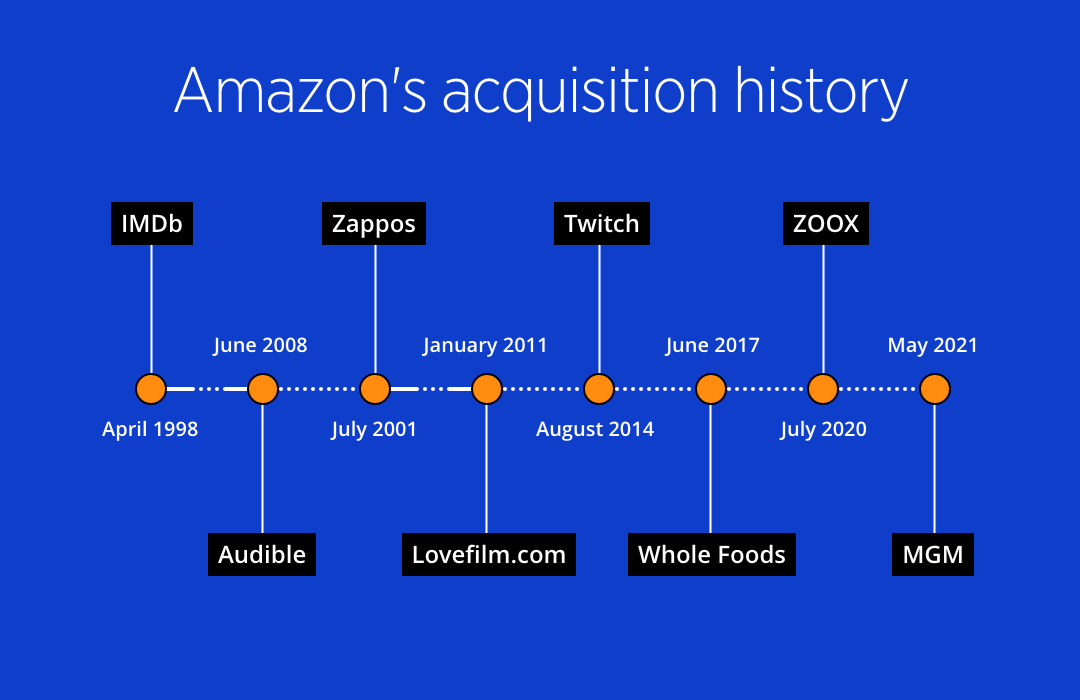
Amazon bought Whole Foods Market for $13.7 billion in 2017. The deal gave Amazon a major physical grocery chain with stores across the United States and other markets.
Before the deal, Amazon had tried grocery delivery and online food retail, but Whole Foods gave it immediate scale in brick-and-mortar grocery.
Why Whole Foods Mattered
Whole Foods helped Amazon enter physical grocery retail in a serious way.
The deal gave Amazon:
- Grocery stores
- Fresh food supply chains
- Private-label food brands
- Physical retail locations
- Wealthier urban customers
- Data on grocery shopping behaviour
- A stronger local delivery network
- More ways to connect Prime with food shopping
Amazon later used Whole Foods to offer Prime discounts, grocery pickup, and delivery options.
Key Risk
Grocery is a difficult business. Margins are low, competition is strong, and logistics are complex. Amazon still competes with Walmart, Kroger, Costco, Target, Instacart, and regional grocers.
2. MGM
Amazon completed its acquisition of MGM in 2022 for $8.5 billion. The deal brought thousands of films and TV episodes into Amazon’s entertainment business.
MGM owns or is associated with major entertainment franchises and titles, including James Bond, Rocky, Creed, The Handmaid’s Tale, Legally Blonde, and many classic films.
Why MGM Mattered
MGM strengthened Prime Video.
The deal gave Amazon:
- A major content library
- Film and television production capability
- Recognisable franchises
- More streaming content
- Stronger competition against Netflix, Disney, Apple, and Warner Bros. Discovery
- More value for Prime membership
In 2025, Amazon MGM Studios also gained creative control of the James Bond franchise through a new partnership with the long-time Bond rights holders, making the MGM acquisition even more strategically important for Amazon’s entertainment ambitions.
Key Risk
Streaming is expensive. Content spending, subscriber growth, theatrical strategy, licensing, and competition all affect whether MGM produces strong returns for Amazon.
3. One Medical
Amazon completed its acquisition of One Medical in 2023 for about $3.9 billion. One Medical is a primary care company offering in-person clinics and virtual care.
The deal expanded Amazon’s healthcare ambitions after earlier moves such as Amazon Pharmacy and PillPack.
Why One Medical Mattered
One Medical gave Amazon direct access to primary healthcare services.
It added:
- Physical clinics
- Virtual care services
- Membership-based primary care
- Healthcare technology
- Patient relationships
- Employer healthcare partnerships
- A stronger Amazon Health Services platform
Healthcare is a large market, and Amazon has long been interested in making medical services more convenient.
Key Risk
Healthcare is highly regulated, complex, and sensitive. Patient privacy, clinical quality, insurance relationships, medical staffing, and regulatory compliance all create risk.
4. Zoox
Amazon acquired Zoox in 2020 for about $1.2 billion.
Zoox develops autonomous vehicle technology. Its goal is to build self-driving vehicles for ride-hailing and mobility services.
Why Zoox Mattered
Zoox gave Amazon access to autonomous driving talent and technology.
Potential strategic uses include:
- Autonomous mobility
- Delivery automation
- Logistics innovation
- Robotics research
- Transportation technology
Amazon’s logistics network is huge, so autonomous technology could matter over the long term.
Key Risk
Autonomous vehicles are technically difficult, costly, and heavily regulated. Commercial success may take longer than expected.
5. Zappos
Amazon acquired Zappos in 2009 for about $1.2 billion.
Zappos is an online retailer best known for shoes, clothing, customer service, and generous return policies.
Why Zappos Mattered
Zappos strengthened Amazon’s fashion and apparel business.
It brought:
- Strong online retail expertise
- A loyal customer base
- Footwear category strength
- Customer service reputation
- Apparel and shoe supplier relationships
Zappos also showed Amazon’s willingness to buy a respected online retailer rather than only compete against it.
Key Risk
Fashion retail has high return rates, trend risk, margin pressure, and strong competition.
6. Twitch
Amazon acquired Twitch in 2014 for about $970 million.
Twitch is a live-streaming platform known for gaming, esports, creators, live chats, and community-driven entertainment.
Why Twitch Mattered
Twitch gave Amazon a major position in live streaming and gaming culture.
It helped Amazon expand into:
- Gaming content
- Creator monetisation
- Live streaming
- Esports
- Digital communities
- Advertising
- Prime Gaming
Twitch also helped Amazon compete for younger digital audiences.
Key Risk
Live streaming requires content moderation, creator retention, advertising growth, and platform safety. Competition from YouTube, TikTok, Kick, and other platforms remains strong.
7. Ring
Amazon bought Ring in 2018 for about $970 million.
Ring makes smart doorbells, home security cameras, alarms, and related devices.
Why Ring Mattered
Ring strengthened Amazon’s smart-home ecosystem.
It gave Amazon:
- Smart security devices
- Home monitoring products
- Subscription revenue
- Connected device data
- Integration with Alexa
- A stronger smart-home platform
Ring fits Amazon’s broader device strategy alongside Echo, Alexa, Fire TV, Blink, and other products.
Key Risk
Smart-home security products raise privacy and data concerns. Amazon must manage user trust, law enforcement requests, cybersecurity, and device competition.
8. Kiva Systems
Amazon acquired Kiva Systems in 2012 for $775 million.
Kiva made warehouse robotics systems. After the acquisition, it became a major foundation of Amazon Robotics.
Why Kiva Mattered
Kiva transformed Amazon’s fulfilment centres.
Its robots helped move shelves and products inside warehouses, improving speed and efficiency.
The deal supported:
- Faster order processing
- Warehouse automation
- Lower fulfilment friction
- Robotics expertise
- Logistics scale
- Amazon Prime delivery speed
Kiva is one of Amazon’s most strategically important acquisitions because logistics is central to Amazon’s retail advantage.
Key Risk
Warehouse automation requires heavy investment. It also raises labour, safety, and operational concerns.
9. PillPack
Amazon acquired PillPack in 2018 for about $753 million.
PillPack was an online pharmacy that organised medications into pre-sorted packets and delivered them to customers.
Why PillPack Mattered
PillPack helped Amazon enter pharmacy services.
It supported:
- Prescription delivery
- Medication management
- Amazon Pharmacy
- Healthcare logistics
- Customer convenience
- Pharmacy technology
This acquisition was one of Amazon’s earliest major healthcare moves.
Key Risk
Pharmacy is regulated and competitive. Amazon must deal with insurers, pharmacy benefit managers, healthcare rules, and patient safety requirements.
10. Souq.com
Amazon acquired Souq.com in 2017 for about $580 million.
Souq.com was a major e-commerce platform in the Middle East.
Why Souq.com Mattered
Souq.com helped Amazon expand in the Middle East.
It gave Amazon:
- Regional e-commerce infrastructure
- Local customers
- Seller relationships
- Logistics knowledge
- Market entry into Arab economies
- A base for Amazon.ae and related regional operations
The deal showed Amazon’s global e-commerce strategy.
Key Risk
International e-commerce requires localisation, logistics, payments, regulation, and competition with regional players.
Other Important Amazon Acquisitions
Amazon has acquired many other companies that shaped its business.
Audible
Amazon acquired Audible in 2008.
Audible became a major part of Amazon’s digital media business. It sells audiobooks, spoken-word content, podcasts, and audio subscriptions.
Audible strengthened Amazon’s position in books and digital content.
IMDb
Amazon acquired IMDb, the Internet Movie Database, in 1998.
IMDb became one of the world’s best-known film and television information platforms. It supports Amazon’s entertainment ecosystem and advertising opportunities.
Goodreads
Amazon bought Goodreads in 2013.
Goodreads is a social platform for readers, book reviews, recommendations, and reading lists.
The deal strengthened Amazon’s connection to readers and its book retail roots.
Blink
Amazon acquired Blink, a smart-home camera and security device company, in 2017.
Blink became part of Amazon’s smart-home device strategy alongside Ring and Alexa.
Woot
Amazon acquired Woot in 2010.
Woot is a deals-focused e-commerce site known for discounted products and limited-time offers.
Eero
Amazon acquired Eero in 2019.
Eero makes mesh Wi-Fi routers and networking devices. It supports Amazon’s smart-home ecosystem by improving home connectivity.
MX Player
Amazon acquired assets connected to MX Player in India and combined them with Amazon miniTV to launch Amazon MX Player in 2024. This strengthened Amazon’s free streaming and advertising-supported video strategy in India.
Amazon Acquisition History by Business Area
Amazon’s acquisitions can be grouped by strategy.
| Business Area | Example Acquisitions |
| Grocery | Whole Foods |
| Entertainment | MGM, Twitch, Audible, IMDb |
| Healthcare | One Medical, PillPack |
| Robotics and logistics | Kiva Systems, Zoox |
| Smart home | Ring, Blink, Eero |
| E-commerce | Zappos, Souq.com, Woot |
| Books and media | Goodreads, Audible |
| Devices and connectivity | Eero, Ring, Blink |
| International expansion | Souq.com, MX Player-related assets |
This shows that Amazon buys companies to support its ecosystem, not just to add revenue.
Amazon’s Failed or Abandoned Deals
Not every Amazon acquisition attempt succeeds.
iRobot
Amazon agreed to buy iRobot, the maker of Roomba robot vacuums, but the deal was later terminated in 2024 after facing regulatory pressure, especially from European regulators.
The failed deal showed that regulators are watching Amazon’s expansion more closely.
Why the iRobot Deal Failed
Regulators were concerned about competition in robot vacuums, smart homes, and Amazon’s marketplace power.
The termination highlighted a growing issue for Big Tech: large acquisitions now face more scrutiny than they did in earlier years.
What Companies Does Jeff Bezos Own?
Jeff Bezos founded Amazon and remains closely associated with the company, though he stepped down as Amazon CEO in 2021.
However, not every company linked to Bezos is owned by Amazon.
Important Bezos-linked companies and entities include:
| Company or Entity | Relationship |
| Amazon | Founded by Jeff Bezos |
| Blue Origin | Founded by Bezos; private aerospace company |
| The Washington Post | Bought by Bezos personally, not Amazon |
| Bezos Expeditions | Bezos’s personal investment vehicle |
| Bezos Earth Fund | Philanthropic climate initiative |
This distinction matters. Amazon does not own The Washington Post or Blue Origin. Bezos owns or funds those separately.
Amazon vs Jeff Bezos Ownership
Amazon and Jeff Bezos are not the same entity.
Amazon is a public company with shareholders. Bezos is one of its major individual shareholders, but Amazon’s acquisitions are made by Amazon as a company.
Bezos’s personal investments are separate from Amazon’s corporate acquisitions.
For example:
- Amazon owns Whole Foods.
- Amazon owns MGM.
- Amazon owns Twitch.
- Bezos personally owns The Washington Post.
- Bezos founded Blue Origin separately from Amazon.
How Amazon Acquisitions Changed the Company
Amazon acquisitions helped reshape the company in several ways.
Grocery Became Physical
Whole Foods gave Amazon stores, grocery expertise, and a stronger local retail presence.
Streaming Became Stronger
MGM, Twitch, Audible, and IMDb expanded Amazon’s media ecosystem.
Healthcare Became Strategic
PillPack and One Medical pushed Amazon further into healthcare.
Logistics Became More Automated
Kiva Systems helped Amazon build one of the most advanced fulfilment networks in retail.
Smart Homes Became Larger
Ring, Blink, and Eero expanded Amazon’s connected home ecosystem.
International Markets Expanded
Souq.com helped Amazon build a stronger Middle East e-commerce presence.
Why Regulators Watch Amazon Acquisitions
Amazon is one of the world’s largest technology and retail companies. Because of its size, regulators often review its deals carefully.
Regulators may ask whether an Amazon acquisition could:
- Reduce competition
- Harm smaller sellers
- Increase marketplace power
- Expand control over consumer data
- Hurt privacy
- Give Amazon unfair platform advantages
- Make it harder for rivals to compete
- Increase dominance in connected devices or healthcare
The failed iRobot deal shows that future Amazon acquisitions may face more resistance.
Amazon Acquisition Strategy
Amazon’s acquisition strategy is based on ecosystem expansion.
The company often buys businesses that connect to its broader goals.
Those goals include:
- Faster delivery
- More Prime value
- More customer data
- Better logistics
- More digital content
- Smart-home integration
- Healthcare expansion
- Cloud and AI services
- International growth
- Stronger marketplace offerings
Amazon is not just buying companies. It is building a network of services that keep customers inside the Amazon ecosystem.
Amazon Acquisitions and Investors
Amazon acquisitions matter to investors because they show where the company is placing long-term bets.
A good acquisition can create new revenue, strengthen customer loyalty, and protect Amazon’s competitive advantage.
A poor acquisition can waste capital, distract management, or attract regulatory problems.
Investors should ask:
- Does the acquisition strengthen Amazon’s ecosystem?
- Does it support Prime?
- Does it improve logistics?
- Does it expand high-growth markets?
- Does it create regulatory risk?
- Is the price reasonable?
- Can Amazon integrate the company?
- Will the deal improve long-term cash flow?
- Does it help Amazon compete with Walmart, Microsoft, Google, Apple, Netflix, or Disney?
Amazon’s Most Successful Acquisitions
Several Amazon acquisitions stand out as especially important.
Kiva Systems
Kiva strengthened Amazon’s fulfilment network and helped improve warehouse automation.
Whole Foods
Whole Foods gave Amazon a serious physical grocery presence.
Twitch
Twitch made Amazon a major player in live streaming and gaming communities.
Audible
Audible strengthened Amazon’s audio and digital media ecosystem.
MGM
MGM expanded Prime Video and Amazon Studios with a major content library.
Amazon’s Most Strategic Acquisitions
Not every deal is judged only by revenue.
Some acquisitions are strategic because they help Amazon defend or expand its ecosystem.
| Acquisition | Strategic Value |
| Kiva Systems | Faster fulfilment and warehouse automation |
| Whole Foods | Physical grocery and local retail |
| MGM | Prime Video content library |
| Ring | Smart-home security ecosystem |
| One Medical | Healthcare market entry |
| PillPack | Pharmacy infrastructure |
| Zoox | Autonomous transport technology |
| Twitch | Gaming and live-streaming community |
Risks of Amazon’s Acquisition Strategy
Amazon’s acquisition strategy carries risk.
Regulatory Risk
Large deals can face antitrust review.
Integration Risk
Buying a company is easier than integrating it successfully.
Culture Risk
A smaller company’s culture may change after joining Amazon.
Privacy Risk
Deals involving healthcare, smart homes, or personal data can raise trust concerns.
Overpayment Risk
Amazon may pay too much if a market is overhyped.
Distraction Risk
Acquisitions can distract management from core businesses.
Key Takeaways
- Amazon acquisitions helped turn an online bookstore into a global technology and retail giant.
- Amazon owns businesses across e-commerce, grocery, streaming, healthcare, robotics, logistics, and smart homes.
- Whole Foods is Amazon’s largest acquisition at $13.7 billion.
- MGM is Amazon’s second-largest acquisition at $8.5 billion.
- One Medical is one of Amazon’s biggest healthcare acquisitions.
- Twitch expanded Amazon into live streaming and gaming communities.
- Ring and Blink strengthened Amazon’s smart-home ecosystem.
- Kiva Systems transformed Amazon’s warehouse automation.
- PillPack helped Amazon enter pharmacy services.
- Souq.com supported Amazon’s Middle East expansion.
- The iRobot deal was terminated after regulatory pressure.
- Jeff Bezos’s personal companies are separate from Amazon’s corporate acquisitions.
Frequently Asked Questions
What companies does Amazon own?
Amazon owns Whole Foods, MGM, Twitch, Ring, Blink, Zappos, One Medical, PillPack, Audible, IMDb, Goodreads, Woot, Eero, Zoox, and other businesses.
What is Amazon’s biggest acquisition?
Amazon’s biggest acquisition is Whole Foods Market, which it bought for $13.7 billion in 2017.
What is Amazon’s second-biggest acquisition?
Amazon’s second-biggest acquisition is MGM, which it completed for $8.5 billion in 2022.
Does Amazon own MGM?
Yes. Amazon completed its acquisition of MGM in 2022.
Does Amazon own Twitch?
Yes. Amazon acquired Twitch in 2014.
Does Amazon own Whole Foods?
Yes. Amazon acquired Whole Foods Market in 2017.
Does Amazon own Ring?
Yes. Amazon acquired Ring in 2018.
Does Amazon own One Medical?
Yes. Amazon completed its acquisition of One Medical in 2023.
Does Amazon own iRobot?
No. Amazon’s planned acquisition of iRobot was terminated in 2024.
Does Amazon own The Washington Post?
No. The Washington Post is owned by Jeff Bezos personally, not by Amazon.
Does Amazon own Blue Origin?
No. Blue Origin was founded by Jeff Bezos and is separate from Amazon.
Why does Amazon buy companies?
Amazon buys companies to enter new markets, improve logistics, expand Prime, strengthen technology, acquire talent, and compete more effectively.
Conclusion
Amazon acquisitions reveal how the company grew from a garage-based online bookstore into a global giant with interests across retail, cloud computing, media, healthcare, robotics, logistics, smart homes, and entertainment.
Whole Foods moved Amazon into physical grocery. MGM strengthened Prime Video and Amazon Studios. One Medical pushed Amazon deeper into healthcare. Twitch made Amazon a major live-streaming platform. Ring and Blink expanded its smart-home ecosystem. Kiva Systems helped transform warehouse automation. PillPack supported Amazon Pharmacy. Souq.com helped expand Amazon’s international retail presence.
Not every deal is simple. Amazon’s failed iRobot acquisition showed that regulators are paying closer attention to Big Tech expansion. Healthcare and smart-home deals also raise privacy and trust questions.
Still, Amazon’s acquisition history shows a clear pattern. The company buys businesses that support its ecosystem, improve customer convenience, and open new growth markets.
For investors, Amazon acquisitions are worth watching because they show where the company sees its future. Some deals may strengthen Amazon for decades. Others may face regulation, integration problems, or weak returns. The key is to judge each acquisition by strategy, price, execution, and long-term value.
Investing in technology and retail stocks involves risk. Share prices can fall as well as rise. Acquisitions can create value, but they can also fail or attract regulatory challenges. Past performance does not guarantee future results. Always conduct your own research and consider seeking independent financial advice.
Read Also: Google Acquisition History: Biggest Deals