The 2024 United States presidential election was held on November 5, 2024, marking one of the most contentious and closely watched contests in modern American history. The election featured a high-stakes battle between the Republican Party ticket of Donald Trump and JD Vance, and the Democratic Party ticket of Kamala Harris and Tim Walz. With intense debates over the economy, healthcare, immigration, and democracy, the election underscored deep divisions within the nation while demonstrating the resilience of its democratic system.
Candidates and Their Campaigns
Republican Party: Donald Trump and JD Vance
Former President Donald Trump, who previously served as the 45th President from 2017 to 2021, made history by becoming the first president since Grover Cleveland to be elected to two non-consecutive terms. Trump’s running mate, JD Vance, a U.S. Senator from Ohio, brought a populist perspective to the ticket, appealing to working-class voters across swing states.
Trump’s campaign focused on:
- Economic Nationalism: Promoting tariffs, reducing immigration, and prioritizing American manufacturing.
- Immigration Reform: Pledging to complete the border wall and deport millions of undocumented immigrants.
- “America First” Foreign Policy: Reducing involvement in global conflicts while renegotiating trade deals.
- Law and Order: Emphasizing stricter measures to combat crime and illegal drug trafficking.
Trump’s rallies were marked by fiery rhetoric, attacks on the Biden administration, and promises to restore what he described as “American greatness.”
Democratic Party: Kamala Harris and Tim Walz
Vice President Kamala Harris became the first woman of color to lead a major party ticket, succeeding President Joe Biden after his withdrawal from the race in July 2024. Harris chose Tim Walz, the Governor of Minnesota, as her running mate, hoping to strengthen the ticket’s appeal in the Midwest.
Harris campaigned on:
- Economic Equality: Addressing inflation, raising wages, and supporting small businesses.
- Healthcare Access: Strengthening the Affordable Care Act and expanding Medicare benefits.
- Climate Action: Pledging ambitious measures to combat climate change.
- Social Justice: Advocating for voting rights, LGBTQ+ protections, and reproductive rights.
Harris’ campaign sought to position itself as a defender of democracy and civil rights against what it characterized as Trump’s authoritarian tendencies.
Key Issues Driving the Election
The Economy
Economic concerns dominated voter priorities, with rising inflation and the lingering effects of the global pandemic playing central roles. Trump blamed the Biden administration for economic mismanagement, while Harris highlighted legislative efforts to stabilize the economy and protect working families.
Healthcare
Healthcare remained a divisive issue. Harris advocated for strengthening the Affordable Care Act, expanding Medicare coverage, and capping prescription drug prices. Trump criticized these measures as overreach, instead proposing market-driven solutions.
Immigration
Immigration policy became a flashpoint in the election. Trump doubled down on his plans for mass deportations and border security, while Harris promoted a balanced approach, including pathways to citizenship for undocumented immigrants and increased border resources.
Democracy and Rule of Law
Concerns about democratic backsliding loomed large, especially following Trump’s challenges to the 2020 election results. Harris campaigned on protecting voting rights and combating misinformation, while Trump framed his candidacy as a fight against perceived election interference.
Election Results
Electoral College and Popular Vote
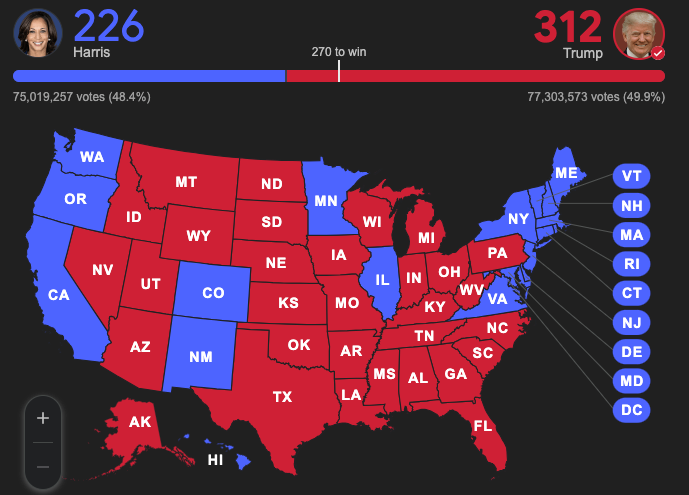
Donald Trump secured victory in the Electoral College with 312 votes to Kamala Harris’ 226 votes, flipping key battleground states that had favored Joe Biden in 2020. Notably, Trump reclaimed Wisconsin, Michigan, and Pennsylvania in the Rust Belt, as well as Nevada, marking the first Republican win in that state since 2004.
In the popular vote, Trump achieved a plurality with 49.8%, while Harris garnered 48.5%, marking one of the narrowest margins in recent elections. Trump’s gains among working-class voters, Hispanic communities, and young men without college degrees were pivotal to his success.
Historic Implications
Trump’s victory made him the oldest president-elect at 78 years old, and he became the first president to be impeached twice and subsequently re-elected. This election also saw Harris make history as the first woman of color to lead a major party ticket, solidifying her role as a key figure in Democratic politics.
Analysis of Voter Trends
Demographics
- Hispanic Voters: Trump improved his standing among Hispanic voters, especially in Florida and Texas, by emphasizing economic opportunities and conservative values.
- Young Voters: Harris retained support from younger, urban voters, but Trump made unexpected gains among young men, particularly those without college degrees.
- Suburban Women: Harris saw strong support among suburban women concerned about reproductive rights, but Trump narrowed the gender gap by focusing on economic security and public safety.
Geographic Shifts
- Rust Belt Revival: Trump’s emphasis on manufacturing jobs and economic populism resonated strongly in the Rust Belt.
- Sun Belt Expansion: Harris maintained Democratic strongholds in Arizona and Georgia, but Trump’s success in Nevada underscored Republican inroads in the region.
Election Challenges and Controversies
Election Integrity
As in 2020, allegations of election interference and fraud surfaced, primarily from Trump’s campaign. However, election officials across all states affirmed the integrity of the vote, citing no evidence of widespread irregularities.
Foreign Interference
Reports indicated attempts by Russia, China, and Iran to influence the election through disinformation campaigns and cyberattacks. U.S. intelligence agencies worked to mitigate these threats, ensuring minimal disruption to the electoral process.
Inauguration and Early Days of the Trump-Vance Administration
Donald Trump and JD Vance were inaugurated on January 20, 2025, amidst a mix of celebration and protest. Trump’s inaugural address focused on unity, economic revitalization, and restoring America’s global standing.
First Actions
- Signing executive orders to increase domestic energy production and strengthen border security.
- Rolling back several Biden-era regulations on climate and healthcare.
- Introducing legislation aimed at reforming election laws and reducing federal bureaucracy.
Impact and Legacy
The 2024 presidential election will be remembered as a defining moment in U.S. history. It highlighted deep partisan divisions, shifting demographic trends, and the enduring influence of populist politics. As Trump begins his second term, the nation remains poised for both challenges and opportunities, with its democratic institutions under scrutiny and its people hopeful for a more unified future.
This election serves as a reminder of the complexities and dynamism of American democracy, where every vote contributes to shaping the nation’s destiny.