
Typhoon-Class Submarine: The Largest Nuclear-Powered Submarine Ever Built
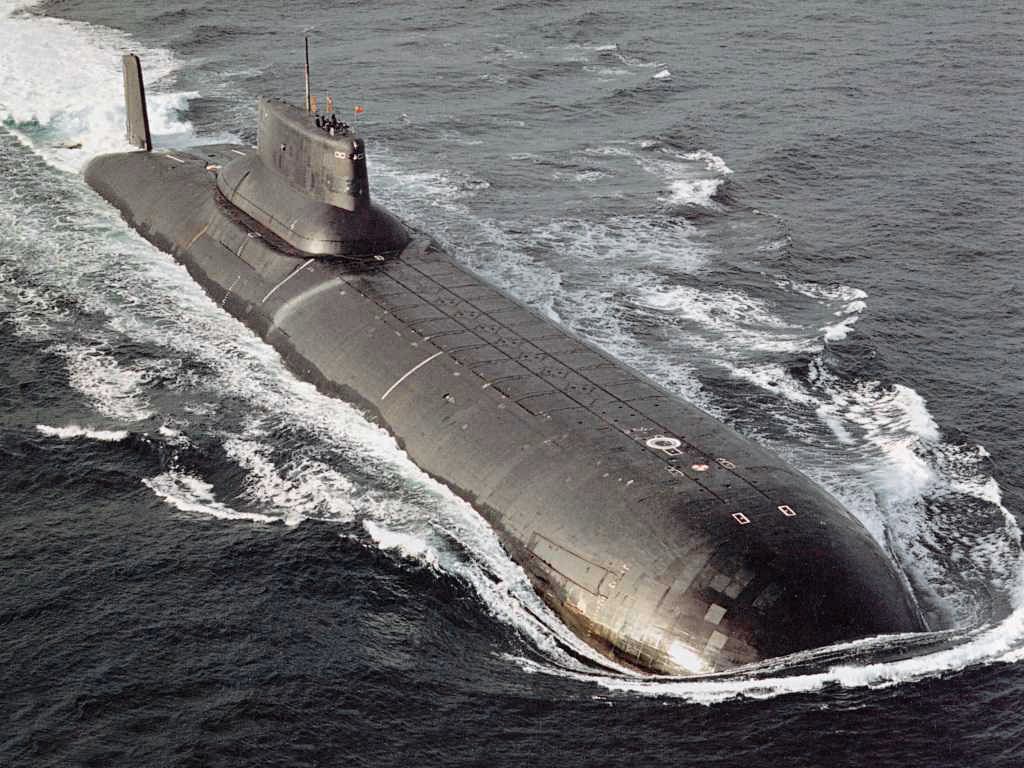
The Typhoon-class submarine, known in Russia as Project 941 Akula (Russian for “Shark”), stands as the largest nuclear-powered ballistic missile submarine ever built. Developed by the Soviet Union during the Cold War, it was designed to match and outclass the Ohio-class submarines of the United States in terms of size, firepower, and endurance. Its sheer size and capabilities allowed it to remain submerged for extended periods, offering strategic deterrence with its nuclear missile arsenal.
A Giant of the Seas
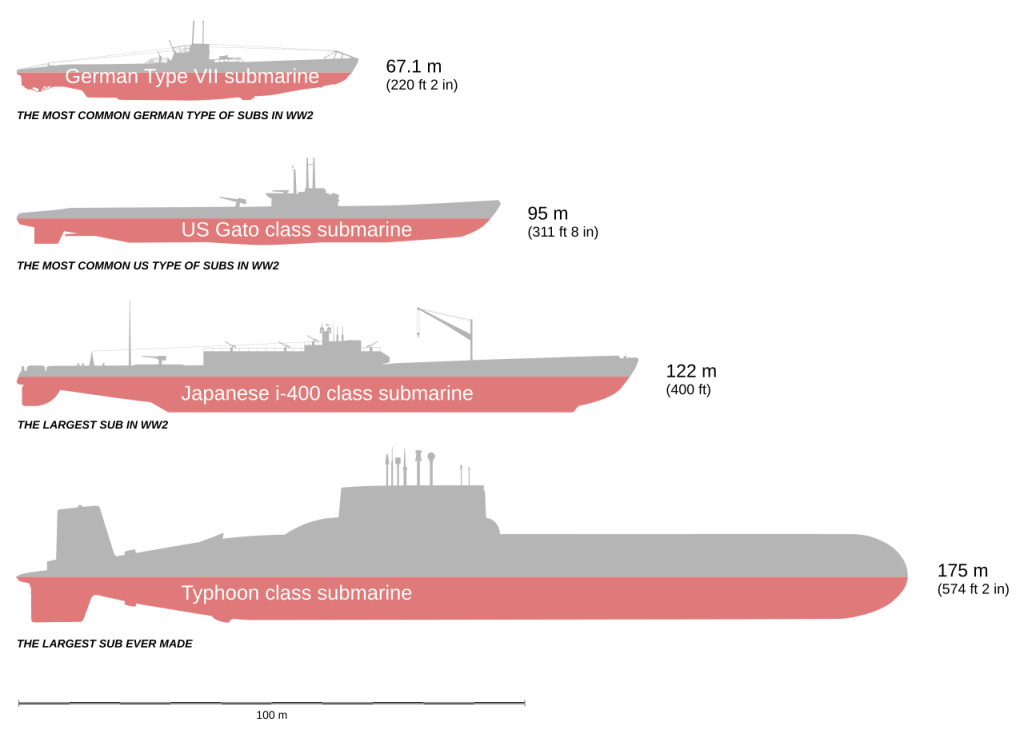
The Typhoon-class submarines have an impressive submerged displacement of 48,000 tonnes, which dwarfs any other submarine ever built. These submarines were designed to operate in harsh conditions and remain submerged for up to 120 days, providing comfortable living conditions for their crew of 160 personnel. With a length of 175 meters and a width of 23 meters, the Typhoon-class is more akin to a moving fortress than a traditional submarine.
Design and Armament
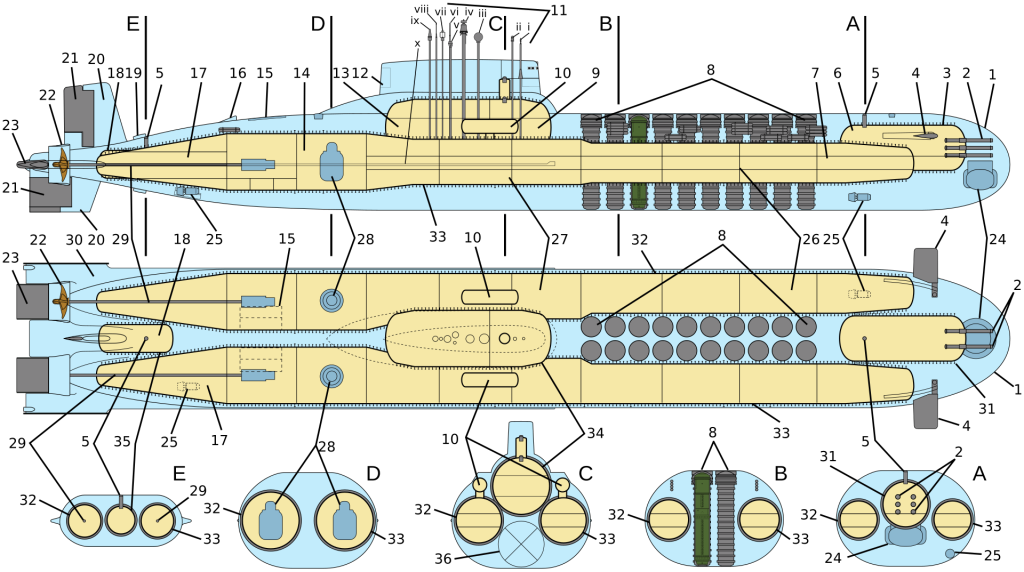
The Typhoon class features a unique design with multiple pressure hulls, giving the submarine superior survivability compared to other submarine designs. This design consists of two long parallel pressure hulls and three smaller pressure hulls, which provide additional structural strength and operational safety. If one hull is compromised, the others remain intact, preventing flooding and keeping the crew safe.
Primary Weaponry
The Typhoon-class was armed with 20 R-39 Rif (NATO designation: SS-N-20 Sturgeon) submarine-launched ballistic missiles (SLBMs). Each R-39 could carry up to 10 MIRV nuclear warheads, giving each submarine the capability to launch 200 nuclear warheads. These missiles had an incredible range and could be launched even while the submarine was moored at its home port.
In addition to the ballistic missiles, the Typhoon-class was equipped with six torpedo tubes capable of firing RPK-2 Vyuga (SS-N-15) missiles or Type 53 torpedoes.
Soviet Engineering Marvel
Developed under Project 941, the Typhoon-class was a testament to Soviet engineering and strategic vision. It was designed to counter the U.S. Navy’s Ohio-class submarines, which were capable of carrying 192 nuclear warheads. To achieve similar capabilities, the Soviet Union needed to build a submarine with significantly larger SLBMs, as their missiles were nearly twice as heavy as their American counterparts. The increased size of the missiles required a submarine large enough to carry them, resulting in the Typhoon-class’s massive size.
Ice Operations and Polar Missions
The Typhoon-class was specifically designed to operate in Arctic waters, navigating under polar ice. The submarine featured reinforced protrusions on the hull to prevent ice from damaging its propellers. This feature allowed it to break through ice when necessary and conduct missile launches from remote and ice-covered regions, giving it an operational advantage in strategic deterrence.
Comfortable Living Quarters
Unlike many other submarines of its era, the Typhoon-class offered relatively comfortable accommodations for its crew. The design included dedicated living spaces, including a gym, swimming pool, and a sauna. These facilities were intended to maintain crew morale during long missions that could last several months.
Operational History and Decommissioning
Six Typhoon-class submarines were built between 1976 and 1985. Their large size and operational capabilities made them ideal for Cold War strategic patrols, but by the early 1990s, the dissolution of the Soviet Union and budget constraints led to the gradual decommissioning of the class.
Modernization and Cancellation
In 2012, the Russian Navy canceled plans to modernize the Typhoon-class submarines, as the cost of upgrading one Typhoon would have been equivalent to building two new Borei-class submarines. The Borei-class is a more modern and cost-effective solution to Russia’s strategic nuclear deterrence needs.
As a result, most Typhoon-class submarines were decommissioned and scrapped by the early 2000s. The last remaining active Typhoon, the Dmitriy Donskoy (TK-208), was used for testing the RSM-56 Bulava SLBM system until its decommissioning in February 2023.
A Historical Perspective
The Typhoon-class submarines will always be remembered as some of the most iconic vessels of the Cold War era. They were seen as symbols of Soviet naval power, and their sheer size and power made them formidable adversaries for NATO forces.
Legacy and Cultural Influence
The Typhoon-class submarines have captured the public’s imagination, most notably featured in the novel and film “The Hunt for Red October” by Tom Clancy, where a fictional Typhoon-class submarine equipped with a stealth propulsion system became the focus of a geopolitical thriller.
In the documentary world, the Typhoon-class was also featured in National Geographic’s “Break It Down”, where they documented the scrapping of one of these submarines. This showcased not only the impressive engineering but also the challenges involved in dismantling such a large vessel.
Conclusion
The Typhoon-class submarine remains a symbol of Cold War engineering prowess and strategic military planning. Designed for long-distance nuclear deterrence missions, these submarines were the backbone of the Soviet Union’s strategic naval force. While their time in active service has come to an end, their legacy continues to inspire fascination in naval technology and Cold War history.
With their massive size, technological advancements, and strategic importance, the Typhoon-class submarines remain some of the most iconic vessels ever constructed.
Contact Information:
For more detailed information on Typhoon-class submarines and their legacy, visit Russian Navy Official Website.