


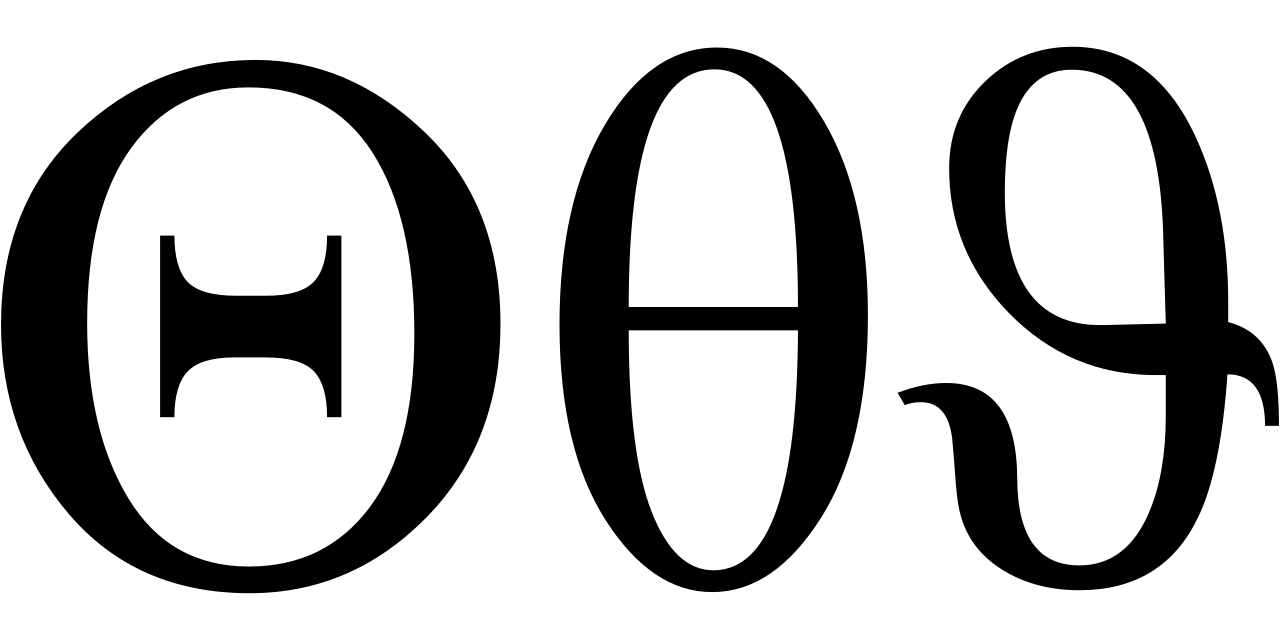
Theta (uppercase Θ, lowercase θ) is the eighth letter of the Greek alphabet, derived from the Phoenician letter Teth (𐤈). In the Greek numeral system, Theta represents the value 9. The letter has played a crucial role in language, mathematics, science, and symbolism for over two millennia.
In Ancient Greek, θ represented the aspirated voiceless dental plosive [t̪ʰ], while in Modern Greek, it denotes the voiceless dental fricative [θ], as in the English words thin or theory.
Forms and Typography
In its archaic form, Theta appeared as a cross within a circle, similar to certain Etruscan symbols. Over time, it evolved into a line or dot enclosed in a circle.
Modern typography recognizes two lowercase variants:
- The barred theta (θ) – resembling a zero with a horizontal line through it.
- The open-loop theta (ϑ) – a cursive form used primarily in mathematical and scientific notation.
Unicode distinguishes between these styles with specific codes:
- U+03B8 (θ): Greek small letter theta
- U+03D1 (ϑ): Greek theta symbol (open form)
- U+0398 (Θ): Greek capital letter theta
Historical and Linguistic Influence
In Latin, Theta influenced several special letters, notably the tau gallicum (Ꟈ, ꟈ) used in Gaulish inscriptions to represent the affricate [t͡s].
In Cyrillic, the letter evolved into Fita (Ѳ, ѳ), which remained in Russian orthography until the 1918 reform.
In the International Phonetic Alphabet (IPA), the symbol [θ] denotes the voiceless dental fricative (as in thin), while [ð]—represented by “eth”—is its voiced counterpart (as in this). A related symbol, [ɵ], represents the close-mid central rounded vowel.
Scientific and Mathematical Usage
The letter Theta (θ, Θ) is widely used as a symbol across multiple scientific fields:
Lowercase θ
- Represents a plane angle in geometry and trigonometry
- Denotes angular displacement or separation in physics
- Symbolizes the potential temperature in meteorology
- Defines the first Chebyshev function in prime number theory
- Represents the fraction of ligand bound in pharmacology
- Used in item response theory as a measure of test-taker ability
- Serves as the threshold value in artificial neural networks
- Indicates an incident angle in X-ray diffraction
Uppercase Θ
- Used in Big Theta (Θ) notation for algorithmic complexity
- Represents the dimension of temperature in SI notation
- Denotes theta functions in mathematics and complex analysis
- Serves as a variable for time decay (in finance options “Greeks”)
- Marks brainwave frequencies (4–8 Hz) in neuroscience
- Represents a symbol for pentaquarks in particle physics
Symbolism and Cultural Significance
In ancient symbolism, Theta (θ) carried associations with death. The letter was used as an abbreviation for Thanatos (θάνατος), meaning “death.”
On Athenian ostraka (potsherds used for voting on executions), Theta marked names of those condemned. Its circular form with a central bar or dot was thought to resemble a human skull, leading to its enduring use as a symbol of mortality—a precursor to the modern skull-and-crossbones motif.
Ancient authors, including Porphyry and Johannes Lydus, noted its spiritual associations with the soul and cosmic order, particularly among Egyptians, who viewed it as a symbol of the universe and divine energy.
Modern Symbolism
Beyond its linguistic and academic roles, Theta remains a powerful icon in culture, design, and symbolism. In mysticism and philosophy, it continues to represent infinity, spirit, and cyclical balance, reflecting its historical ties to life and death.


