


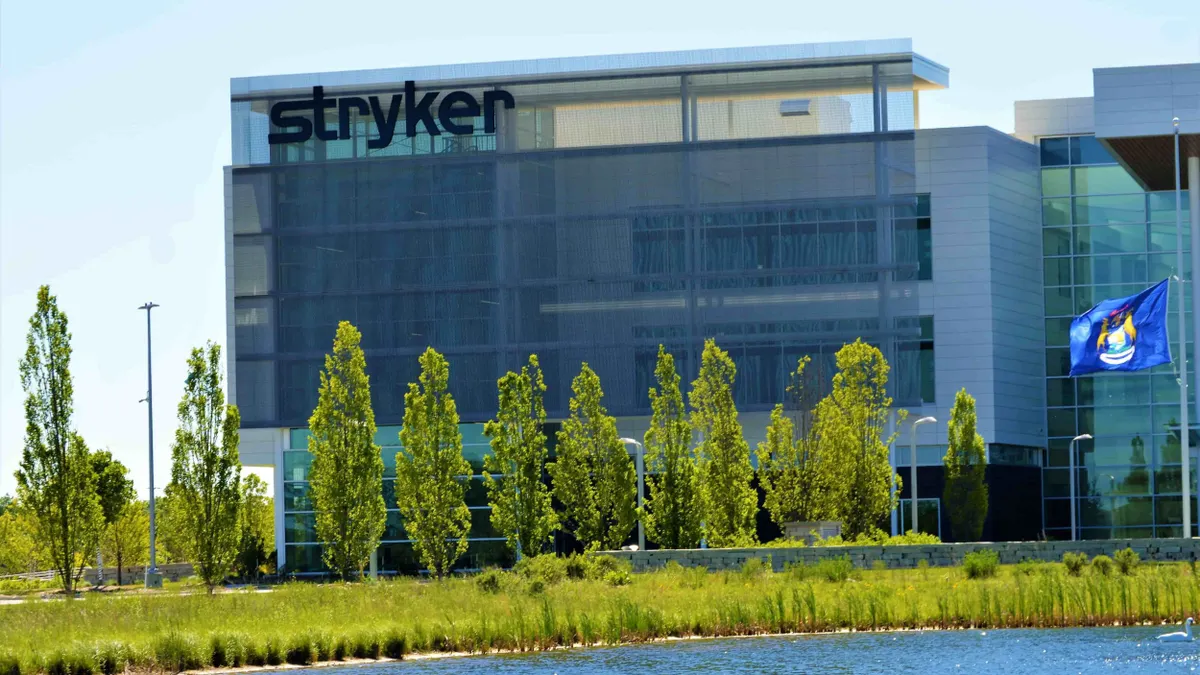
Stryker acquisitions show how one of the world’s leading medical technology companies has expanded from its historic strength in orthopaedics into a broader portfolio covering surgical technology, robotic-assisted surgery, emergency care, imaging, patient safety, spine, ENT, extremities, hospital communication, and peripheral vascular intervention.
From 2011 to 2025, Stryker completed 18 acquisitions with a total disclosed deal value of about $22.7 billion and an average disclosed deal size of roughly $1.3 billion. Its M&A activity has focused heavily on health care, biotechnology, medical technology, manufacturing, and medical devices.
That concentration reflects Stryker’s core business. The company does not use acquisitions to move far outside healthcare. Instead, it buys businesses that deepen its position in procedure-based markets, improve its hospital relationships, expand its product lines, and strengthen its role in operating rooms, emergency settings, specialist clinics, and interventional care.
The most recent acquisition, Inari Medical, marked an important step into peripheral vascular intervention. The deal gave Stryker an established position in venous thromboembolism clot removal and expanded its reach beyond traditional orthopaedics and surgical devices.
What Is Stryker?
Stryker is a medical technology company that provides products and services across orthopaedics, medical and surgical equipment, neurotechnology, spine, emergency care, and related healthcare markets.
Its products are used by surgeons, hospitals, emergency medical teams, nurses, specialists, and care providers. Stryker is especially known for orthopaedic implants, surgical equipment, hospital products, robotic-assisted surgical technology, emergency response devices, and medical systems that support patient care.
The company operates in markets where reliability, clinical evidence, surgeon adoption, regulatory clearance, and hospital relationships matter. That makes M&A particularly useful. A smaller medical device company may develop a strong technology, but Stryker can often provide global distribution, manufacturing support, clinical training, and commercial scale.
Why Stryker Acquisitions Matter
Stryker acquisitions matter because they reveal how the company has built a broader medical technology platform while staying close to its healthcare roots.
In medtech, innovation often begins at smaller specialist companies. These companies may create a new surgical device, imaging system, communication platform, implant, or minimally invasive therapy. A large medical technology company can then acquire that innovation and scale it across hospitals and healthcare systems.
Stryker’s deal history shows that strategy clearly.
MAKO Surgical gave Stryker robotic-arm assisted surgery in orthopaedics. Wright Medical strengthened extremities and biologics. Physio-Control expanded emergency response. Vocera added healthcare communication systems. Inari Medical added peripheral vascular technology. Mobius Imaging, Novadaq, Invuity, and OrthoSpace expanded imaging, visualization, and surgical solutions.
The result is a company that has used acquisitions to build depth around high-value clinical workflows.
Full List of Stryker Acquisitions
| Acquiree | Announced Date | Price | Main Category | Strategic Value |
|---|---|---|---|---|
| Inari Medical | Jan 6, 2025 | $4.9B | Medical Device and Biotechnology | Adds peripheral vascular intervention and venous thromboembolism clot-removal technology. |
| Vocera Communications | Jan 6, 2022 | $3.1B | Healthcare Communication | Adds communication systems for healthcare professionals and patients. |
| Wright Medical Group | Nov 4, 2019 | $4.0B | Orthopaedics and Biologics | Expands extremities, biologics, and orthopaedic device portfolio. |
| Mobius Imaging | Oct 21, 2019 | $500.0M | Medical Imaging | Adds mobile computed tomography and imaging solutions. |
| OrthoSpace | Mar 3, 2019 | $220.0M | Orthopaedic Devices | Adds biodegradable balloon systems for orthopaedic procedures. |
| HyperBranch Medical Technology | Oct 1, 2018 | $220.0M | Surgical Wound Technology | Adds products for traumatic and surgically induced wounds. |
| Invuity | Sep 11, 2018 | $190.0M | Surgical Visualization | Adds illumination and visualization products for minimally invasive surgery. |
| K2M | Aug 30, 2018 | $1.4B | Spine Technology | Adds spine technologies, techniques, and related medical devices. |
| Entellus Medical | Dec 7, 2017 | $662.0M | ENT Medical Technology | Adds treatment solutions for ear, nose, and throat physicians. |
| Vexim | Oct 24, 2017 | $216.0M | Spine and Fracture Solutions | Adds vertebral compression fracture treatment solutions. |
| Novadaq Technologies | Jun 19, 2017 | $701.0M | Fluorescence Imaging | Adds clinically relevant fluorescence imaging for operating rooms and clinics. |
| Stanmore Implants Worldwide | Apr 29, 2016 | $52.2M | Orthopaedic Implants | Adds bespoke and modular implants for complex joint reconstruction. |
| Physio-Control | Feb 16, 2016 | $1.3B | Emergency Care | Adds acute cardiac care tools and emergency response solutions. |
| Sage Products | Feb 1, 2016 | $2.8B | Healthcare Products | Adds products that support patient care and hospital safety. |
| Small Bone Innovations | Jun 30, 2014 | $375.0M | Orthopaedic Devices | Adds devices for small bones, joints, trauma, and arthroplasty. |
| Patient Safety Technologies | Dec 31, 2013 | $120.0M | Patient Safety | Adds products and services for medical patient safety markets. |
| MAKO Surgical | Sep 25, 2013 | $1.6B | Robotic Surgery | Adds robotic-arm assisted surgery in orthopaedics. |
| Orthovita | May 16, 2011 | $316.0M | Orthobiologics | Adds spine and orthopaedic biosurgery products. |
Stryker Acquisitions Timeline
2011: Orthobiologics and Spine Biosurgery
Stryker acquired Orthovita in 2011 for $316.0 million. Orthovita was a spine and orthopaedic biosurgery company that manufactured and marketed orthobiologic and biosurgery products.
This acquisition fit Stryker’s core orthopaedic identity. Orthobiologics can support bone healing, spine surgery, and related procedures, making the deal a natural addition to Stryker’s surgical and orthopaedic portfolio.
2013: Patient Safety and Robotic Surgery
In 2013, Stryker acquired Patient Safety Technologies and MAKO Surgical.
Patient Safety Technologies added products and services for medical patient safety markets. MAKO Surgical was the more transformative deal. Acquired for $1.6 billion, MAKO specialized in robotic-arm assisted surgery in orthopaedics.
The MAKO acquisition became one of Stryker’s most important strategic moves. Robotic-assisted surgery later became a major growth area in orthopaedics, helping surgeons plan and perform procedures with greater precision.
2014: Small Bone and Joint Devices
Stryker acquired Small Bone Innovations in 2014 for $375.0 million. The company made devices for small bones and joints, with focus on trauma and arthroplasty.
This deal expanded Stryker’s orthopaedic portfolio into specialized extremities and smaller joint markets. These areas can be attractive because they serve specific surgeon needs and can complement broader implant offerings.
2016: Emergency Care, Hospital Products, and Complex Implants
Stryker made several notable acquisitions in 2016, including Sage Products, Physio-Control, and Stanmore Implants Worldwide.
Sage Products, acquired for $2.8 billion, expanded Stryker’s hospital product offering. Physio-Control, acquired for $1.3 billion, added acute cardiac care tools and emergency response solutions. Stanmore Implants Worldwide added bespoke and modular implants for complex joint replacement and limb-sparing procedures.
This year showed Stryker expanding beyond orthopaedic implants into broader hospital care, emergency medicine, and specialized reconstruction.
2017: Imaging, Spine, and ENT
In 2017, Stryker acquired Novadaq Technologies, Vexim, and Entellus Medical.
Novadaq added fluorescence imaging used in operating rooms and clinics. Vexim added vertebral compression fracture solutions. Entellus Medical added technology-based treatment solutions for ENT physicians.
These acquisitions strengthened Stryker’s presence in procedure-based specialties. They also show how the company has expanded by buying technologies that improve surgical visualization, spine treatment, and specialist workflows.
2018: Spine, Visualization, and Wound Technology
Stryker acquired K2M, Invuity, and HyperBranch Medical Technology in 2018.
K2M, acquired for $1.4 billion, strengthened Stryker’s spine technology portfolio. Invuity added illumination and visualization products for minimally invasive surgical fields. HyperBranch added products for traumatic or surgically induced wounds.
Together, these deals expanded Stryker’s spine, surgical, and operating-room technology capabilities.
2019: Extremities, Biologics, Imaging, and Orthopaedic Devices
In 2019, Stryker acquired OrthoSpace, Mobius Imaging, and Wright Medical Group.
OrthoSpace added biodegradable balloon systems for orthopaedic procedures. Mobius Imaging added mobile CT and medical imaging solutions. Wright Medical Group, acquired for $4.0 billion, was one of Stryker’s largest deals and significantly expanded its extremities and biologics business.
The Wright Medical acquisition strengthened Stryker in upper and lower extremities, giving it a larger presence in specialized orthopaedic markets.
2022: Healthcare Communication With Vocera
Stryker acquired Vocera Communications in 2022 for $3.1 billion. Vocera provided communication systems and solutions for healthcare professionals and patients.
This acquisition moved Stryker deeper into healthcare communication and digital workflow. Hospitals need better coordination among nurses, doctors, patients, and care teams. Vocera helped Stryker address that need.
2025: Inari Medical and Peripheral Vascular Intervention
Stryker announced the acquisition of Inari Medical in January 2025 for approximately $4.9 billion and completed the acquisition in February 2025. Inari provides solutions for venous thromboembolism clot removal without the use of thrombolytic drugs. The deal gave Stryker an established position in the fast-growing peripheral vascular segment. (stryker.com)
This acquisition is significant because it expands Stryker into a new high-growth area adjacent to its existing neurovascular and interventional capabilities.
Biggest Stryker Acquisitions by Deal Value
| Rank | Acquiree | Announced Date | Deal Value | Strategic Area |
| 1 | Inari Medical | Jan 6, 2025 | $4.9B | Peripheral vascular intervention |
| 2 | Wright Medical Group | Nov 4, 2019 | $4.0B | Extremities and biologics |
| 3 | Vocera Communications | Jan 6, 2022 | $3.1B | Healthcare communication |
| 4 | Sage Products | Feb 1, 2016 | $2.8B | Hospital products and patient care |
| 5 | MAKO Surgical | Sep 25, 2013 | $1.6B | Robotic orthopaedic surgery |
| 6 | K2M | Aug 30, 2018 | $1.4B | Spine technology |
| 7 | Physio-Control | Feb 16, 2016 | $1.3B | Emergency response and cardiac care |
| 8 | Novadaq Technologies | Jun 19, 2017 | $701.0M | Fluorescence imaging |
| 9 | Entellus Medical | Dec 7, 2017 | $662.0M | ENT treatment solutions |
| 10 | Mobius Imaging | Oct 21, 2019 | $500.0M | Mobile CT and imaging |
The largest deals show Stryker’s willingness to invest heavily when a target gives it leadership or access to an attractive procedure-based market.
Most Common Acquisition Categories
| Category | Number of Deals | Strategic Meaning |
| Health Care | 17 | Core operating market across hospitals, specialists, surgery, and patient care. |
| Biotechnology | 10 | Adds advanced therapeutic and medical device innovation. |
| Medical | 7 | Expands clinical technology and patient treatment capabilities. |
| Manufacturing | 6 | Supports device production, implants, and hospital products. |
| Medical Device | 4 | Strengthens procedure-based product portfolio. |
This category mix shows that Stryker’s acquisitions are highly focused. Nearly every listed acquisition supports healthcare delivery, clinical procedures, patient care, or medical technology.
Strategic Lessons From Stryker Acquisitions
Procedure-Based Markets Create Durable Demand
Many Stryker acquisitions serve specific procedures, such as orthopaedic surgery, spine treatment, ENT interventions, imaging-guided surgery, vascular intervention, and emergency response.
These markets can be attractive because surgeons and hospitals need reliable tools that improve outcomes and workflow.
Robotic Surgery Can Reshape a Category
MAKO Surgical showed how a single acquisition can reshape a company’s competitive position. Robotic-assisted orthopaedics became an important part of Stryker’s growth story.
Hospital Workflow Is Now Strategic
Vocera shows that medical technology is not only about implants and instruments. Communication, coordination, and workflow also matter in modern healthcare.
Specialist Markets Can Be Valuable
Deals such as Wright Medical, Entellus, K2M, OrthoSpace, and Inari show how specialist markets can create strong medtech opportunities.
Scale Helps Commercialization
Stryker can take acquired technologies and scale them through its sales teams, hospital relationships, clinical training programs, and global distribution.
How Stryker Acquisitions Fit Its Business Model
Stryker’s business model depends on selling medical devices, equipment, implants, and healthcare technologies to hospitals, surgeons, emergency care providers, and specialist physicians.
Acquisitions fit this model because they add products that can be sold into existing healthcare channels. They also help Stryker expand into adjacent procedure categories.
For example, MAKO strengthened robotic-assisted orthopaedics. Wright Medical expanded extremities. K2M expanded spine. Inari Medical added peripheral vascular care. Vocera added hospital communication. Physio-Control added emergency response.
These acquisitions allow Stryker to serve more parts of the patient care journey, from emergency response to surgery, imaging, recovery, and clinical communication.
Financial and Ownership Context
Stryker completed 18 acquisitions from 2011 to 2025 with total disclosed deal value of about $22.7 billion. The average disclosed deal size was approximately $1.3 billion.
This reflects a steady pattern of significant medtech dealmaking. Stryker has not only made small technology purchases. It has also made large strategic acquisitions, including Inari Medical, Wright Medical Group, Vocera Communications, Sage Products, MAKO Surgical, K2M, and Physio-Control.
The Inari deal was funded through an all-cash offer of $80 per share, representing about $4.9 billion in fully diluted equity value. Stryker completed the acquisition on February 19, 2025. (stryker.com)
Competitive Impact of Stryker Acquisitions
Stryker competes with other large medical technology companies across orthopaedics, surgical devices, emergency care, spine, neurotechnology, medical equipment, and hospital products.
Its acquisitions strengthen its competitive position in several ways.
MAKO gave Stryker a major robotic surgery platform. Wright Medical strengthened extremities and biologics. K2M improved spine capabilities. Physio-Control expanded emergency care. Vocera added healthcare communications. Inari Medical gave Stryker an entry point into peripheral vascular intervention and venous thromboembolism treatment.
These deals help Stryker compete not only on product breadth, but also on workflow integration. The company can offer hospitals and surgeons a wider portfolio across multiple clinical settings.
However, competition in medtech is intense. Rival companies also acquire innovative device makers, invest in robotics, and pursue specialist procedure markets. Stryker must integrate acquisitions well to keep its advantage.
Advantages of the Acquisition Strategy
Faster Entry Into High-Growth Markets
Acquisitions allow Stryker to enter or expand in attractive markets such as robotic surgery, extremities, spine, emergency care, healthcare communication, and peripheral vascular intervention.
Stronger Product Portfolio
Each acquisition adds new products, technologies, or clinical capabilities to Stryker’s platform.
Better Surgeon and Hospital Relationships
A broader portfolio gives Stryker more touchpoints with hospitals, surgeons, nurses, emergency teams, and specialist physicians.
Global Commercial Scale
Stryker can use its distribution and sales infrastructure to scale acquired products more widely.
Innovation Without Starting From Zero
Instead of developing every technology internally, Stryker can acquire companies that have already built promising products or platforms.
Disadvantages of the Acquisition Strategy
Integration Risk
Medical technology acquisitions require integration across regulatory systems, quality controls, manufacturing, sales teams, clinical training, and product roadmaps.
High Purchase Prices
Large medtech deals can be expensive. If growth disappoints, returns may fall short.
Regulatory Complexity
Medical devices and healthcare technologies must meet strict regulatory and quality requirements.
Clinical Adoption Risk
A product may be technically strong but still require physician training, reimbursement support, and hospital adoption.
Portfolio Complexity
As Stryker expands into more categories, it must manage a broader and more complex medical technology portfolio.
Case Studies of Major Stryker Acquisitions
Inari Medical
Inari Medical is Stryker’s largest listed acquisition at about $4.9 billion. The company provides technology for venous thromboembolism clot removal without the use of thrombolytic drugs.
The deal gives Stryker an established position in peripheral vascular intervention. It also expands the company into a fast-growing VTE segment, adding a new growth platform beyond its traditional orthopaedic and surgical strengths. (stryker.com)
Wright Medical Group
Wright Medical Group was acquired for $4.0 billion. The company specialized in extremities and biologics.
This acquisition strengthened Stryker’s position in specialized orthopaedic markets, especially upper and lower extremities. It also expanded Stryker’s biologics capabilities.
MAKO Surgical
MAKO Surgical was acquired for $1.6 billion in 2013. It specialized in robotic-arm assisted orthopaedic surgery.
This acquisition became one of Stryker’s defining strategic moves. Robotic-assisted surgery helped differentiate the company in orthopaedics and gave surgeons a technology platform linked to planning, precision, and implant placement.
Vocera Communications
Vocera Communications was acquired for $3.1 billion in 2022. It provided healthcare communication systems for professionals and patients.
The acquisition expanded Stryker into hospital communication and care-team coordination. It reflects the growing importance of digital workflow inside healthcare settings.
Physio-Control
Physio-Control was acquired for $1.3 billion in 2016. It designed and manufactured acute cardiac care tools for emergency response.
The deal strengthened Stryker’s emergency care portfolio and expanded its role beyond operating rooms and orthopaedic procedures.
Common Mistakes When Analyzing Stryker Acquisitions
Seeing Stryker Only as an Orthopaedics Company
Orthopaedics remains central, but Stryker acquisitions show a broader strategy across emergency care, imaging, communication, spine, ENT, patient safety, and vascular intervention.
Ignoring Robotic Surgery
MAKO Surgical was a major strategic acquisition. Any analysis of Stryker’s M&A history should treat robotics as a key turning point.
Treating All Medtech Deals the Same
A spine acquisition, emergency care deal, imaging company, and vascular intervention platform have different economics, risks, and growth drivers.
Overlooking Clinical Adoption
Acquired devices must be adopted by physicians and hospitals. Technology alone does not guarantee success.
Focusing Only on Deal Size
Large deals matter, but smaller acquisitions can add important specialized capabilities.
Lessons for Business Owners and Investors
Stryker’s acquisition history offers several lessons.
First, focused M&A can strengthen a company without diluting its identity. Stryker stayed close to healthcare and medical technology.
Second, procedure-based markets can be attractive because they are tied to real clinical workflows and recurring hospital needs.
Third, robotics and digital workflow can transform traditional device categories. MAKO and Vocera show this clearly.
Fourth, specialist medtech companies can become valuable acquisition targets when they solve important clinical problems.
Finally, acquisition success depends on execution. Regulatory compliance, manufacturing quality, surgeon training, hospital adoption, and integration all determine long-term value.
Key Takeaways
- Stryker completed 18 acquisitions from 2011 to 2025.
- Total disclosed deal value is about $22.7 billion.
- The average disclosed acquisition size is approximately $1.3 billion.
- Stryker acquisitions focus mainly on health care, biotechnology, medical technology, manufacturing, and medical devices.
- Inari Medical is the largest listed Stryker acquisition at about $4.9 billion.
- Wright Medical Group strengthened extremities and biologics.
- MAKO Surgical gave Stryker a major robotic-assisted orthopaedic surgery platform.
- Vocera Communications expanded Stryker into healthcare communication systems.
- Physio-Control strengthened emergency care.
- K2M expanded spine technology capabilities.
- Stryker’s acquisition strategy supports a broader procedure-based medtech platform.
- The main risks include integration complexity, high valuations, regulatory requirements, clinical adoption, and portfolio complexity.
Frequently Asked Questions
What are Stryker acquisitions?
Stryker acquisitions are companies bought by Stryker to expand its medical technology, orthopaedics, surgical, imaging, emergency care, communication, spine, and vascular intervention portfolio.
How many acquisitions has Stryker made?
Stryker has made 18 acquisitions from 2011 to 2025.
What is the total value of Stryker acquisitions?
The total disclosed value of Stryker acquisitions is about $22.7 billion.
What is Stryker’s average acquisition size?
Stryker’s average disclosed acquisition size is approximately $1.3 billion.
What is Stryker’s biggest listed acquisition?
Inari Medical is the largest listed Stryker acquisition, valued at about $4.9 billion.
What was Stryker’s most recent acquisition?
Stryker’s most recent listed acquisition is Inari Medical, announced in January 2025 and completed in February 2025.
Why did Stryker acquire Inari Medical?
Stryker acquired Inari Medical to enter the peripheral vascular segment and expand into venous thromboembolism clot-removal technology.
Why was MAKO Surgical important to Stryker?
MAKO Surgical gave Stryker robotic-arm assisted surgery technology, which became a major differentiator in orthopaedics.
Which sectors dominate Stryker acquisitions?
The most common sectors are health care, biotechnology, medical technology, manufacturing, and medical devices.
What are the risks of Stryker’s acquisition strategy?
The main risks include integration complexity, high deal prices, regulatory requirements, physician adoption, reimbursement uncertainty, and portfolio complexity.
Conclusion
Stryker acquisitions show how a medical technology leader has used M&A to expand from orthopaedics into a wider healthcare platform. Across 18 acquisitions from 2011 to 2025, Stryker added capabilities in orthobiologics, robotic surgery, patient safety, emergency care, hospital products, imaging, spine, ENT, surgical visualization, wound technology, healthcare communication, extremities, biologics, and peripheral vascular intervention.
The company’s largest deals tell the story clearly. Inari Medical added vascular intervention. Wright Medical strengthened extremities. Vocera added hospital communication. Sage Products expanded hospital care. MAKO Surgical gave Stryker a robotics platform that reshaped its orthopaedic strategy.
The benefits are significant. Stryker gains access to innovative technologies, specialist markets, and broader hospital relationships. But the risks are equally real. Medical technology acquisitions require disciplined integration, clinical adoption, regulatory compliance, quality control, and long-term execution.
For investors, healthcare leaders, and business analysts, Stryker acquisitions offer a clear example of focused medtech M&A. The company has not chased unrelated diversification. It has used acquisitions to build around clinical workflows, procedure-based markets, and technologies that can improve how care is delivered.
Disclaimer: This article is for informational and educational purposes only. It is not investment advice, financial advice, medical advice, or a recommendation to buy or sell any security. Always conduct your own research and consider speaking with a qualified financial adviser before making investment decisions.
Read Also: Stripe Acquisitions: How Stripe Built Its Business Through M&A


