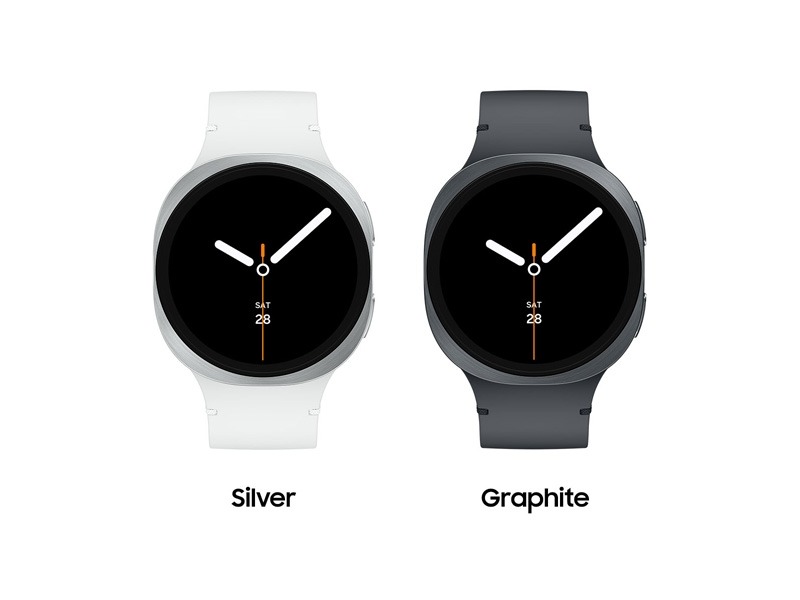
The Galaxy Watch8 Specs reveal a smartwatch designed to balance performance, durability, and everyday usability. Released on July 25, the device arrives in two sizes, 44mm and 40mm, giving users flexibility without compromising features. Samsung continues refining its smartwatch formula by combining Wear OS 6 with One UI 8 Watch, ensuring access to both Google services and Samsung’s ecosystem tools.
The Galaxy Watch8 Specs emphasize efficiency and clarity. A Super AMOLED display reaches up to 3000 nits peak brightness, which significantly improves outdoor visibility. Additionally, the Exynos W1000 chipset built on a 3nm process delivers smoother performance while improving energy efficiency.
Unlike the Classic model, the Galaxy Watch8 adopts a lighter aluminum frame. However, it still maintains IP68 water resistance and 5ATM certification. As a result, the watch remains suitable for workouts, swimming, and daily wear. Below is a complete technical breakdown.
Samsung Galaxy Watch8 Specifications Table
| Category | Specifications |
|---|---|
| Device Name | Samsung Galaxy Watch8 |
| Versions | 44mm (34g), 40mm (30g) |
| Release Date | July 25 |
| Thickness | 8.6 mm |
| Build | Sapphire crystal front, Armor Aluminum 2 frame |
| Durability | IP68, 5ATM, MIL-STD-810H |
| Display Type | Super AMOLED |
| Display Size | 1.47 inches |
| Resolution | 480 x 480 pixels (~327 ppi) |
| Peak Brightness | 3000 nits |
| Operating System | Android Wear OS 6 |
| Interface | One UI 8 Watch |
| Chipset | Exynos W1000 (3nm) |
| CPU | Penta-core |
| GPU | Mali-G68 |
| RAM | 2GB |
| Internal Storage | 32GB |
| Connectivity | Bluetooth 5.3, Wi-Fi dual-band |
| Positioning | GPS (L1+L5), GLONASS, GALILEO, BDS |
| NFC | Yes |
| SIM | eSIM (LTE model only) |
| Battery | 435mAh |
| Charging | 10W wireless |
| Health Sensors | Heart rate, ECG, SpO2, temperature, BioActive, antioxidant index |
| Colors | Graphite, Silver |
| Models | SM-L320, SM-L325, SM-L330, SM-L335 |
| Starting Price | $289.99 |
Galaxy Watch8 Specs – Display and Build Quality
The Galaxy Watch8 Specs include a 1.47-inch Super AMOLED display with a 480 x 480 resolution. Because of its 3000-nit peak brightness, the screen remains readable in strong daylight. Sapphire crystal protection improves scratch resistance, which is important for a wearable device exposed to daily contact.
Moreover, the aluminum frame keeps weight low. The 44mm version weighs 34 grams, while the 40mm model weighs just 30 grams. Despite the lighter build, the watch maintains 5ATM water resistance and IP68 dust protection.
Galaxy Watch8 Specs – Performance and Software
Performance improvements come from the Exynos W1000 chipset. Built on a 3nm process, it enhances processing speed while maintaining battery efficiency. The penta-core CPU works alongside 2GB RAM and 32GB storage, allowing smooth multitasking and app performance.
Wear OS 6 provides access to Google Maps, Google Wallet, and Play Store applications. Meanwhile, One UI 8 Watch refines the user interface with Samsung’s visual style and fitness integration. Therefore, the Galaxy Watch8 Specs support both productivity and lifestyle needs.
Galaxy Watch8 Specs – Health and Fitness Features
Health tracking remains central to the Galaxy Watch8 Specs. The BioActive sensor measures heart rate, blood oxygen, and skin temperature. In supported regions, ECG and blood pressure monitoring are available.
Dual-band GPS improves route tracking accuracy, especially in urban environments. Additionally, the antioxidant index introduces an extra wellness metric, supporting broader health insights.
Galaxy Watch8 Specs – Battery and Connectivity
The 435mAh battery supports wireless charging at 10W. Although compact, the watch balances power consumption through chipset efficiency and display optimization.
Connectivity includes Bluetooth 5.3, Wi-Fi dual-band, NFC, and optional LTE via eSIM. Consequently, users can stream music, make calls, or receive notifications independently of their smartphone.
Overall, the Galaxy Watch8 Specs present a lightweight smartwatch with high-brightness display performance, reliable chipset efficiency, and comprehensive health monitoring within a durable yet comfortable design.