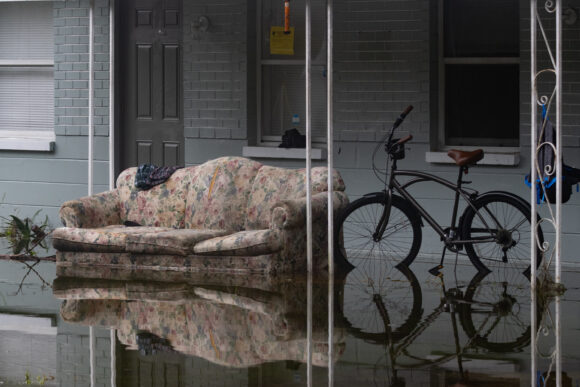
Rising flood insurance premiums are pushing lower-income Americans out of the nation’s primary flood coverage program, leaving millions of households increasingly exposed to climate-driven disasters, according to new academic research.
A study published this week in the Journal of Catastrophe Risk and Resilience finds that reforms to the U.S. National Flood Insurance Program led to a measurable drop in coverage among homeowners facing the largest rate hikes, with poorer communities hit the hardest.
FEMA’s Risk Rating 2.0 and Its Consequences
In 2021, Federal Emergency Management Agency overhauled pricing for the National Flood Insurance Program through a reform known as Risk Rating 2.0. The goal was to correct decades of underpricing and align premiums with actual, property-level flood risk—much of it amplified by climate change.
The reform replaced broad flood-zone pricing with industry-standard catastrophe models that account for factors such as distance to water, elevation, and rebuilding costs. While some homeowners saw premiums fall, many others faced annual increases capped at 18% until they reached full risk-based rates. New policyholders were required to pay full rates immediately.
Critics warned that higher, more accurate prices could make coverage unaffordable for vulnerable households. The new research suggests those concerns were well-founded.
Study Finds Drop in Coverage Among High-Risk Households
The paper estimates that up to 13% of homeowners facing the largest premium increases dropped their flood insurance policies following the reform.
“Risk Rating 2.0 was designed so that flood insurance pricing could reflect property-specific flood risks,” said lead author Jesse Gourevitch, an economist at the Environmental Defense Fund. “Our findings show that rising premiums are also driving many households—especially those with lower incomes—to forgo NFIP coverage.”
The study did not assess whether homeowners who exited the program obtained private flood insurance instead.
Why NFIP Matters So Much
Most standard U.S. homeowners insurance policies do not cover flood damage. The federally subsidized NFIP accounts for nearly 90% of residential flood insurance coverage nationwide. Created in the 1960s, the program was intended to make flood insurance affordable while discouraging risky development.
However, years of below-market pricing left the program with roughly $20 billion in debt to the U.S. Treasury, while failing to halt construction in flood-prone areas.
Flood Insurance Coverage Already in Decline
NFIP enrollment peaked in 2009 at about 5.7 million policies. Today, coverage has fallen below 4.7 million policies, even as flood risk intensifies.
While the private flood insurance market has grown modestly, FEMA estimates that only around 4% of American homeowners carry flood insurance of any kind.
“Flood remains the most under-insured physical risk in the US,” said Firas Saleh of Moody’s, who was not involved in the study. He pointed to recent river flooding in Washington state that forced more than 100,000 evacuations, despite the state having fewer than 30,000 NFIP policies.
Poorer ZIP Codes Hit Hardest
To isolate the impact of Risk Rating 2.0, the researchers analyzed FEMA policy transaction data and compared ZIP codes facing large premium increases with those facing smaller changes.
They found:
- New policy uptake declined by 11% to 39%, depending on the size of the premium increase
- Existing policies declined by 5% to 13%
- The steepest drops occurred in lower-income ZIP codes, regardless of premium-increase category
In short, households with fewer financial resources were the most likely to drop coverage or avoid purchasing it altogether.
Political and Policy Uncertainty Ahead
The findings come as the Trump administration has convened a review council to evaluate whether FEMA should be restructured, downsized, or potentially dismantled—moves that could directly affect the future of the NFIP.
FEMA did not respond to requests for comment on the study.
The authors argue that while Risk Rating 2.0 improves transparency and market signaling, policymakers must address affordability to prevent a widening protection gap.
Possible Solutions to the Coverage Gap
The study suggests several policy options to stabilize flood insurance participation, including:
- Means-tested subsidies for lower-income households
- Greater investment in local flood mitigation and infrastructure
- Stronger incentives to reduce risk at the community level
Without intervention, researchers warn that climate change combined with declining insurance coverage could leave millions of Americans financially unprotected when floods strike.