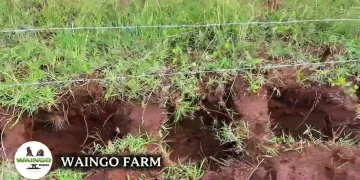
Situated near Marigat Town, the Perkerra Irrigation Scheme stands as one of Kenya’s most successful community irrigation projects, transforming the once-barren flats of the ancient Lake Kamasia into a thriving agricultural landscape. Fed by the Perkerra River, the scheme harnesses the power of irrigation to breathe life into the semi-arid lands of Baringo County, providing both food security and economic opportunity for thousands of farmers.
Historically, irrigation is not new to this region. The Njemps community—indigenous to the area—had practiced small-scale irrigation long before European settlement. However, their traditional systems faded over time until the establishment of the Perkerra Irrigation Scheme, which revived and expanded the craft into a modern, large-scale enterprise. Today, the scheme covers approximately 2,750 acres, supporting 1,625 farming households who benefit from its reliable water distribution network.
The Perkerra Scheme sustains two main growing seasons annually. The primary crop is seed maize, cultivated on over 2,500 acres through production contracts that ensure both market access and profitability. The secondary crop rotation features green grams, okra, cowpeas, and Nerica rice, complemented by a variety of other produce including onions, tomatoes, butternuts, cassava, finger millet, sorghum, watermelon, mangoes, pawpaws, and bananas. This diversity not only boosts food supply but also strengthens the local economy.
In addition to the main project, several out-grower schemes—such as Eldume, Sandai, Kamoskoi, and Kapkuikui—draw irrigation support from the Perkerra system, extending its reach across the wider Marigat region. Continuous rehabilitation of irrigation canals and the establishment of fruit-tree nurseries have further enhanced the scheme’s sustainability, aligning with Kenya’s national goal of achieving a 10% forest and green cover.
Beyond food production, the Perkerra Irrigation Scheme represents resilience and innovation—proof that community-driven agriculture can transform even the driest lands into oases of productivity. It remains a cornerstone of Baringo County’s agricultural growth, ensuring that the waters of the Perkerra River continue to nurture both the land and the people who depend on it.