People’s Parliament, the Trafalgar Square of Kisumu. Where Ordinary People Gather in Kisumu to Discuss Pressing Issues.
Kenya is a diverse nation with many different peoples who have diverse cultures, ideas, needs, and aspirations. Although an official People’s Parliament of Kenya exists to unite these people and promote their interests, it has failed dismally to live up to expectation. Due to the failures of the official People’s Parliament to meet the needs of the Kenyan people, the people themselves have decided to come together informally, in their own “People’s Parliament,” to discuss, ventilate, and deliberate on issues that the official Kenyan parliament has failed to address.
Kenya became an independent country on December 12, 1963, and developed its own Parliament to deliberate on social, economic, and political policies that impacted the interests of Kenyan people. However, three decades since independence, Kenya’s Parliament, according to many people, has failed to live up to its billing. Many people view it as a discredited institution that is bereft of intellectual, moral, and ethical gravitas to command respect and deference from the people. It operates more or less as an extension of the executive arm of government that only enacts laws in favor of the president and his cronies instead of truly representing the interests of its constituents. Indeed, Kenya’s parliament, most observers believe, is one of the most corrupt in the world. It has very little credibility in the eyes of the people.
The credibility of Kenya’s parliament started to decay during the reign of the first president of Kenya, Jomo Kenyatta, and continued declining under his successor, Daniel arap Moi. Indeed, it was during President Moi’s time that Kenya’s parliament, through executive pressure, adopted the drastic and draconian Structural Adjustment Program policies of the World Bank (WB) and the International Monetary Fund (IMF) in the 1980s. These ill-advised policies led to the withdrawal of basic social services from Kenyans. The policies led to the gutting of social programs in the areas of education, health care, and agriculture, in the name of “cost-sharing.” These policies led to suffering among the people. People started losing their jobs, homes, and savings. Factories closed. Schools were shut down. Hospitals suffered shortage of medicine. Poverty increased. Many people started dying in large numbers in Kenya during this period.
As Kenya’s parliament sat on its hands fiddling or otherwise waiting to receive orders from the executive, ordinary Kenyans started organizing resistance against the government of President Moi. The resistance took many forms. There were protests and even riots by petty traders, squatters, victims of ethnic clashes, and low-paid workers against parliament and the government as a whole. These Kenyans resented the IMF and World Bank economic policies in Kenya.
There were migrations by young men who, without anything to do at home, started flocking from the rural areas to the towns in Kenya. There were many young people migrating from their homes to Nairobi during this period. These young men were migrating in search of employment. As agricultural activities in the rural areas declined, sugar factories closed in Nyanza, textile factories went down in the Rift Valley, and milk processing plants like the Kenya Cooperative Creameries, and many small cooperative industries turned in their keys in Central province, young men started leaving their homes in search of new opportunities and income.
Over time, Kenyans became very disappointed and frustrated by what the parliament had done or not done to protect their interests. They also became very angry with parliament because of its failure to address the long-time scourge of HIV/AIDS, which was contributing to the death of very many Kenyans.
Gradually, disgruntled Kenyans started clustering around newspaper vendors, shoe shiners, or just any petty traders conducting business to express their political opinions, anger, and frustration over the failures of the parliament to address their problems and challenges. Many of these people were unemployed. They were also unhappy with the lack of freedom of expression in the country. Many of these people regularly gathered around newspaper vendors because they could not even afford to buy newspapers of their own to read and keep up to date with the political developments of their country.
By late 1980s and early 1990s, the dissatisfied Kenyans were gathering under a tree in Jeevanjee Gardens, a popular open-air field located in the center of Kenya’s capital city, Nairobi. Many of the people meeting at Jeevanjee Gardens felt deprived of opportunities to make a decent living. Jeevanjee Gardens became a popular place for Kenyans who wanted special but neglected issues to be discussed and solutions to be proposed. Attendance at Jeevanjee Gardens meetings grew continually, and eventually regulars at the meetings felt that they needed to be recognized as a serious organization. Hence, the birth of what came to be known as “Bunge la Mwanachi,” or “People’s Parliament.” Wilfred Olal, the People’s Parliament’s coordinator, states of the forum, “we are always fighting someone, trying to make things better for the future of this country.”
Gradually, the People’s Parliament fever spread all over Kenya like wildfire. The People’s Parliament fora started emerging in various towns in Kenya, among them Kisumu, Mombasa, Kisumu, Busia, Siaya, Nakuru, Eldoret, Kisii, Narok, Kericho, and others. The founders of these fora felt that their People’s Parliament should be recognized, not only as important socio-political movements, but also as a genuine forum alternative to the official parliament. They also started creating formal structures within their organization with rules, traditions, biennial elections, and office holders, including a president, a speaker, and a coordinator.
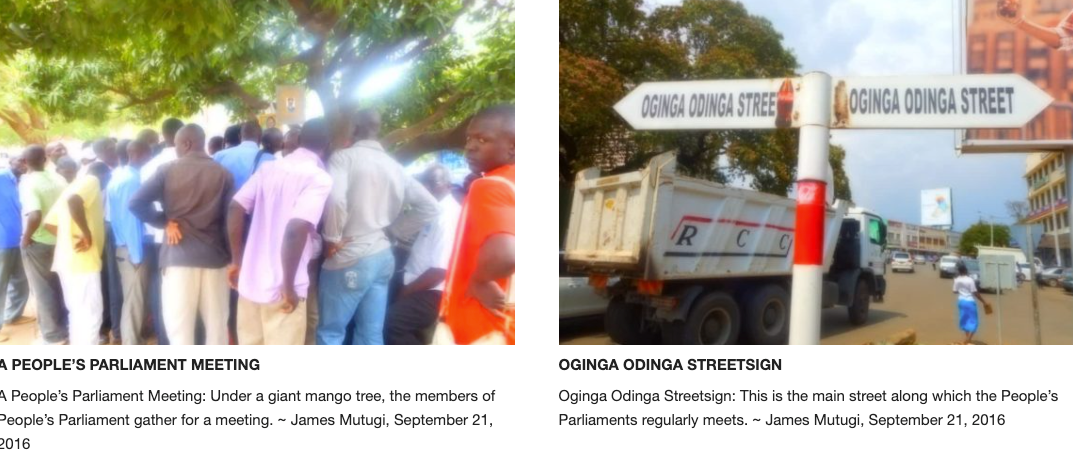
The People’s Parliament in Kisumu is perhaps one of the most active open-air gatherings in Kenya, second only to the ones in Nairobi. Today, in the 2010s, the Peoples Parliament in Kisumu has evolved into a forum where Kisumu residents meet to express their thoughts, ideas and views on the political, social and economic issues in the country. In fact, the parliament has open various branches in places such as Kisumu West, and Kisumu East, where one can find many people gathering to discuss issues of local and national importance.
The main meeting place of the People’s Parliament of Kisumu is along the Oginga Odinga Road, an area between Bank of Baroda and African Banking Corporation. This location is not far from the big mango tree where members usually gather to discuss recent and important political, social, and economical issues occurring in Kenya.
The members of the People’s Parliament advocate for good governance propelled by a desire for citizens to enjoy their rights and freedoms. They offer mass education to the residents of Kisumu concerning current political affairs, for instance, on the importance of voter registration. They act as watchdogs for the government since they criticize the government and advocate for change, thus preventing politicians from getting too comfortable and be able to ignore the voice of the people with no worries to government or personal power. Lastly, they also campaign against land grabbing throughout Kenya by various well-connected individuals and groups.
Over time, the People’s Parliament in Kisumu has grown in number. More and more people have joined the parliament despite government efforts to clamp on their meetings. It is therefore very common for people to attend its meetings to voice their opinions on what should be done in the face of the official Parliament’s inaction to help alleviate the challenges facing the people of Kenya.
The leadership of the People’s Parliament is comprised of the chairman, the secretary, and the treasurer, who are elected on an open forum after every three years. Candidates are expected to speak fluent English and Swahili. They are also required to be loyal to “Jakom” (chairman), who is Raila Odinga, one of the leading politicians in Kenya today. The officials are also required to have very good knowledge of history and of past and current political affairs of Kenya. They must also have a very good grasp of the history of the People’s Parliament itself.
Running the People’s Parliament is not without its costs. The People’s Parliament relies mostly on personal contributions for funding. It also relies on donations and financial support from donors, usually politicians, in order to help pay for its work in educating citizens. It also uses funds from donors to provide assistance to its members in need. There are now plans for the People’s Parliament to ask for formal financial support from the government through the Constituency Development Fund (CDF). If the plan works, then the People’s Parliament” will be able to enjoy greater financial independence and support its members, their needs, and their activities.
Apart from funding problems, the People’s Parliament has also been facing other challenges. These include police brutality, lack of opportunities for full involvement in the politics of the country, and lack of proper facilities where members can sit and deliberate on issues affecting their communities.
But, despite these challenges, the People’s Parliament continues with its work of fighting for the emergence of a better, more just, and more popular government that truly represents and helps Kenya and Kenyans no matter what their differences or struggles are.
Due to its work, role, and influence, one can even be tempted to compare the People’s Parliament in Kisumu to Trafalgar Square in Britain, where anyone can stand up and express his or her own opinion about anything in order to make it known to fellow citizens and the government of the day in Britain. As we write this essay, the People’s Parliament in Kisumu continues to grow strong. People continue to gather to hear and express their views, ideas, and opinions about important issues of the day in the city, the region, and the country.
“People’s Parliament, the Trafalgar Square of Kisumu | Macleki,” Macleki, December 4, 2017, https://macleki.org/stories/peoples-parliament-the-trafalgar-square-of-kisumu/.