


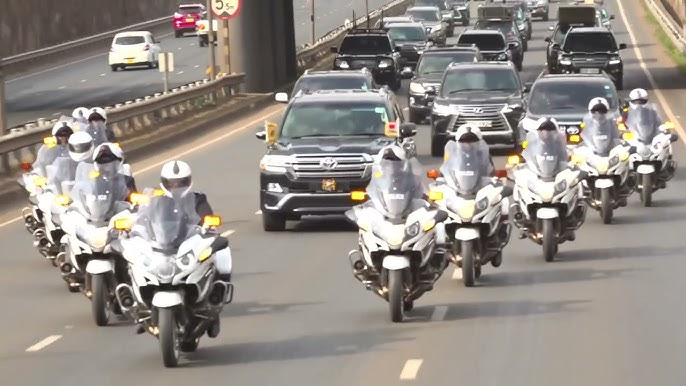
The presidency is not only the most powerful office in Kenya—it is also among the most heavily protected institutions in the country. Every public appearance, road movement, regional tour, and international trip involving William Ruto requires extensive planning, intelligence coordination, and elite security deployment.
Behind the scenes, the Ruto security detail functions as a multilayered protection system involving highly trained officers, intelligence operatives, specialized drivers, tactical commandos, and rapid-response teams. The operation extends far beyond visible bodyguards standing near the president during public rallies or official events.
Ruto was elected Member of Parliament for Eldoret North constituency from 1997 to 2007 under the KANU, and from 2007 to 2013 through the ODM party. He was the Minister for Home Affairs in the Daniel arap Moi administration from August to December 2002.
Under the Mwai Kibaki administration, he was the Minister for Agriculture from 2008 to 2010 and Minister for Higher Education from April to October 2010. Ruto first contested for the presidency during the 2007 election, but lost to Raila Odinga on the ODM party primaries; together with Musalia Mudavadi, who finished second, he then supported the candidature of Odinga. He again ran for the presidency on the 2013 election, but withdrew his candidature in favour of Uhuru Kenyatta.
He was later nominated to run for the deputy presidency in the 2013 election under the United Republican Party, becoming the running mate of Uhuru Kenyatta from The National Alliance (TNA). He was re-elected to the deputy presidency under the Jubilee Party in the 2017 Kenyan general election. Following a political fallout, Kenyatta endorsed Raila Odinga as his preferred successor.
Ruto, now running under the United Democratic Alliance (UDA), defeated Odinga for the presidency in the 2022 election. While the election was largely described as fair by the African Union and other international missions, it was contested by Odinga’s allies, who alleged electoral fraud. However, the Supreme Court of Kenya upheld the results, ruling that the allegations lacked sufficient evidence to invalidate the outcome.
Security analysts say modern presidential protection combines physical defense, intelligence gathering, route surveillance, crowd assessment, and emergency response planning designed to neutralize threats before they emerge.
In Kenya, the president’s security architecture draws heavily from elite police units, military-grade training systems, and intelligence structures developed over decades.
How Kenya’s Presidential Security System Works
The president occupies a unique constitutional position as both Head of State and Commander-in-Chief of the armed forces. As a result, his security framework integrates several powerful institutions.
The president receives direct security briefings from:
- The Inspector General of Police
- The National Intelligence Service
- The Chief of Defense Forces
These briefings help assess national threats, political risks, intelligence alerts, public security concerns, and operational vulnerabilities before presidential events or travel.
Security planning becomes especially intensive during:
- Political rallies
- International summits
- National celebrations
- County development tours
- High-risk public gatherings
- Foreign visits
Presidential security teams must account for both physical threats and unpredictable crowd dynamics.
The Presidential Escort Unit: Ruto’s Inner Security Ring
At the center of the Ruto security detail is the Presidential Escort Unit, commonly known as the PEU.
An Elite Specialized Unit
The Presidential Escort Unit is responsible for the president’s immediate personal protection.
This unit consists of specially selected officers with advanced tactical skills, many of whom are drawn from the elite Recce Squad under the General Service Unit (GSU).
The Recce Squad is widely regarded as one of Kenya’s most feared and highly trained tactical formations. Officers selected into presidential protection roles typically undergo additional layers of vetting and specialized training before joining the unit.
Their responsibilities include:
- Close-quarter presidential protection
- Counter-assault response
- Tactical evacuation
- Threat neutralization
- Secure movement coordination
- Emergency rescue operations
Unlike ordinary police assignments, presidential protection requires constant readiness and absolute precision.
The Selection Process
Not every officer qualifies for presidential security duties.
Candidates often emerge from top-performing police recruits and commandos who demonstrate exceptional discipline, physical endurance, marksmanship, tactical awareness, and decision-making abilities.
Training pathways frequently include advanced programs conducted at:
- Embakasi training facilities
- Magadi Training Camp
- Solio Ranch
- National Police College Kiganjo and Ruiru-based tactical schools
The aim is to create officers capable of reacting instantly under extreme pressure.
International-Level Tactical Training
Modern presidential protection requires skills that go beyond ordinary policing.
Overseas Specialized Programs
Some officers assigned to elite presidential security units receive additional international training in countries including:
- Israel
- The United States
- The United Kingdom
These programs expose officers to global protection techniques used by advanced presidential security agencies worldwide.
Areas of specialization may include:
- Counterterrorism
- VIP extraction operations
- Bomb detection and handling
- Advanced firearms tactics
- Sky marshalling
- Urban warfare response
- Tactical driving
- Intelligence coordination
The objective is to prepare officers for both conventional and unconventional threats.
Why Presidential Security Requires Elite Skills
Protecting a head of state is fundamentally different from standard law enforcement.
Presidential security teams must anticipate attacks before they happen while maintaining public accessibility for political engagements.
That balance creates immense operational pressure.
Officers are trained to identify suspicious behavior, monitor crowd movements, assess environmental risks, and respond within seconds to emergencies.
The Presidential Motorcade: More Than a Convoy
One of the most visible parts of the Ruto security detail is the presidential motorcade.
Yet what appears to ordinary citizens as a fast-moving convoy is actually a carefully engineered tactical formation.
Read Also: Arrest and Chaos: KDF Officer Detained for Assault and Obstruction in Kilifi County
How the Convoy Is Structured
The presidential escort convoy usually consists of multiple security layers involving:
- Lead escort motorcycles
- Advance security vehicles
- Tactical response units
- Armored presidential vehicles
- Ambulance and medical response teams
- Rear security vehicles
The convoy’s arrangement changes depending on threat levels, geography, public visibility, and intelligence assessments.
Specialized Riders and Drivers
The motorcade typically includes highly skilled motorcycle riders who regulate convoy speed and movement.
Drivers assigned to presidential duties undergo advanced training in:
- Defensive driving
- High-speed maneuvering
- Combat escape tactics
- Emergency evasive action
- Collision avoidance
These officers must maintain control even during chaotic or hostile conditions.
Why Routes Are Scanned Before Presidential Movement
Before the president travels anywhere, extensive route clearance operations take place.
Security Sweeps and Surveillance
Security agencies conduct detailed inspections to identify potential threats along intended routes.
This may involve:
- Explosive detection checks
- Building surveillance
- Rooftop monitoring
- Traffic control
- Crowd management assessments
- Intelligence gathering
Roads are often secured hours before the president’s arrival.
In some cases, alternative routes are prepared in case of emergencies or unexpected disruptions.
The Importance of Advance Teams
Advance security teams usually arrive ahead of the president to evaluate venues and surrounding areas.
They inspect:
- Entry and exit points
- Emergency evacuation routes
- Crowd positioning
- Communication systems
- Structural vulnerabilities
This preparation helps reduce operational surprises during public appearances.
Tactical Motorcade Formations Explained
The presidential convoy does not move randomly.
Security formations are designed to maximize survival and rapid response capabilities.
Wedge Formation
The wedge formation positions escort vehicles in angled arrangements around the president’s vehicle.
This creates both visibility and rapid maneuvering space during movement.
Box Formation
The box formation surrounds the president’s vehicle on multiple sides to provide close-range protection.
It limits exposure to external threats while maintaining convoy cohesion.
Diamond Formation
The diamond arrangement creates 360-degree tactical protection.
This structure helps officers respond quickly regardless of the direction of a potential attack.
These formations are commonly used by presidential security agencies worldwide.
The President’s Close Protection Team
Beyond the convoy itself, the president is often surrounded by a close protection detail during public appearances.
The Human Shield Structure
At times, the president may be accompanied by up to five immediate bodyguards positioned strategically around him.
These include:
- The lead protector in front
- Two flank officers on either side
- Rear protection officers
- A detail leader positioned close to the president
The detail leader often remains within arm’s length of the Head of State to coordinate rapid protective responses.
Why Bodyguard Positioning Matters
Close protection officers are trained to become immediate physical barriers between the president and danger.
If an attack occurs, their role is to:
- Shield the president
- Neutralize threats
- Create evacuation space
- Coordinate emergency extraction
Their positioning changes constantly depending on crowd size, terrain, and movement patterns.
Intelligence Agencies and Presidential Protection
Physical bodyguards represent only one part of presidential security.
Much of the real work happens behind the scenes through intelligence gathering.
The Role of the National Intelligence Service
The National Intelligence Service plays a critical role in threat assessment.
The agency monitors:
- Potential terror threats
- Political tensions
- Organized criminal activity
- Public unrest risks
- Security vulnerabilities
This intelligence helps shape presidential movement plans and public event security arrangements.
Coordination Between Agencies
Presidential security requires close cooperation between:
- Police units
- Intelligence agencies
- Military command structures
- Specialized tactical teams
This coordination allows rapid response if security conditions change suddenly.
Why Presidential Security Is Intensifying Globally
Kenya is not unique in maintaining extensive presidential protection systems.
Around the world, heads of state face increasingly complex risks.
Modern Security Threats
Presidential security teams today must prepare for:
- Terror attacks
- Lone-wolf threats
- Political violence
- Drone surveillance
- Cybersecurity risks
- Crowd stampedes
- Coordinated criminal attacks
As a result, modern VIP protection has become more sophisticated and technology-driven.
Public Visibility Versus Security
Democratic leaders must remain accessible to citizens while still protecting themselves from threats.
This creates a difficult balance.
Too much security may appear excessive. Too little security creates vulnerability.
Presidential protection teams therefore operate under constant pressure to maintain both safety and public engagement.
The Psychological Pressure on Presidential Security Officers
Serving within the Ruto security detail demands more than physical fitness.
Constant Readiness
Officers operate under permanent alert conditions.
Every handshake, public rally, roadside stop, or crowd interaction carries unpredictable risk.
Security personnel must process large amounts of information instantly while remaining calm and disciplined.
Sacrifice and Secrecy
Many elite officers work under strict confidentiality rules and demanding schedules.
The job often involves:
- Long deployments
- High stress levels
- Limited public recognition
- Extensive travel
- Continuous training
Despite their visibility near the president, much of their work remains hidden from the public.
The Evolution of Kenya’s Presidential Security
Kenya’s presidential protection systems have evolved significantly over decades.
Earlier administrations relied heavily on traditional police structures. Modern security operations now integrate tactical intelligence, surveillance technology, advanced communications, and specialized response capabilities.
The growing complexity of political environments, public demonstrations, terrorism threats, and digital-age security concerns has transformed presidential protection into one of the country’s most sophisticated security operations.
FAQ
How many officers protect President Ruto?
Reports indicate that approximately 200 officers are involved in protecting the president and the First Family through various security units.
What is the Presidential Escort Unit?
The Presidential Escort Unit is a specialized security formation responsible for the president’s close protection and tactical security operations.
Are presidential bodyguards drawn from the Recce Squad?
Yes. Many officers assigned to presidential protection are selected from the elite Recce Squad under the General Service Unit.
Why does the presidential convoy use formations?
Formations such as wedge, box, and diamond provide 360-degree tactical protection and improve emergency response capability.
Does the president receive intelligence briefings daily?
The president regularly receives security and intelligence briefings from senior police, military, and intelligence officials.
Why are routes cleared before presidential movement?
Security teams scan routes to detect threats, control crowds, inspect buildings, and ensure safe movement before the president travels.
Conclusion
The Ruto security detail represents one of Kenya’s most advanced protection systems, combining elite tactical units, intelligence coordination, armored transport, and rigorous operational planning.
Far beyond the visible motorcade and bodyguards, presidential security involves continuous surveillance, strategic risk assessment, and rapid-response preparedness designed to protect the country’s Head of State under all conditions.
As security threats evolve globally, presidential protection has become increasingly sophisticated, blending traditional close protection methods with modern intelligence and tactical operations.
For the officers tasked with safeguarding the presidency, every movement, route, crowd, and public appearance demands precision, discipline, and unwavering readiness.


