


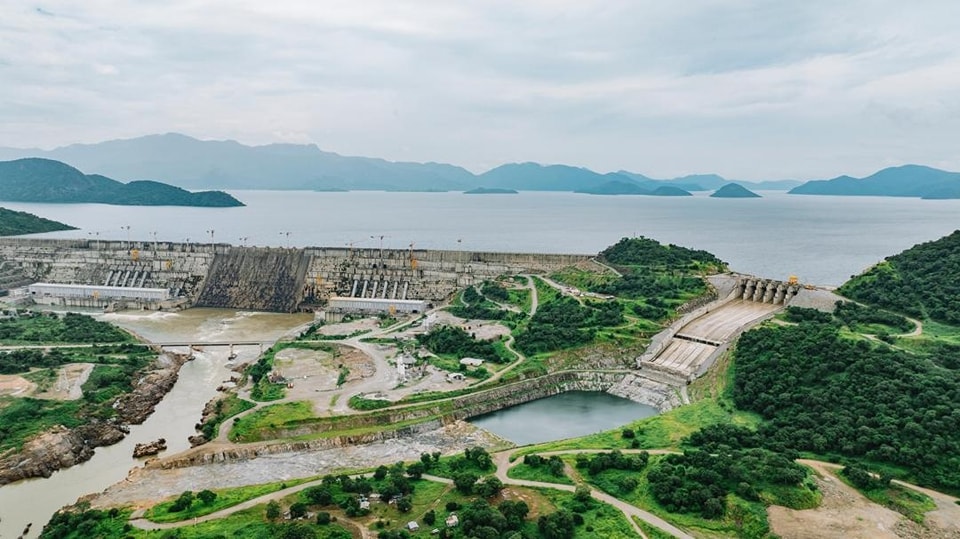
GERD Lake, born from Ethiopia’s Grand Ethiopian Renaissance Dam (GERD), is now one of Africa’s most significant inland seas. With a capacity of 74 billion cubic meters (BCM) and a surface area of 1,874 km², this vast reservoir has already transformed the Blue Nile Basin, reshaping hydrology, fisheries, and local livelihoods. Its scale and design make it a landmark in modern African geography.
At full supply level (640 m a.s.l.), GERD Lake stores water equivalent to about 1.5 times the Blue Nile’s annual flow at the dam site. The lake stretches up to 246 km along steep canyons in Benishangul-Gumuz, forming a deep, narrow, and efficient storage system. By volume, it ranks 4th in Africa after Kariba, Volta, and Nasser, and sits among the top 10 globally.
Key Figures That Define GERD Lake
- Total capacity: 74 BCM
- Active storage: ~59.2 BCM
- Dead storage: ~14.8 BCM
- Surface area at FSL: ~1,874 km² (shrinks to ~606 km² at minimum level)
- Maximum depth: ~140 m
- Average depth: ~39–41 m
The lake’s depth is remarkable, allowing Ethiopia to store vast amounts of water with lower evaporation losses than shallow basins—an advantage in a warming climate.
Formation and Early Growth
Filling began in 2020 with 4.9 BCM, expanding each rainy season: 13.5 BCM (2021), 22 BCM (2022), 41.5 BCM (2023). Satellite imagery documented the Blue Nile’s transition into a sprawling lake, complete with new islands and evolving shorelines.
Seventy New Islands
GERD Lake now contains about 70 islands, formed from ridges and hilltops. These islands range from 5 hectares to 20 km². Ethiopia envisions them as hubs for ecotourism, birding, and boat-based travel, while scientists see a natural experiment in island biogeography with precisely dated origins.
Fisheries Boom
Before the GERD, annual fish catch was ~2,400 tons. Today, production exceeds 5,800 tons, with a sustainable potential of 10,000–15,000 tons per year. About 64–74 youth cooperatives, employing over 1,600 people, target Nile Perch (up to 80 kg), tilapias, and catfish.
Still, experts caution that:
- Early high yields will normalize after nutrient-rich vegetation decomposes.
- Predator dominance could threaten native river species, requiring careful mesh regulation and seasonal closures.
Groundwater Recharge Below GERD Lake
Satellite data suggests ~20 BCM seeped underground between 2019–2022, effectively recharging aquifers. This “hidden reservoir” could:
- Sustain dry-season springs and wells.
- Raise seismic monitoring concerns from increased pore pressure.
- Challenge water-sharing models that focus only on surface storage.
Climate and Health Concerns
Evaporation losses are estimated at 1.7–4+ BCM annually, relatively modest for its size. GERD Lake’s presence is expected to create microclimate shifts, including higher humidity and moderated temperature swings. However, public health planners warn that stable shorelines could expand mosquito breeding zones, requiring vector control near fishing villages.
Sediment Trap and Regional Impacts
The Blue Nile carries vast sediment loads, now largely trapped in GERD Lake:
- Ethiopia’s cost: Gradual storage loss unless upstream restoration and sediment routing are implemented.
- Sudan & Egypt’s gain: Cleaner flows extending dam lifespans, reducing dredging, and improving canal efficiency.
- Trade-off: Loss of fertile silt for floodplain farming, creating reliance on fertilizers.
A System of Interdependence
GERD regulation will reduce Sudanese floods and steady Nile flows, requiring coordination with Egypt’s Aswan High Dam. Together, they create a coupled water system where transparency and data sharing—on inflows, releases, sediment, and evaporation—are key to avoiding mistrust.
Why GERD Lake Stands Out
- Efficient geometry: Deep, narrow storage reduces evaporation.
- New landscapes: Islands as ecological and tourism frontiers.
- Blue economy potential: Fisheries, cold-chain logistics, and transport networks.
- Groundwater recharge: A second, hidden reservoir for resilience.
- Geopolitical leverage: A pivotal asset in Eastern Nile diplomacy.
Priorities Ahead
- Sediment management through watershed restoration.
- Fishery governance and cold-chain infrastructure.
- Integrated health and vector control strategies.
- Seismic monitoring for reservoir-induced stress.
- Shared data dashboards for transparency.
Bottom line: GERD Lake is not only Africa’s newest inland sea but also a living experiment in hydrology, ecology, and geopolitics. If managed well, it can fuel industries, power cities, and reshape cooperation along the Nile, turning Ethiopia’s engineering feat into a continental asset.


