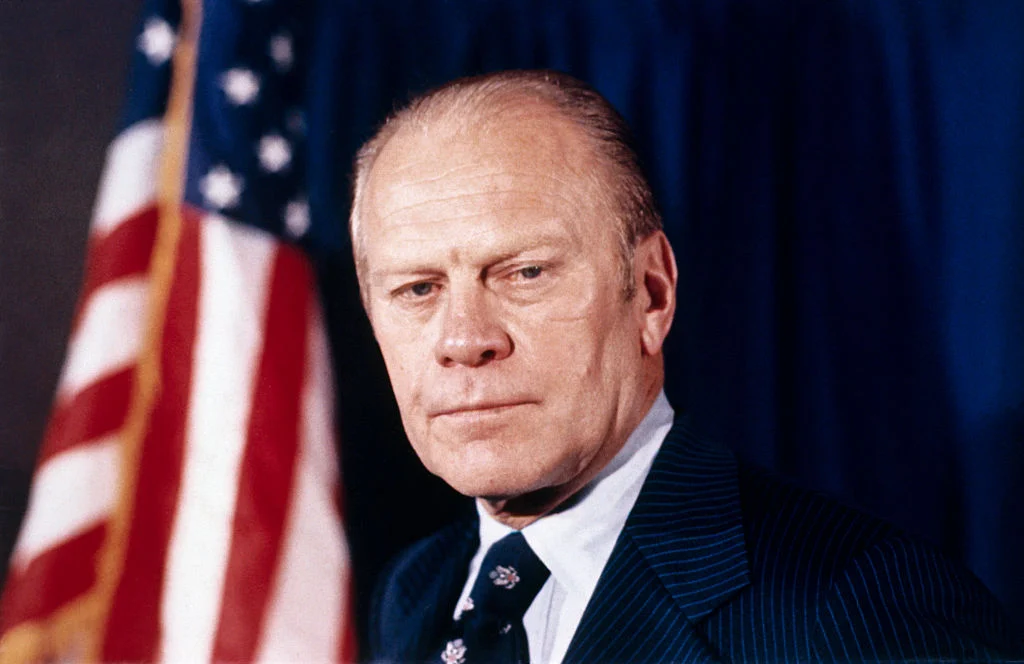
Net Worth: $7 Million (Equivalent to $11 Million today after inflation)
Category: Richest Politicians › Republicans
Birthdate: July 14, 1913 – December 26, 2006 (93 years old)
Birthplace: Omaha, Nebraska
Height: 6 ft (1.83 m)
Profession: Lawyer, Politician, American Football Player
Nationality: United States of America
Overview
Gerald Ford, the 38th President of the United States, was a politician and lawyer who held the unique distinction of becoming both Vice President and President without ever being elected to either position. Ford’s presidency, from 1974 to 1977, was shaped by efforts to heal a nation still reeling from the Watergate scandal and economic downturns. Despite facing immense challenges, he played a significant role in easing Cold War tensions through the Helsinki Accords and made history by pardoning his predecessor, Richard Nixon.
Early Life
Gerald Ford was born Leslie Lynch King Jr. in Omaha, Nebraska. His parents, Dorothy Gardner and Leslie Lynch King Sr., separated shortly after his birth due to domestic violence. Dorothy later remarried Gerald Rudolf Ford, who informally adopted the young Ford and gave him his name.
- Education:
- Grand Rapids South High School: Star athlete and team captain in football and wrestling.
- University of Michigan: Graduated with a B.A. in Economics in 1935. Played football and received offers from the NFL’s Detroit Lions and Green Bay Packers, both of which he declined.
- Yale Law School: Graduated in 1941 after working as a football coach to fund his education.
Military Service
Following the attack on Pearl Harbor, Ford enlisted in the U.S. Navy in 1941. He served aboard the USS Monterey and earned several awards for his contributions. Ford was honorably discharged in 1946 as a Lieutenant Commander.
Political Career
House of Representatives
- 1949–1973: Represented Michigan’s 5th Congressional District for nearly 25 years.
- Served on the House Appropriations Committee and became House Minority Leader in 1965.
- Known for his bipartisan negotiation skills, Ford worked on various issues, including defense spending and the Kennedy assassination investigation as part of the Warren Commission.
Vice Presidency
- 1973–1974: Appointed Vice President following Spiro Agnew’s resignation. Ford was the first person to assume this role under the 25th Amendment.
Presidency
- 1974–1977: Sworn in as President on August 9, 1974, after Nixon’s resignation.
- Key Policies & Challenges:
- Pardoned Nixon, a controversial decision aimed at helping the country move forward.
- Focused on economic recovery during a period of high inflation and recession.
- Signed the Helsinki Accords, advancing détente during the Cold War.
- Oversaw the final stages of U.S. involvement in the Vietnam War.
1976 Election
Ford narrowly lost to Jimmy Carter in the 1976 election after defeating Ronald Reagan for the Republican nomination.
Post-Presidency
After leaving office, Ford remained active in politics and philanthropy. Despite his moderate Republican views, he often clashed with the party’s growing conservative faction. He delivered lectures, wrote memoirs, and participated in civic and academic endeavors.
Personal Life
Marriage and Family
- Married Elizabeth “Betty” Bloomer in 1948. Betty became a notable First Lady, advocating for women’s rights and substance abuse recovery.
- Children: Michael, John, Steven, and Susan.
Freemasonry
Ford was an active Freemason and held honorary roles, including 33rd Degree Mason.
Health and Death
- Ford passed away at 93 years old in Rancho Mirage, California, due to arteriosclerotic cerebrovascular disease. He was the longest-lived U.S. president at the time of his death.
Legacy
Impact on the Nation
- Ford’s presidency is remembered for prioritizing national healing and setting a precedent for transparency and accountability in government.
- His decision to pardon Nixon remains one of the most debated presidential acts in U.S. history.
Memorials and Honors
- Ford was interred at his Presidential Museum in Grand Rapids, Michigan.
- Michigan commissioned a statue of Ford for the National Statuary Hall in 2011.
Key Accomplishments
- Economic Stabilization Efforts: Launched initiatives to address inflation and unemployment during a challenging economic period.
- Cold War Diplomacy: Signed the Helsinki Accords, enhancing U.S.-Soviet relations.
- Post-Watergate Healing: Played a pivotal role in restoring public trust in government.
Net Worth and Financial Summary
At the time of his death, Ford’s net worth was $7 million, roughly $11 million today after adjusting for inflation. This wealth stemmed from:
- Congressional and presidential salaries.
- Post-presidency book deals and speaking engagements.
Ford’s modest net worth reflects his lifelong dedication to public service rather than personal financial gain.
Gerald Ford’s legacy as a president who prioritized unity and stability continues to resonate, cementing his place in history as a leader who steered the nation through a tumultuous era.