Nyongesa Sande
No Result
View All Result
  • News
    • World
    • Africa
  • Politics
  • Business
  • Tech
  • AI
  • Telecom
  • Sports
  • Opinion
  • Lifestyle
  • Live
  • World Cup 2026
    • World Cup 2026 Standings
    • World Cup 2026
Nyongesa Sande
  • About Us
    • Nyosake Designers
      • Nyosake Webmasters
      • Nyosake Investment
  • Contact Us
    • Newsroom Contact
  • Ownership Disclosure
  • Advertise
No Result
View All Result
Nyongesa Sande
No Result
View All Result
  • News
  • Politics
  • Business
  • Tech
  • AI
  • Telecom
  • Sports
  • Opinion
  • Lifestyle
  • Live
  • World Cup 2026
ADVERTISEMENT

Home » Ethnic Conflicts in Kenya: History and Root Causes

Ethnic Conflicts in Kenya: History and Root Causes

Understanding the historical, political, and socio-economic drivers of Kenya’s ethnic conflicts and their regional impact

NyongesaSande News Desk by NyongesaSande News Desk
12 months ago
in Kenya
Reading Time: 4 mins read
A A
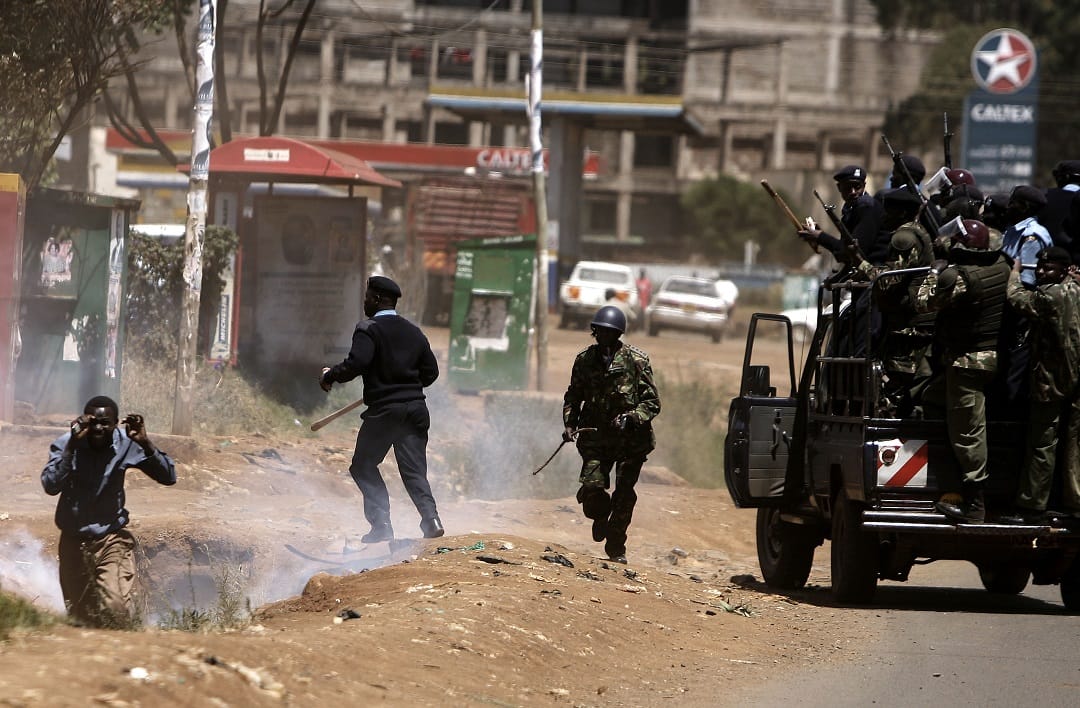
Creator: JOSE CENDON | Credit: AFP Copyright: AFP PHOTO/JOSE CENDON

A man flees away from policemen in a street of Eldoret 17 January 2008 in western Kenya. Seven demonstrators were killed in Nairobi slums on Thursday in the second day of protests against the re-election of President Mwai Kibaki, opposition leader Raila Odinga said. Odinga said the dead included a driver for a Kenyan opposition member of parliament who was shot by police as he attempted to leave his house in the Kasarani district which includes the sprawling Mathare slum, an opposition stronghold. AFP PHOTO / JOSE CENDON / AFP PHOTO / JOSE CENDON

Ethnic conflicts in Kenya have been a recurring challenge, especially since the introduction of multi-party politics in the early 1990s. While many incidents are classified as minor skirmishes, others—like the 2007–08 post-election crisis—have triggered widespread violence, displacement, and political instability. The escalation of communal violence has largely stemmed from political instigation, competition over land, water resources, and unresolved historical grievances.

  • Key Factors Behind Ethnic Conflicts
  • Regional Flashpoints of Violence
    • Rift Valley Province
    • Western Kenya: Mount Elgon Conflict
    • Coastal Region: Likoni and Tana River
  • Transregional and Urban Clashes: Eastleigh and Garissa
  • National Consequences and the Way Forward

The 2007–08 crisis was the most severe ethnic conflict in Kenya since independence. Sparked by a disputed presidential election, the violence saw over 1,000 people killed and hundreds of thousands displaced. Communities such as the Indian minority in Kisumu began repatriating, citing insecurity and a lack of trust in local law enforcement. As a result, ethnic conflicts in Kenya continue to pose a major challenge to national unity and sustainable peace.


Key Factors Behind Ethnic Conflicts

Several interlinked factors contribute to ethnic tensions in Kenya, including:

ADVERTISEMENT
  • Colonial-era land policies that displaced indigenous communities
  • Political incitement by leaders seeking to gain tribal support
  • Disputes over land ownership and boundaries
  • Competition for access to water and grazing land
  • High youth unemployment and lack of economic opportunities
  • Cattle rustling and historical tribal rivalries
  • Harassment, extortion, and insecurity in marginalised areas

These root causes are particularly potent in rural and semi-arid regions where communities compete over dwindling natural resources.


Regional Flashpoints of Violence

Rift Valley Province

The Rift Valley has seen some of Kenya’s bloodiest ethnic violence. Since 1992, over 5,000 people have been killed and 75,000 displaced, particularly in towns like Molo. Most of the conflict has occurred between Kalenjin and Kikuyu communities, with land ownership as a key trigger. In 2012, 40 people were killed in cattle-related ethnic clashes in Samburu, and in 2017, 13 more were killed during rustling raids in Baringo County.

ADVERTISEMENT

Western Kenya: Mount Elgon Conflict

In 2005, the Mount Elgon District experienced a violent insurgency led by the Sabaot Land Defence Force, composed mainly of the Sabaot sub-tribe of the Kalenjin. The conflict revolved around contested land rights and left scores of civilians displaced.

Coastal Region: Likoni and Tana River

In 1997, the Likoni clashes in Mombasa revealed deep ethnic and political rifts. Later, between 2012 and 2013, deadly violence broke out in Tana River between the Orma and Pokomo communities, rooted in disputes over water, pasture, and farmland.


Transregional and Urban Clashes: Eastleigh and Garissa

One of the most controversial chapters of ethnic tension occurred in Eastleigh, Nairobi, in November 2012, when a suspected IED attack on a matatu triggered widespread anti-Somali violence. Mobs looted Somali-owned businesses and destroyed property, prompting Somali residents to defend themselves. The incident led to heightened ethnic profiling and police brutality.

ADVERTISEMENT

In the days that followed, the Kenya Defence Forces (KDF) launched a military operation in Garissa, during which soldiers were accused of burning markets, shooting civilians, and assaulting residents, including school children and women. MP Farah Maalim condemned the operation, threatening to pursue charges at the International Court of Justice (ICJ) for alleged crimes against humanity.

The backlash caused a mass exodus of Somali residents, especially from Eastleigh, where entrepreneurs withdrew Sh10 to Sh40 billion from local banks. The local real estate and retail economy suffered significantly as vacated apartments and shops became unaffordable for non-Somali tenants.


National Consequences and the Way Forward

The long-standing pattern of ethnic conflicts in Kenya has had devastating effects on the economy, human security, and national cohesion. Politically motivated ethnic incitement continues to rear its head during election cycles, making ethnic peacebuilding a recurring challenge for the government.

Efforts toward long-term solutions must include:

  • Transparent land reform policies
  • Equal economic opportunities for marginalized regions
  • Demilitarization of conflict-prone zones
  • Prosecution of inciters and perpetrators of ethnic violence
  • Sustained national dialogue on ethnic identity and inclusion

Ethnic conflicts in Kenya remain a deeply rooted issue shaped by history, politics, and socio-economic inequality. While progress has been made in peacebuilding, electoral reforms, and devolution, the risk of ethnic-based violence remains unless fundamental issues are addressed through structural change and inclusive governance.

Tags: 2007–08 Kenyan crisisEastleigh conflictEthnic conflicts in KenyaKenyan politicsRift Valley clashestribal violence Kenya
Share1Tweet1SendShareScanSharePinShareShare
Google Add as a Preferred Source on Google
Previous Post

Western Province Kenya: History and Regional Transition

Next Post

National Library Service of Kenya: Maktaba Kuu & Beyond

NyongesaSande News Desk

NyongesaSande News Desk

Nyongesa Sande offers diverse content across news, technology, entertainment, and more, aiming to provide readers with a wide range of informative and engaging articles. NYONGESA SANDE's dedicated team provides our audience not only with the highly relevant news but also with outstanding interactive experience.

Related Posts

Filing KRA Returns Via WhatsApp in 7 Steps
Kenya Revenue Authority (KRA)

KRA Tax Returns Filing Gets Easier for Kenyans in 2026

2 weeks ago
Filing KRA Returns Via WhatsApp in 7 Steps
Kenya Revenue Authority (KRA)

Filing KRA Returns Via WhatsApp: A Simple Guide for Kenyans

3 weeks ago
KRA Says Personal M-PESA Transfers Won’t Be Monitored
Kenya Revenue Authority (KRA)

KRA Says Personal M-PESA Transfers Won’t Be Monitored

2 months ago
KRA landlord registration
Kenya Revenue Authority (KRA)

KRA Landlord Registration: 5 Key Changes in New Tax Plan

2 months ago
KRA to Launch Automated Tax Return Validation in January 2026
Kenya Revenue Authority (KRA)

Kenya Tax Deadline Shift Raises Compliance Concerns

2 months ago
IEBC Hits 75% Voter Registration Target Nationwide
2027 General Elections in Kenya

IEBC Hits 75% Voter Registration Target Nationwide

2 months ago
Load More
Next Post
National Library Service of Kenya

National Library Service of Kenya: Maktaba Kuu & Beyond

View of Earth taken during ISS Expedition 42.

Lake Victoria: Africa’s Largest Freshwater Lake

ADVERTISEMENT

Who We Are

Nyongesa Sande

NyongesaSande.com is a digital news and media platform covering breaking news, business, technology, AI, politics, sports, world affairs and African innovation.

News Sections

  • News
    • World
    • Africa
  • Politics
  • Business
  • Tech
  • AI
  • Telecom
  • Sports
  • Opinion
  • Lifestyle
  • Live
  • World Cup 2026
    • World Cup 2026 Standings
    • World Cup 2026

Editorial Standards

  • Editorial Policy
  • Fact Checking Policy
  • Corrections Policy
  • Ethics Policy
  • AI Usage Policy
  • News Tips
  • Submit Press Release

Legal

  • Privacy Policy
  • Terms of Use
  • Cookie Policy
  • Disclaimer
  • Risk Disclaimer
  • DMCA
  • Ad Choices

Our Company

  • About Us
    • Nyosake Designers
      • Nyosake Webmasters
      • Nyosake Investment
  • Contact Us
    • Newsroom Contact
  • Ownership Disclosure
  • Advertise
  • Privacy Policy
  • Terms of Use
  • Cookie Policy
  • Disclaimer
  • Risk Disclaimer
  • DMCA
  • Ad Choices

NyongesaSande.com is an independent digital news and media platform covering Africa, business, technology, AI, politics and global developments.

© 2026 NyongesaSande.com. All rights reserved.

No Result
View All Result
  • News
    • World
    • Africa
  • Politics
  • Business
  • Tech
  • AI
  • Telecom
  • Sports
  • Opinion
  • Lifestyle
  • Live
  • World Cup 2026
    • World Cup 2026 Standings
    • World Cup 2026

NyongesaSande.com is an independent digital news and media platform covering Africa, business, technology, AI, politics and global developments.

© 2026 NyongesaSande.com. All rights reserved.