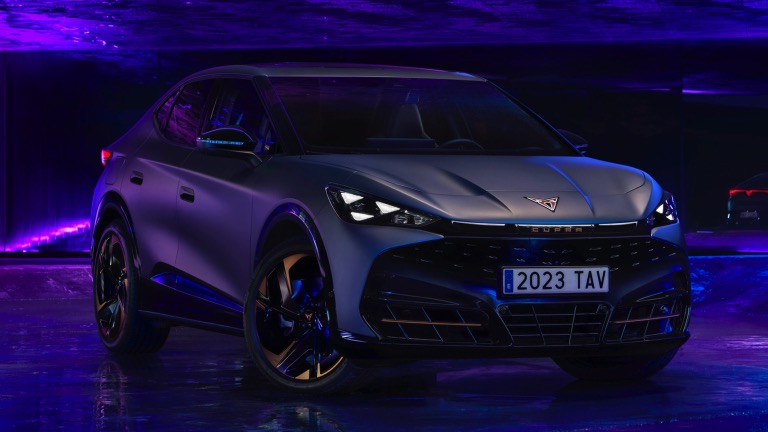
The CUPRA Tavascan Endurance redefines what drivers can expect from an electric SUV, combining bold design, robust performance, and long-range capability. Released in June 2024, this EV offers a real-world range of 445 km from its 77.0 kWh usable battery, providing dependable versatility for daily driving and extended road trips. It maintains an impressive efficiency of 173 Wh/km, supported by intelligent battery management.
With a rear-wheel-drive layout powered by a 210 kW (286 PS) electric motor, the Tavascan sprints from 0 to 100 km/h in 6.8 seconds. Fast charging is handled by a 135 kW DC input, enabling a 10–80% charge in just 28 minutes. While bidirectional charging isn’t supported, it does offer Plug & Charge (ISO 15118-2), battery preconditioning, and solid thermal management. Available from £47,340 in the UK, €48,990 in the Netherlands, and €56,210 in Germany, the CUPRA Tavascan Endurance is a premium EV made for dynamic driving.
CUPRA Tavascan Endurance Full Specifications
| Category | Specification |
|---|---|
| Availability | Since June 2024 |
| Battery Capacity | 77.0 kWh usable / 82.0 kWh nominal |
| Real-World Range | 445 km |
| WLTP Range (TEL/TEH) | 568 / 542 km |
| Energy Efficiency | 173 Wh/km (real-world) |
| Charging (AC) | 11 kW onboard |
| AC Charging Time | 8h 15m |
| Fast Charging (DC) | 135 kW max; 10–80% in 28 min |
| Plug & Charge | Supported (ISO 15118-2) |
| Performance | 0–100 km/h in 6.8 sec, top speed 180 km/h |
| Motor Output | 210 kW (286 PS), 545 Nm |
| Drive Type | Rear-wheel drive |
| Long-Distance Rating | 3/5 (1-stop range: 467 km avg.) |
| Consumption Range | 119–241 Wh/km |
| Platform / Segment | VW MEB / JC – Medium SUV |
| Bidirectional Charging | Not supported |
| Dimensions (L×W×H) | 4644 × 1861 × 1597 mm |
| Wheelbase | 2766 mm |
| Unladen Weight | 2178 kg |
| Cargo Capacity | Rear: 540 L |
| Seats / ISOFIX | 5 / Yes, 3 seats |
| Towing Capacity | Braked: 1000 kg, Unbraked: 750 kg |
| Turning Circle | 10.2 m |
| Heat Pump | Optional |
| Safety (Euro NCAP) | Adult: 89%, Child: 86%, Assist: 79%, Road Users: 80% (2024) |