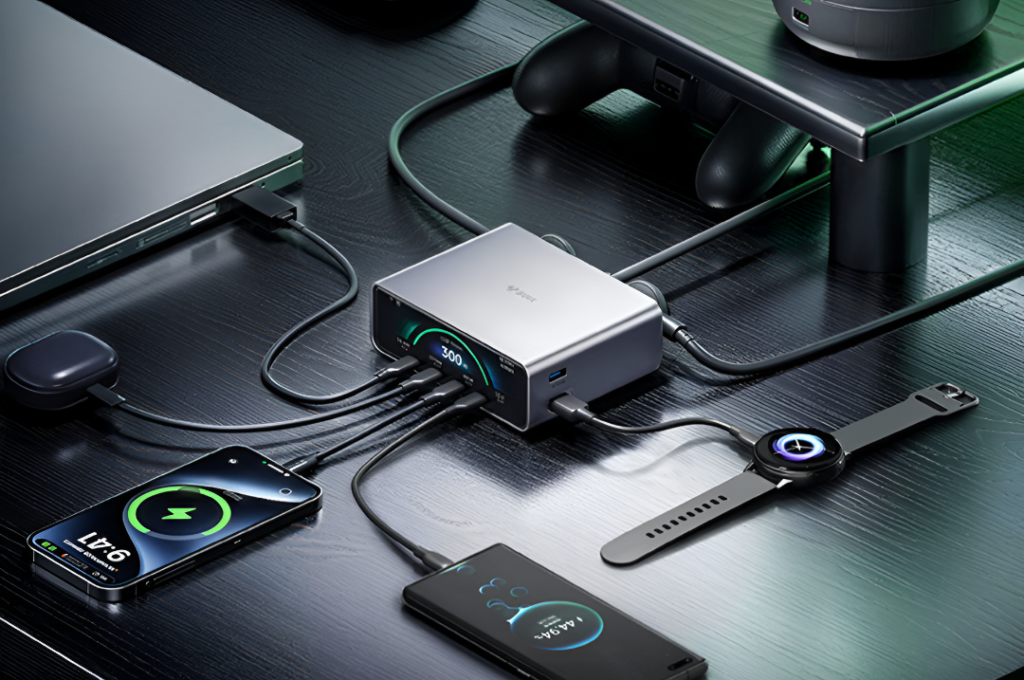
Bull has launched a powerful 300W desktop charging station in China, targeting users who want one compact hub for laptops, phones, tablets and household power needs.
The new Bull Smart Super Charging Station Ultra combines high-speed USB charging, two AC outlets, a built-in color display and Wi-Fi app control. It is priced at 799 yuan in China, which is roughly $118 before taxes, exchange-rate changes or import costs.
The charging hub is designed for modern desks where users may need to power a laptop, smartphone, tablet, earbuds, smartwatch, monitor accessories and small AC-powered devices at the same time. With four USB-C ports, two USB-A ports and two AC sockets, it is positioned as a premium all-in-one desktop power station rather than a simple charger.
Bull Smart Super Charging Station Ultra Launched
The Bull Smart Super Charging Station Ultra is a high-output desktop charging hub with eight total power ports.
It includes four USB-C ports, two USB-A ports and two five-hole AC sockets on the rear. The USB section supports up to 300W combined output when multiple ports are used together, while the AC sockets support a maximum load of 2,500W.
That makes it suitable for users who want to reduce cable clutter and replace multiple wall chargers with one central charging station.
The product is also part of a wider trend toward smarter GaN desktop chargers that show real-time power data and allow users to manage charging behavior through an app.
Eight Ports for Desktop Charging
The charging station offers eight ports in total.
The rear includes two AC sockets for conventional plugs. These can be used for devices such as monitors, lamps, speakers, routers or other low-to-medium power desk accessories, as long as the total load stays within the supported limit.
The front USB array includes four USB-C ports and two USB-A ports.
This layout is practical because most high-power modern devices now use USB-C, while USB-A remains useful for older cables, accessories, headphones, smartwatches and smaller gadgets.
For users with several devices, the port selection is one of the biggest advantages of the charger.
300W Total USB Output
The headline feature is 300W total USB output.
When multiple USB ports are used at the same time, the Bull Smart Super Charging Station Ultra can deliver up to 300W combined across the USB-C and USB-A ports.
This is enough to charge several high-power devices at once.
For example, users could charge a laptop, tablet, smartphone and accessories from the same hub instead of carrying separate adapters.
The exact charging speed for each device will depend on the device, cable, protocol support and how many ports are active.
Still, 300W total output puts the Bull hub in serious desktop charging territory.
240W USB-C PD 3.1 Support
The primary USB-C port, labeled C1, supports USB Power Delivery 3.1 Extended Power Range.
According to launch coverage, the C1 port can deliver up to 240W from a single port, using the full PD 3.1 EPR standard.
This is important because 240W USB-C charging is designed for high-performance laptops and power-hungry devices that need more than the older 100W USB-C limit.
Not every laptop supports 240W USB-C input, but the capability gives the charger room for newer devices.
Users will need a compatible USB-C cable rated for high-wattage PD charging to take full advantage of this port.
Three Additional 140W USB-C Ports
The remaining three USB-C ports are also powerful.
The C2, C3 and C4 ports reportedly support up to 140W each.
That means the hub can charge multiple laptops or high-power tablets, depending on how power is distributed across active ports.
The C2 port also supports Xiaomi’s 120W HyperCharge protocol, making it especially useful for compatible Xiaomi phones.
This combination of PD and proprietary fast-charging support gives the Bull hub a wider device compatibility range than a basic USB-C charger.
It should appeal especially to users who own laptops and Chinese-brand phones with high-speed charging protocols.
USB-A Ports for Smaller Accessories
The two USB-A ports are intended for lower-power devices and older cables.
One USB-A port reportedly supports up to 20V/2A, while the other is capped at 5V/1A.
These ports are not the main attraction, but they are still useful.
Many accessories still ship with USB-A cables. Smartwatches, earbuds, small speakers, LED lights, older phones and simple gadgets may not need USB-C fast charging.
Including USB-A ports makes the station more flexible for mixed-device desks.
It also reduces the need for extra adapters.
Dual AC Outlets With 2,500W Load
The rear AC outlets support a maximum combined load of 2,500W.
This gives the charging station a major advantage over ordinary USB charging bricks. It can act like a desktop power strip and USB charger in one device.
The AC outlets can power standard plug-in devices, while the USB ports handle phones, tablets and laptops.
The charger includes overload protection and can automatically cut off power if the AC load exceeds the supported limit.
That protection is important because combining USB charging and AC power in one compact unit requires careful safety design.
Users should still avoid connecting high-risk or excessive-load devices beyond the rated capacity.
Built-In 3.02-Inch Display
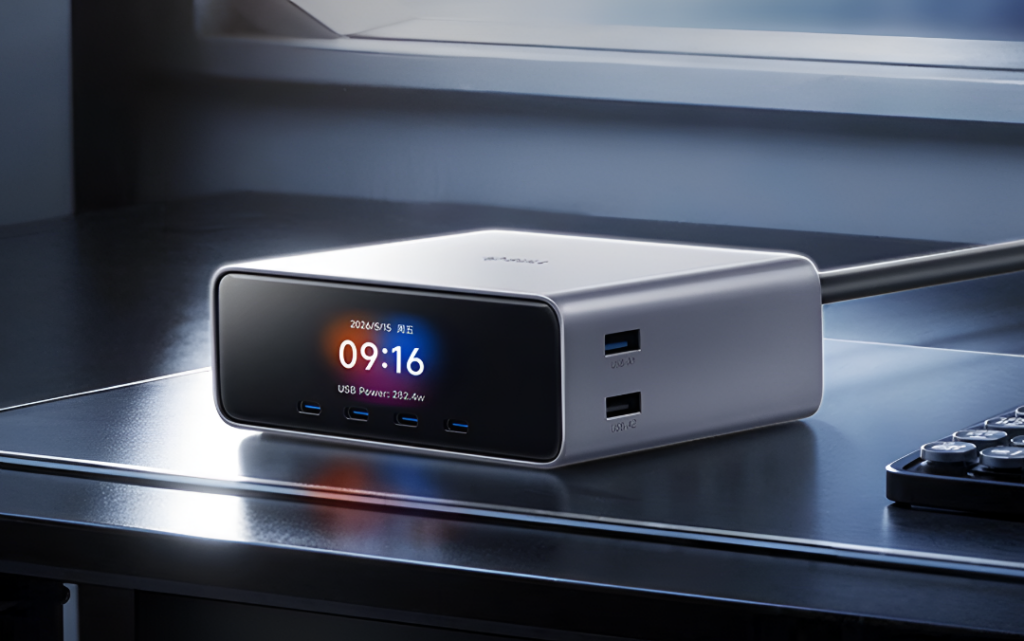
The charging station includes a 3.02-inch color display on the front.
The display shows real-time charging information, including individual port wattage, charging protocols and AC power consumption.
This is one of the most useful features for power users.
Instead of guessing whether a laptop is receiving 65W, 100W, 140W or 240W, users can see charging data directly on the device.
The display can also help diagnose cable or charger issues. If a device is charging slower than expected, users can check whether the correct protocol is active or whether power has been redistributed to other ports.
Real-Time Charging Monitoring
Real-time monitoring makes the Bull charging station more transparent than a normal charger.
Many fast chargers do not show what they are doing. Users plug in a device and hope it is charging at the expected speed.
With the built-in display, users can monitor wattage per port, overall power activity and active charging standards.
This is useful for people who own multiple devices with different charging requirements.
It is also useful for creators, remote workers, gamers and tech enthusiasts who want to know exactly how much power each device is receiving.
The display turns charging from a hidden process into something visible.
Wi-Fi and Bull MosHome App Control
The charging hub supports Wi-Fi and app control through Bull’s MosHome app.
Through the app, users can view charging status, manually allocate power to specific ports and install OTA firmware updates.
Manual power allocation is especially interesting.
By default, the station uses dynamic power allocation to distribute wattage automatically based on connected devices. But app control allows users to prioritize certain ports, with reports noting a 20W minimum allocation.
This could be useful when one device needs guaranteed charging power while others can charge more slowly.
App control also makes the charger feel more like a smart desktop power hub than a traditional power strip.
OTA Firmware Updates
Bull says the charging station supports OTA firmware updates through the app.
This matters because fast-charging standards continue to evolve.
Phones, laptops and tablets often use different charging protocols. A charger that can receive firmware updates may be able to improve compatibility or add support for newer devices over time.
That does not guarantee unlimited future support, but it is a useful feature for a premium charger.
Most ordinary chargers are fixed at launch. If they do not work well with a device, users usually have no way to improve them.
OTA support gives Bull more flexibility to maintain the product after release.
Dynamic Power Allocation
The Bull Smart Super Charging Station Ultra uses dynamic power allocation by default.
This means the charger automatically adjusts output based on the devices connected to each port.
For example, if a laptop needs high power and a pair of earbuds needs very little, the charger can send more power to the laptop and less to the earbuds.
If more devices are connected, total output is redistributed.
Dynamic allocation is important on a 300W multi-port charger because not every port can always deliver its maximum at the same time in every scenario.
A good power allocation system makes the experience smoother and reduces the need for users to think about port limits constantly.
GaN Technology Inside
The charger uses gallium nitride technology.
GaN components allow chargers to deliver high power more efficiently and in smaller bodies than many older silicon-based designs. This is why modern high-wattage chargers can be relatively compact despite supporting laptop-level output.
The Bull charging station also uses an integrated copper heatsink and thermal gel encapsulation process to manage heat during heavy use.
Heat management is important because 300W USB output and 2,500W AC load capability are serious figures.
A high-power desktop charger must remain stable under sustained use.
Cooling and Safety Features
Bull has included several safety features in the Smart Super Charging Station Ultra.
Reports list protections against overvoltage, overcurrent, surges, electrostatic discharge, overheating and short circuits. The AC section also includes overload protection and automatic cutoff when the supported load is exceeded.
These protections are essential for a device that combines USB fast charging and AC outlets.
Charging several devices at once creates heat, electrical load and compatibility demands.
While safety features are reassuring, users should still follow basic precautions. The charger should be placed in a ventilated area, not covered during operation and used with quality cables rated for the required power level.
Compact Titanium Gray Design
The unit measures 130 x 101 x 44mm and comes in a Titanium Gray finish.
That makes it compact enough for a desk, bedside table, workstation or shared charging area.
The design appears focused on practicality rather than flashy styling. The built-in display gives it a more technical look, while the gray finish should blend well with laptops, monitors and modern desk setups.
The size is especially impressive considering it combines a high-power USB charger, display, Wi-Fi control and AC outlets.
For users trying to clean up desk clutter, the form factor is part of the appeal.
Who the Bull 300W Charging Station Is For
The Bull Smart Super Charging Station Ultra is best suited for users with multiple power-hungry devices.
It makes sense for laptop users, remote workers, creators, students, gamers, desk setup enthusiasts and households with many USB-C devices.
It is especially useful for people who charge more than one laptop or tablet at the same time.
It also makes sense for Xiaomi users because the C2 port supports Xiaomi’s 120W HyperCharge protocol.
This is not a simple phone charger. It is a desktop power hub for users who want one central charging station.
Who Should Skip It
This charger may be overkill for casual users.
If you only charge one phone and maybe a pair of earbuds, a small 30W or 65W charger is enough.
It may also not be ideal for travelers because the unit is designed more for desktop use than pocket portability.
Buyers outside China should also check plug compatibility, voltage requirements, app availability and warranty support before importing.
The AC outlets use Chinese-style five-hole sockets, so international buyers may need adapters depending on region.
That could reduce convenience outside China.
Why 240W USB-C Matters
USB-C charging has moved far beyond phones.
Modern laptops, gaming handhelds, tablets, portable monitors and docking stations increasingly rely on USB-C Power Delivery.
The older 100W USB-C ceiling was enough for many ultrabooks, but not for every high-performance laptop.
USB PD 3.1 EPR raised the limit up to 240W, allowing USB-C to support more demanding devices.
Bull’s inclusion of a 240W C1 port makes the charging station more future-ready.
Even if many current devices do not need 240W, upcoming laptops and accessories may benefit.
Why the Display Matters More Than It Seems
The display is not just a gimmick.
Fast charging can be confusing. A phone may advertise 120W charging, but only reach that speed with the right charger, cable and protocol. A laptop may support 100W or 140W, but fall back to lower speeds if the cable is not rated correctly.
A display helps users see what is actually happening.
This can prevent unnecessary troubleshooting.
If a device is charging slowly, the user can check the displayed wattage and protocol instead of guessing whether the cable, port or device is the problem.
For a high-end charging station, that transparency is valuable.
How It Compares With Ordinary Chargers
Ordinary chargers are usually smaller, cheaper and simpler.
A single-port phone charger or basic laptop charger may be enough for most users. But they do not offer multiple high-power ports, AC outlets, display monitoring or app control.
The Bull Smart Super Charging Station Ultra is closer to a desktop power management device.
It combines the functions of a power strip, multi-port GaN charger and smart energy monitor.
That makes it more expensive than ordinary chargers, but also more versatile.
For users who already own several chargers and power strips, replacing them with one device could make sense.
Price and Availability
The Bull Smart Super Charging Station Ultra has launched in China for 799 yuan, or about $118.
At that price, it sits in the premium charger category but remains competitive for a 300W GaN desktop hub with AC outlets, display and app control.
Availability appears to be focused on China at launch.
Bull has not been reported to announce global availability yet, so buyers outside China may need to wait for official international release or import options.
International buyers should consider plug type, warranty and app-language support before purchasing.
Final Verdict
The Bull Smart Super Charging Station Ultra is one of the more feature-packed desktop chargers launched in 2026.
Its strongest features are the 300W total USB output, 240W USB-C PD 3.1 support, dual AC outlets, built-in display and app-controlled power allocation.
It is clearly designed for people who charge several devices every day and want more control over how power is distributed.
The biggest limitations are likely regional availability, Chinese AC socket compatibility and the fact that casual users may not need this much power.
For power users, however, this looks like a serious desktop charging upgrade.
Conclusion: Bull’s 300W Charging Station Is Built for Modern Desks
Bull’s Smart Super Charging Station Ultra brings together several useful features in one compact desktop hub.
It offers four USB-C ports, two USB-A ports, two AC outlets, 300W total USB output, 240W USB-C PD 3.1 support, Xiaomi 120W HyperCharge compatibility, a 3.02-inch display, Wi-Fi app control, OTA updates and GaN-based cooling.
At 799 yuan in China, it is not a basic charger, but it is priced aggressively for the amount of power and control it offers.
For users with laptops, phones, tablets and accessories spread across a desk, the Bull Smart Super Charging Station Ultra could reduce clutter and make charging easier to monitor.
The main question now is whether Bull will bring it to more markets beyond China.